Pre-auricular Sinus
Written 8th April 2020 - Last Update 20th July 2026
Pre-auricular Sinus
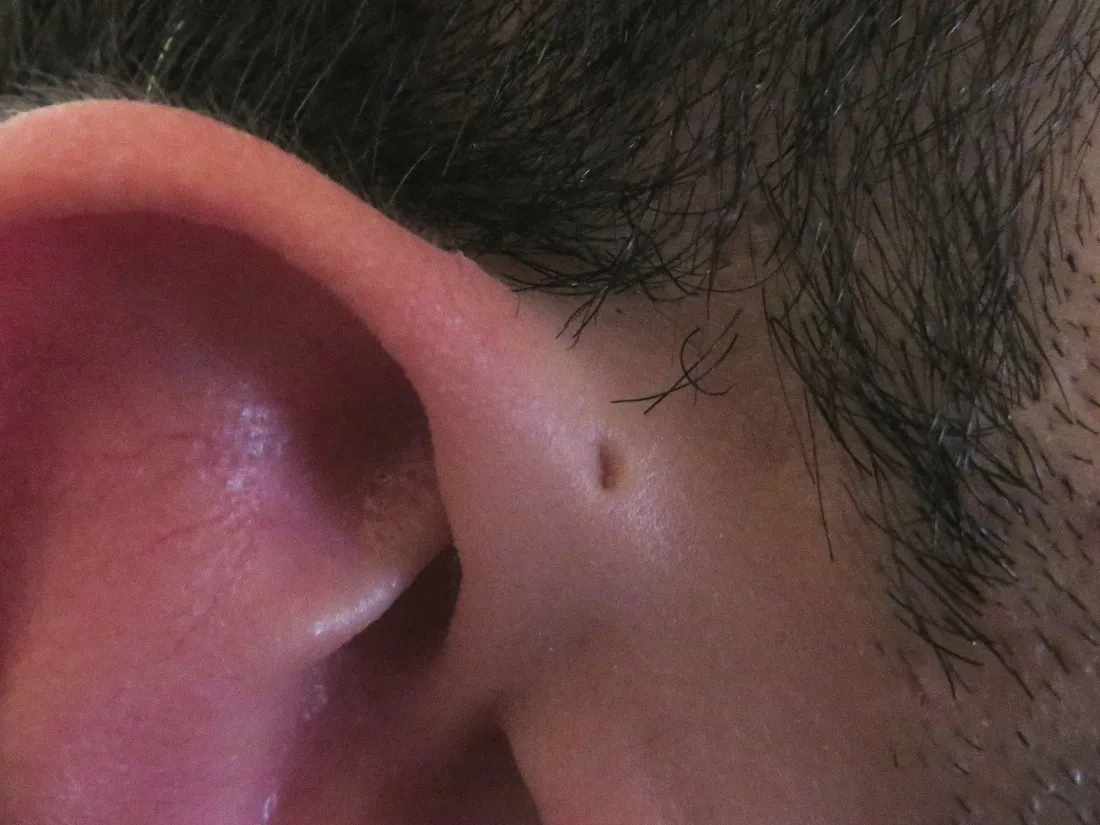
A common finding resulting from failure of fusion of the helix to the face. See also neck lumps (branchial cleft abnormality is the closely related lateral-neck counterpart).
Management
- Can be left alone if asymptomatic.
- May become infected easily — treat with antibiotics as needed.
- Refer for surgical excision if recurrently infected or a cosmetic concern.
Branchio-oto-renal syndrome (BORS)
Rarely associated with branchio-oto-renal syndrome (Melnick-Fraser syndrome) — an autosomal dominant disorder, incidence ~1 in 40,000, caused mainly by EYA1 mutations (variable penetrance, so presentation varies even within the same family). Bilateral pits, or a pit plus a branchial anomaly (cyst/sinus/fistula), should prompt consideration of BORS.
Diagnostic criteria — major: branchial anomalies, hearing impairment, preauricular pits, renal anomalies. Minor: external/middle/inner ear anomalies, preauricular tags, facial asymmetry, palate abnormalities. Diagnosis: 3 major, or 2 major + 2 minor criteria (no family history); 1 major criterion if a first-degree relative is affected.
- Hearing impairment — conductive, sensorineural or mixed; may be present at birth or develop later; can range mild to profound.
- Renal involvement — agenesis, hypoplasia, dysplasia; UPJ obstruction, hydronephrosis, vesicoureteric reflux. ~6% progress to end-stage renal failure. (The variant without kidney involvement is called brachio-otic syndrome, BOS.)
Workup if BORS is suspected: urinalysis, renal function (creatinine, electrolytes, eGFR), renal tract ultrasound, neck ultrasound (excludes a branchial cyst), and a hearing assessment. Targeted gene testing (EYA1, SIX1, SIX5) confirms the diagnosis, particularly useful when criteria aren’t fully met — though it doesn’t predict severity or change management, and is most useful for confirming diagnosis or prenatal screening in affected families.
Management is multidisciplinary — genetics referral/counselling; renal function monitoring (6-monthly bloods, annual ultrasound) with paediatric nephrology if renal involvement found; annual hearing assessment if the initial test is normal (more frequent otologic review if impairment is found — refer early, ideally before school age, to minimise speech/ language/learning/social impact); avoid ototoxic and nephrotoxic drugs given the risk of otologic/renal involvement.