Oral Candidiasis
Written 27th March 2020 - Last Update 15th August 2026
Oral Candidiasis
See Candidiasis for candida intertrigo, napkin rash, and breast/nipple candidiasis — this page covers oral disease in full detail.
Condition
Candida is an opportunistic commensal organism in the oral cavity — uncommon in healthy individuals but occurs commonly in neonates. Management of candidiasis in immunocompromised patients requires specialist advice; patients with undiagnosed HIV may present initially with oral candidiasis.
Risk factors:
- Local — dentures; salivary gland hypofunction; corticosteroid inhalers; poor oral hygiene; smoking.
- Systemic — immune compromise (e.g. poorly controlled diabetes); drugs (systemic corticosteroids, antibiotics).
Presentations
Pseudomembranous candidiasis: creamy white curd, papules, and plaques that are sometimes removable, with a red, raw, often bleeding base; generally asymptomatic; may affect the oropharynx; autoinoculation of the palate may occur if the dorsal tongue is affected.
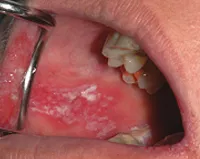
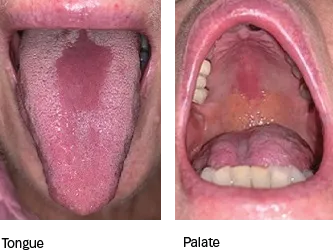
Erythematous candidiasis: sensitive red lesions commonly affecting the palate and tongue; the tongue may appear depapillated and smooth. Predisposing factor: broad-spectrum antibiotic therapy.
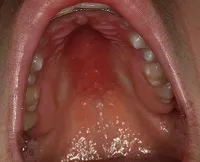
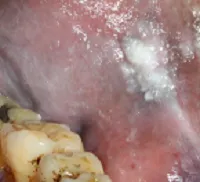
Hyperplastic candidiasis: asymptomatic, non-removable white plaques that may appear nodular; usually affects the retro-commissures, anterior buccal mucosa, and lateral tongue; may be bilateral; may resemble oral leukoplakia or oral cancer. May be associated with epithelial dysplasia — refer to a specialist for biopsy and management.
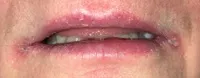
Angular cheilitis (angular stomatitis): painful erythema and fissuring of the corners of the mouth, usually caused by a mixed infection of Candida, Staphylococcus aureus, and Streptococcus species; often associated with intraoral candidiasis. Additional predisposing factors: deep skin folds around the mouth (worn-down teeth, ill-fitting or absent dentures); iron, folate, or B12 deficiency; Crohn’s disease; granulomatous disease; atopic and seborrhoeic dermatitis.
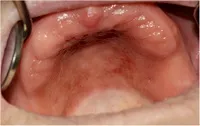
Denture-associated erythematous stomatitis (denture stomatitis): sensitive erythematous lesions confined to denture-bearing areas (particularly the palate); may appear punctate, or smooth and red; nodular hyperplasia may be observed. Predisposing factors: ill-fitting dentures; suboptimal oral and denture hygiene; dietary factors.
Median rhomboid glossitis: a rhomboid area of depapillation and erythema in the midline of the dorsal tongue; may be fissured or nodular; autoinoculation of the palate may occur; usually asymptomatic although it may sting or burn.
Management principles
Address predisposing factors first — antifungal therapy is not always needed if the underlying cause can be corrected. If required, successful therapy relies on adequate contact time between the antifungal and the affected mucosa, so advise the patient not to eat or drink directly after administration. Patients with intractable candidiasis should be investigated for systemic disease.
Oral candidiasis in neonates and children younger than 2 years — topical antifungal (apply to the front of the mouth in infants to avoid choking):
- Nystatin liquid 100,000 units/mL, 1mL topically (then swallowed), 4 times daily after feeding, for 7–14 days; continue for 2–3 days after symptoms resolve. Or
- Miconazole 2% gel, 1.25mL topically (then swallowed), 4 times daily after feeding, for 7–14 days; continue for at least 7 days after symptoms resolve.
Oral candidiasis in adults and children ≥2 years:
- Miconazole 2% gel, 2.5mL topically (then swallowed), 4 times daily after food and drink, for 7–14 days, as guided by symptom resolution. Or
- Amphotericin B 10mg lozenge, sucked then swallowed, 4 times daily after food, for 7–14 days; continue for 2–3 days after symptoms resolve. Or
- Nystatin liquid 100,000 units/mL, 1mL topically (then swallowed), 4 times daily after food, for 7–14 days; continue for 2–3 days after symptoms resolve.
Denture wearers: use miconazole or nystatin, applied to the fitting surface of the dentures at least twice daily. Remove dentures at night, clean, and store dry.
Angular cheilitis: treat with a topical antifungal cream — clotrimazole 1% cream to the angles of the mouth twice daily for at least 14 days (continue 14 days after symptoms resolve), or miconazole 2% cream, same regimen. A mild topical corticosteroid (hydrocortisone 1% cream to the angles of the mouth, twice daily until inflammation subsides) can be added for the associated inflammatory dermatitis. Combination corticosteroid/antifungal products are available, but should only be used until inflammation subsides — complete treatment with a topical antifungal alone for 14 days after symptoms resolve. If oral candidiasis is present, treat it too (see above). Seek specialist advice for persistent angular cheilitis — it may reflect a mixed infection needing broader treatment, or be a symptom of a systemic condition such as Crohn’s disease or granulomatous disease.
Denture stomatitis: advise the patient to optimise denture hygiene — remove dentures at night, clean them, and store them dry overnight; dental review to assess denture fit. If symptoms don’t resolve after 1 month of optimal oral and denture hygiene, use topical antifungal therapy applied inside the mouth and to the dentures.