Naevi & Moles
Written 9th April 2019 - Last Update 14th March 2020
Naevi & Moles
Naevi are small, circumscribed macules, papules or nodules, usually <1 cm; lesions >1 cm should raise suspicion for an atypical naevus, congenital naevus, or melanoma.
Non-melanocytic pigmented lesions
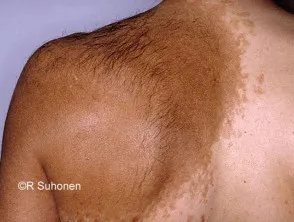
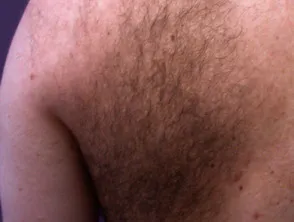
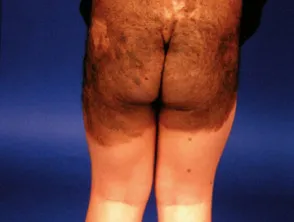
- Becker naevus — faint, brown, diffuse pigmented area with coarse hairs; occurs mainly in boys around puberty.
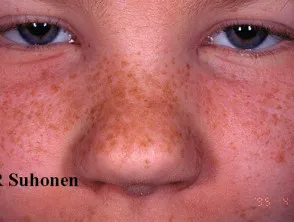
- Freckles (ephelides) — small brown flat macules (usually <0.5 cm); darken in summer, fade in winter.
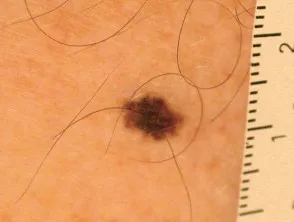
- Lentigines — small, round, brown-to-black macules (1 mm–1 cm+); common, may appear in childhood in non-sun-exposed areas, or on sun-damaged skin in the elderly.
Melanocytic naevi
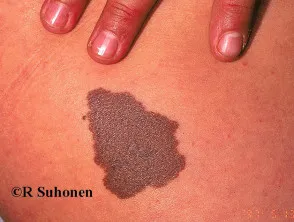
- Congenital melanocytic naevi — present at birth, sometimes large, with an increased risk of malignant change (especially larger lesions).
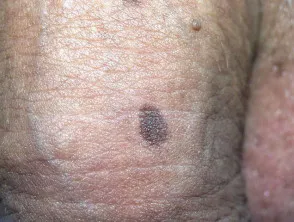
- Junctional naevus — melanocytes clumped at the dermo-epidermal junction; flat (macular); usually brown-black; typically in children.
- Compound naevus — melanocyte nests at the dermo-epidermal junction and within the dermis; centrally raised with surrounding flat pigmentation; usually lighter than a junctional naevus, can be hairy.
- Intradermal naevus — melanocytes confined to the dermis; papular; often skin-coloured.
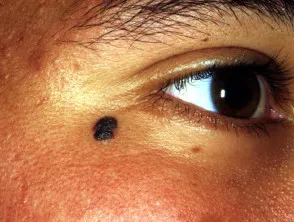
- Blue naevus — acquired, benign, blue-to-black; usually appears in childhood, more common in people of Asian descent. Melanoma can masquerade as a blue naevus — biopsy if >1 cm, late-appearing, asymmetric, or changing.
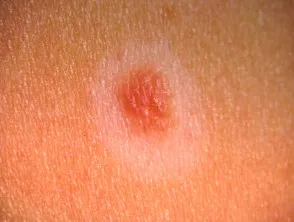
- Halo naevus — a depigmented halo around a central melanocytic naevus from a cytotoxic lymphocyte reaction; usually benign, but melanoma can masquerade as a halo naevus (and a melanoma elsewhere can itself trigger a halo reaction around an unrelated naevus) — a halo naevus warrants a total body skin check, and any atypical feature of the lesion itself warrants biopsy.
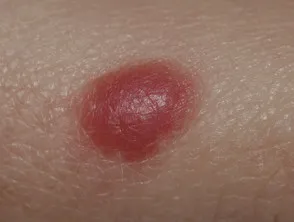
- Spitz naevus — solitary pink or tan papule/nodule, most often in children, growing quickly to about 1 cm then stabilising; rare after age 40 (excise if new in an adult >40 to exclude melanoma, given rapid growth and to allow reassurance). Can be difficult to distinguish clinically from melanoma but has a characteristic histology.
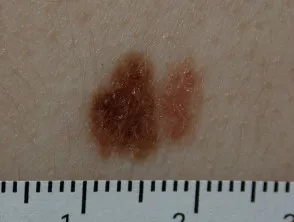
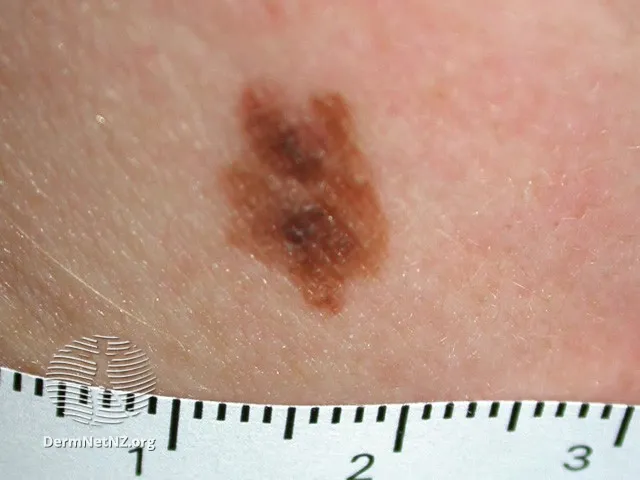
- Atypical (dysplastic) naevus — large, irregular “ugly duckling”-type moles, predominantly on the trunk in young adults; can be familial or sporadic. Occur in ~5% of Caucasians; population melanoma risk is ~1.9%, rising to ~5% with one atypical naevus, ~18% with atypical naevus syndrome, and up to 100% with atypical naevus syndrome plus two first-degree relatives with melanoma. Colour is pink-to-black and variegated, size is often >6 mm (the usual upper limit for a typical naevus), borders are irregular, and histology shows mild-to-severe architectural atypia. Most are stable and do not progress to melanoma, but they are markers of increased risk and warrant surveillance.
For the melanoma diagnostic approach (ABCDEF rule, biopsy strategy, management by Breslow thickness), see Melanoma.