Eczema Herpeticum
Written 2nd March 2020 - Last Update 14th August 2026
Eczema Herpeticum
See Dermatitis / Eczema for its role as a red flag in atopic dermatitis.
Condition
Most cases due to HSV-1 or HSV-2. Generally arises as a primary herpes infection in infants and children with atopic dermatitis (or another skin condition), 5–12 days after contact with an infected individual.
Clinical features
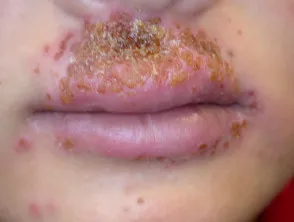
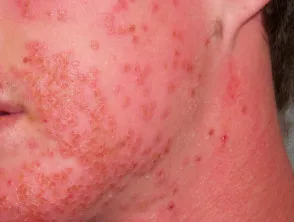
Classic triad: fever + clusters of itchy blisters + atopic dermatitis/eczema. Starts with clusters of itchy, painful blisters in normal skin or sites actively/previously affected by eczema. Examination: fever, swollen local lymph nodes, monomorphic blisters that may be filled with clear/yellow fluid or thick purulent material, often blood-stained (red/purple/black).
Investigations
Viral PCR of a swab from the base of a fresh blister; swab for MCS as secondary bacterial infection is common.
Management
One of the few dermatological emergencies — prompt antiviral treatment should avoid the need for hospital admission:
- Valaciclovir 1 g orally twice daily for 10–14 days or until lesions heal, or
- Aciclovir 400 mg (child 10 mg/kg) orally 5 times daily for 10–14 days or until lesions heal.
- IV antivirals may be needed if very unwell or unable to swallow oral medication.
Monitor for secondary staphylococcal/streptococcal infection and treat with antibiotics. Lesions heal over 2–6 weeks. Severe disease can affect multiple organs (eyes, brain, lung, liver) — consult ophthalmology if eyelid or eye involvement is seen or suspected.