Drug Reactions & Severe Cutaneous Adverse Reactions (SJS/TEN)
Written 15th March 2020 - Last Update 13th August 2026
Drug Reactions & Severe Cutaneous Adverse Reactions (SJS/TEN)
See Erythema Multiforme for a predominantly infection-triggered mimic that does not progress to SJS/TEN.
Acute drug eruptions
Around 2% of prescriptions for a new medication lead to a drug eruption. Mechanisms include true allergy (IgE-mediated immediate reactions, IgG-mediated delayed reactions), drug metabolism issues, and underlying viral infection. Predisposing factors: strong family/personal history of drug eruption, immunodeficiency (HIV, cystic fibrosis, autoimmune disease), polypharmacy.
Reactions range from mild, unnoticed rash to severe cutaneous adverse reactions (SCARs). The most common are morbilliform eruptions and urticaria/angioedema (rarely progressing to anaphylaxis). SCARs are rare but serious, and comprise several distinct entities beyond SJS/TEN: DRESS (drug reaction/rash with eosinophilia and systemic symptoms — the current term for what this note calls “drug hypersensitivity syndrome”) and AGEP (acute generalised exanthematous pustulosis — widespread sterile pustules, usually resolving faster than DRESS/SJS-TEN and often responding to topical steroids plus stopping the drug alone, without needing systemic therapy).
Morbilliform (measles-like) drug eruption:
- Most commonly caused by antibiotics, though many drugs can trigger it; in children a viral cause is more likely than drug-related.
- Mediated by cytotoxic T-cells (type IV hypersensitivity).
- Appears 1–2 weeks after first exposure, or 1–3 days after re-exposure.
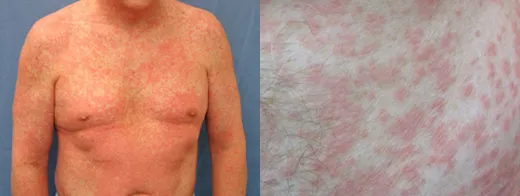
- Starts on the trunk and spreads to limbs/neck, bilateral and symmetrical; axillae, groin, hands and feet are usually spared.
- Pink-red flat macules/papules, sometimes annular or targetoid, mostly blanching (can be purpuric on the lower legs); mucosa, hair and nails are unaffected in uncomplicated cases.
- Can evolve into SJS/TEN or drug hypersensitivity syndrome — monitor for this.
Investigation: no routine test identifies the culprit drug — a careful history and a 2-week to 1-month drug calendar helps identify a recently introduced medication or OTC product.
Management: identify and stop the causative drug (if essential and non-replaceable, seek specialist advice on whether it’s safe to continue before stopping). Emollients and a potent topical steroid (betamethasone valerate 0.05%, mometasone furoate, or methylprednisolone aceponate 0.1%) once or twice daily for 2 weeks; for widespread rash use a larger-tube lower-potency preparation (betamethasone valerate 0.02% up to three times daily). For a severe rash, prednisolone 25 mg daily for 5–7 days then taper over 2 weeks. Wet dressings for very inflamed skin. Antihistamines are recommended alongside corticosteroids to relieve symptoms — add a less-sedating antihistamine specifically if there’s an urticarial component or dermographism. Prevention: minimise unnecessary antibiotic prescribing, educate the patient about re-exposure risk, flag the reaction in the medical record.
Stevens-Johnson syndrome / toxic epidermal necrolysis (SJS/TEN)
Rare, acute, potentially fatal reactions causing sheet-like skin and mucosal loss, almost always drug-induced (no drug implicated in ~20% of cases). Estimated incidence 1–2 per million/year; affects all ages/races, more common in females, ~100x more common with HIV. Most common causative drugs: antibiotics (~40%, especially sulfonamides and beta-lactams), anticonvulsants, allopurinol, paracetamol, nevirapine, NSAIDs. Mechanism is CD8 cytotoxic/NK-cell mediated and remains incompletely understood.
HLA-B*58:01 screening before starting allopurinol is recommended for patients of Han Chinese, Thai, Korean, or Indian descent, given a markedly elevated SCAR risk in these populations — check before initiating allopurinol in at-risk patients (cross-reference Gout).
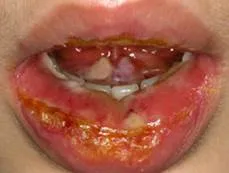
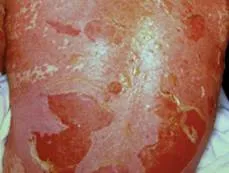
Onset: within the first week for antibiotics, up to 2 months for anticonvulsants (most drugs: days to 1 month). A several-day flu-like prodrome (fever >39°C, sore throat, cough, conjunctivitis, myalgia) precedes an abrupt, painful, red rash starting on the trunk and spreading rapidly over hours to days to the face and limbs (maximal extent by ~4 days). Lesions: flat red/purpuric macules, diffuse erythema, targetoid lesions, and flaccid blisters that merge into sheets of skin detachment exposing raw, oozing dermis. Mucosal involvement is prominent and severe — eyes (conjunctivitis, occasionally corneal ulceration/uveitis), lips/mouth (cheilitis, painful ulcers), pharynx/oesophagus (dysphagia), genitourinary tract (erosions, urinary retention), respiratory tract, and GI tract (diarrhoea); liver, kidneys, lungs, bone marrow and joints may also be affected. Mortality is ~10% in SJS and ~30% in TEN.
Diagnosis by body surface area (BSA) detachment:
- SJS — <10% BSA with widespread erythematous/purpuric macules or flat atypical targets.
- SJS/TEN overlap — 10–30% BSA.
- TEN — >30% BSA.
- TEN without spots — >10% BSA but large epidermal sheets without purpuric macules.
A skin biopsy is needed to confirm the diagnosis and exclude staphylococcal scalded skin syndrome; serum granulysin measured early may be predictive. The SCORTEN score estimates illness severity.
Management: requires hospital admission (acute phase 8–12 days, followed by weeks of skin healing, managed like burns); increased mortality persists in survivors of the acute phase, especially if elderly or unwell. Ongoing needs: monitoring for organ damage, physiotherapy (to prevent joint contractures and pneumonia), psychiatric support (PTSD is common), and prompt treatment of secondary staphylococcal/gram-negative infection (prophylactic antibiotics are not recommended). Educate the patient to avoid re-exposure to the causative drug and to other high-risk drug classes — anticonvulsants, NSAIDs, sulfonamides, and beta-lactam penicillins/ cephalosporins/carbapenems are the four most strongly implicated groups. Multidisciplinary care (dermatology + ophthalmology at minimum) is essential. Evidence from controlled trials for specific systemic therapy (corticosteroids, IVIG) in SJS/TEN is limited, but most patients still receive systemic corticosteroids (and often IVIG) given disease severity.
DRESS follows a more protracted course than SJS/TEN and needs long-term follow-up; evidence for corticosteroids reducing DRESS mortality is limited, but they’re still used in most patients, typically with a more prolonged taper than for other drug reactions because of a high recurrence risk on withdrawal. Cross-reactivity between antiepileptics is common — a patient with DRESS from one antiepileptic should generally avoid the whole class, not just the causative drug.