Rash/itch in pregnancy
Written 30th April 2020 - Last Update 31st August 2026
Rash/itch in pregnancy
Three main factors contribute to the skin changes commonly observed during pregnancy: increased hormone levels, intravascular volume expansion, and compression of the skin by the growing uterus. Most rashes in pregnancy are benign, but two must not be missed — intrahepatic cholestasis, because of stillbirth risk, and pemphigoid gestationis, because of placental insufficiency.
The first question is whether there is a primary skin lesion. Itch with no rash, particularly on palms and soles and worse at night, is intrahepatic cholestasis until proven otherwise.
In skin of colour, erythema may be less apparent while post-inflammatory hyperpigmentation is more prominent, and inflammatory conditions can look violaceous rather than red.
Intrahepatic cholestasis of pregnancy
The most common liver disorder specific to pregnancy, and the one with real fetal risk.
Features: intrahepatic cholestasis typically presents in the late second or third trimester with generalised pruritus, often beginning on the palms and soles, and frequently worse at night. There are no primary skin lesions, though excoriations, erosions and scabbing follow the scratching. Jaundice, pale stools and steatorrhoea occur but are not always present.
Investigations: check serum bile acids and liver function tests. Severity bands by bile acid concentration are mild 10–39 µmol/L, moderate 40–99 µmol/L, and severe 100 µmol/L or above.
Locally, the upper limit of normal for random bile acids in pregnancy is 18 µmol/L. Bile acid results can take up to two weeks — do not let that delay clinical management. If the LFTs and bile acids are normal but the itch persists, repeat both every 10–14 days while she remains symptomatic. Transaminases, GGT and bilirubin all have an upper limit of normal in pregnancy about 20% lower than the non-pregnant range, so a high-normal LFT in a symptomatic woman may still be significant.
Management: make an urgent maternity referral — itch without a rash is treated locally as intrahepatic cholestasis until proven otherwise. Obstetric management centres on timing of birth, because the goal is to prevent stillbirth; planned birth is usually recommended around 39 weeks. Advise immediate birth suite review for any concern about fetal movements. The itch settles in the first week or two after birth. Ursodeoxycholic acid at a dose of 10–15 mg/kg/day divided into two or three doses is the primary pharmacologic therapy. Note the caveat: the Society for Maternal-Fetal Medicine states that UDCA therapy does not improve fetal outcomes with intrahepatic cholestasis of pregnancy, although it significantly reduces maternal pruritus. Second-line options include rifampicin, cholestyramine and S-adenosyl-L-methionine.
Risks and follow-up: preterm delivery occurs in about a third of affected pregnancies. Stillbirth risk rises sharply with bile acids of 100 µmol/L or above, which is why delivery is brought forward in that group. The recurrence rate in subsequent pregnancies is approximately 60%, and women with a history of intrahepatic cholestasis are at higher risk of later gallbladder and hepatobiliary disease. HNE HealthPathways quotes a wider recurrence range of 45–90%.
Symptomatic relief while awaiting review
General skin care first: loose clothing, emollients and soap substitutes. Then an oral antihistamine, chosen locally from:
- Sedating — cyproheptadine 4 mg three times daily, or dexchlorpheniramine 2 mg four times daily.
- Non-sedating — cetirizine 10 mg daily, or loratadine 10 mg daily.
Physiological skin changes of pregnancy
Common, benign, and worth naming so they are not investigated: darkening of the areola, nipple and genital skin; linea nigra; palmar erythema; skin tags; striae gravidarum; telangiectasia; telogen effluvium after the birth; and vascular lesions such as pyogenic granulomas and haemangiomas.
Pre-existing naevi may darken or enlarge, particularly on the abdomen and breast. Biopsy as you normally would if a lesion is non-homogeneous or otherwise concerning — lidocaine with or without adrenaline is category A.
Atopic eruption of pregnancy
This is the commonest of the specific dermatoses, and the one that appears earliest in pregnancy. Atopic eruption of pregnancy is the most common dermatosis of pregnancy, accounting for approximately 50% of cases, and in about 75% of patients it begins before the third trimester.
Two clinical patterns:
- E-type — eczematous lesions involving the face, neck, upper chest and flexural areas.
- P-type — grouped, erythematous papules on the extensor surfaces of the extremities and the trunk. This is the pattern historically called prurigo of pregnancy.
Many patients have a personal or family history of atopy, asthma or seasonal allergies. Diagnosis is clinical, by ruling out other causes; reliable diagnostic criteria do not exist.
Management: emollients and skin hydration first, with urea or 1–2% menthol for itch, then a topical corticosteroid and an oral antihistamine. The local (eTG-derived) steroid choice is hydrocortisone 1% cream or ointment once daily for the face, flexures or mild dermatitis elsewhere, and betamethasone dipropionate 0.05% cream or ointment once to twice daily for more severe dermatitis away from the face and flexures, each until the skin clears. Oral corticosteroids may be needed when initial treatment is not successful. Fluticasone propionate should not be used in pregnancy because the placenta does not metabolise it. Methotrexate, mycophenolate and the Janus kinase inhibitors are contraindicated. Check LFTs to exclude cholestasis before settling on this diagnosis.
Prurigo of pregnancy
Now regarded as part of atopic eruption of pregnancy rather than a separate entity, but still a useful clinical label. Occurs in up to 1 in 300 pregnancies, generally in the second or third trimester.
Features: grouped papules, predominantly on the extensor limb surfaces and sometimes the trunk; papules 0.5–1 cm; pustules may occur but not blisters; often excoriated from itching.
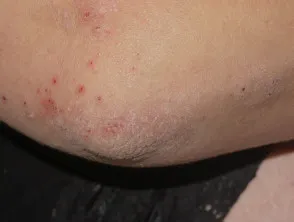
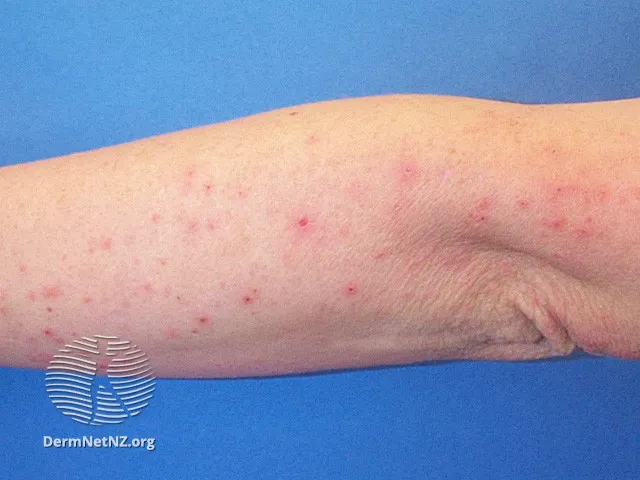
Investigations: clinical diagnosis. If uncertain, biopsy shows non-specific dermatitis with negative direct immunofluorescence. Check LFTs to exclude cholestasis.
Management: symptom relief with menthol emollient, a moderate-potency topical steroid, oral antihistamines, or phototherapy. Resolves after delivery, though this can take some time.
Polymorphic eruption of pregnancy (PUPPP)
Polymorphic eruption of pregnancy is the updated or preferred term for the dermatosis formerly called pruritic urticarial papules and plaques of pregnancy. It most commonly occurs in primiparous patients during the third trimester, and in multiple pregnancies, remitting within days of delivery.
Features: urticarial lesions initially involve the abdominal striae and characteristically spare the periumbilical region, then spread to the breasts, back, arms and thighs. Lesions may be surrounded by pale halos, giving a target-like appearance. Bullae are not present.
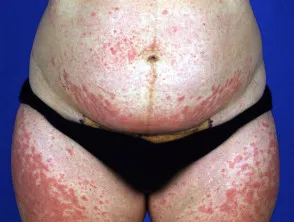
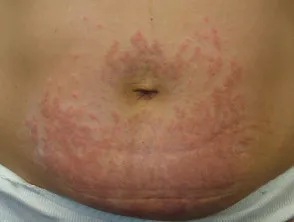
Investigations: usually diagnosed on clinical presentation and history, and skin biopsy is rarely required. If done, direct immunofluorescence is negative, unlike pemphigoid gestationis. Distinguishing the two matters because polymorphic eruption of pregnancy is not associated with pregnancy complications whereas pemphigoid gestationis may be.
Management: cooling baths for symptomatic relief; a topical corticosteroid (locally, betamethasone dipropionate 0.05% cream or ointment twice daily to the itchy papules); an antihistamine such as dexchlorpheniramine 2 mg up to four times daily, category A. The lesions frequently resolve on their own in 4 to 6 weeks. A short course of systemic corticosteroid may be used if topical treatment is not satisfactory.
Pemphigoid gestationis
A rare pregnancy-associated autoimmune blistering disease. The incidence of pemphigoid gestationis is 1 in 50,000 to 1 in 60,000 pregnancies, and it involves the formation of autoantibodies against bullous pemphigoid antigens BP180 and BP230.
The most significant risk factor is a history of pemphigoid gestationis in a prior pregnancy.
Features: starts as itchy red bumps around the umbilicus, spreading over days to weeks — face, scalp, palms, soles and mucous membranes are usually spared. Large tense fluid-filled blisters form after 2–4 weeks, though some women have plaques instead of blisters. Fever, malaise, leukocytosis and eosinophilia can accompany it.
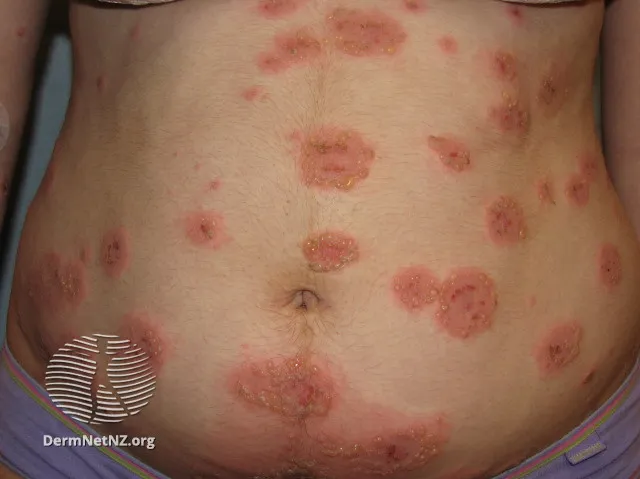
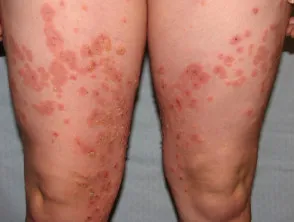
Investigations: pemphigoid gestationis is diagnosed by skin biopsy for histopathologic examination and direct immunofluorescence, which demonstrates linear C3 deposition along the perilesional or basal membrane lamina lucida. Biopsy should not delay referral if it is clinically suspected.
Management: refer urgently to maternity services. First-line medical therapy consists of topical corticosteroids, with systemic corticosteroids as first-line therapy for moderate to severe disease. Usually regresses after delivery.
Outcomes: pemphigoid gestationis may be associated with fetal growth restriction and preterm delivery. Neonatal pemphigoid gestationis occurs in 10% to 13% of neonates as a result of the transplacental passage of maternal IgG autoantibodies, and the mild blistering resolves spontaneously within several weeks of birth. It frequently recurs in subsequent pregnancies, affecting approximately 50% to 70% of patients, often earlier and more severely.
Pustular psoriasis of pregnancy
Previously called impetigo herpetiformis — unrelated to impetigo or herpes simplex. A rare dermatosis that most commonly occurs during the third trimester of pregnancy, more frequently in primigravidas.
Features: characterised by circumferential rings of erythematous plaques covered with sterile pustules along the periphery that occur in flexural areas. The lesions do not typically itch, and the plaques may spread to the trunk and extremities while the hands, feet and face are generally spared. Plaques may become centrally crusted and eroded.
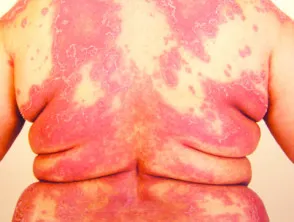
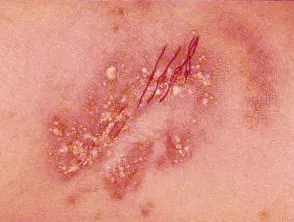
Systemic features matter: although rare, this disorder may be associated with systemic symptoms, including nausea, vomiting, diarrhoea, fever, anorexia, lymphadenopathy, malaise, and in severe cases seizures. It may also be associated with underlying hypocalcaemia, vitamin D deficiency or hyperparathyroidism, so check calcium.
Triggers to ask about: lithium, aspirin or beta blockers; infection; and sudden withdrawal of corticosteroids. Many patients have a personal or family history of psoriasis.
Investigations: biopsy should not delay referral. Swab for MCS if secondary bacterial infection is possible, and check FBC, CRP, EUC, calcium, magnesium, phosphate and LFTs — low albumin, low calcium and renal or liver impairment all occur.
Management: can be life-threatening — early dermatology discussion is essential, and hospitalisation is generally required. Systemic corticosteroid is the usual first treatment, with ciclosporin or TNF inhibitors reserved for very severe cases. Delivery is considered curative and may be appropriate in refractory disease.
Striae gravidarum (stretch marks)
Common and benign, from continuous skin stretching in pregnancy.
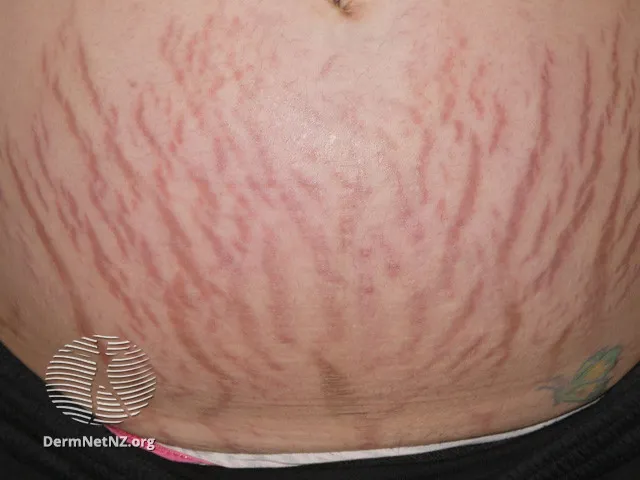
Management: cosmetic only. Moisturisers, topical retinoid therapy (postpartum only) and pulsed dye laser may be tried, though none is proven effective.
Referral
Make an urgent maternity referral for suspected pemphigoid gestationis, generalised pustular psoriasis, or itch without a rash (likely intrahepatic cholestasis). Refer to a dermatologist, antenatal clinic or private obstetrician for polymorphic eruption, atopic eruption or prurigo of pregnancy that is severe or unresponsive. If a serious condition is suspected, the specialist arranges the biopsy — do not delay the referral to do one yourself.
Source (local): Skin Conditions (Rash and Itch) in Pregnancy, Community HealthPathways Hunter New England, last updated 16 June 2026 (registry: hne-healthpathways-skin-conditions-rash-itch-pregnancy; verified 2026-08-31). Local bile-acid threshold and repeat interval, antihistamine and topical corticosteroid choices, and referral routes come from this pathway.