Endometrial Cancer
Written 20th April 2020 - Last Update 15th August 2026
Endometrial Cancer
Risk factors, staging & prevention
-
Abnormal uterine bleeding is the cardinal symptom of endometrial cancer
-
Endometrial carcinoma is a histologic diagnosis, based upon characteristic findings on an endometrial biopsy, curettage, or hysterectomy specimen
Risk factors
Chronically increased estrogen levels or estrogenic activity
-
Exogenous sources
-
Unopposed estrogen therapy
-
Tamoxifen
- In endometrial tissue, it acts as an estrogen agonist in postmenopausal women (who have low estrogen levels), whereas it acts as an estrogen antagonist in premenopausal women (who have high estrogen levels)
-
-
Endogenous sources
-
Chronic anovulation
-
The menopausal transition and polycystic ovary syndrome (PCOS)
-
Nulliparity and infertility have been associated with EC but do not appear to be independent risk factors
-
-
Obesity
-
Estrogen-secreting tumors
- Granulosa cell tumors
-
Early menarche and late menopause
-
Hereditary factors
-
Lynch syndrome (hereditary nonpolyposis colorectal cancer)
-
Cowden syndrome (rare)
-
First-degree relative with EC
-
BRCA carriers
Protective factors
-
Use of hormonal contraception
-
Increasing gravidity and parity
-
Older age at last birth - The reason older age is protective is not known
-
Breastfeeding
-
Smoking
- Cigarette smoking is associated with a decreased risk of developing EC in postmenopausal, but not premenopausal, women
-
Physical activity and diet
Staging and treatment
- Refer gynae
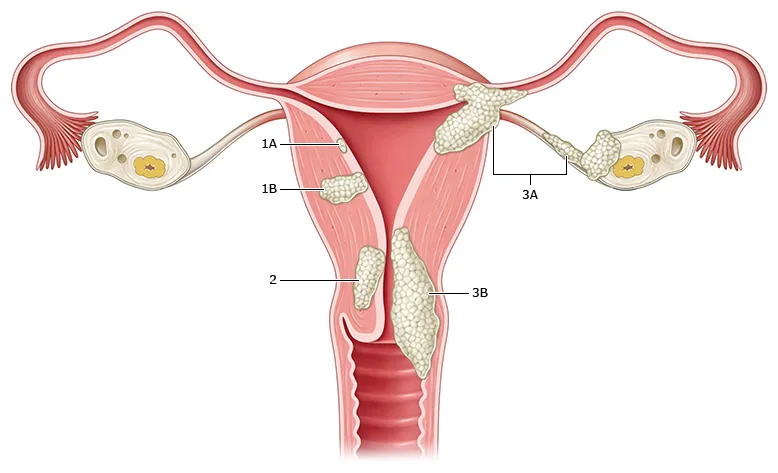
This diagram shows the anatomic extent of the previous (pre-2023) FIGO stages — still a useful visual guide to how far a tumour has spread, though current staging (below) also factors in histological subtype and lymphovascular invasion, not anatomic extent alone.
FIGO 2023 staging (revised from the previous anatomic-only system):
-
Stage I — confined to the uterine corpus and ovary.
-
IA — disease limited to the endometrium, or a nonaggressive histological type with less than 50% myometrial invasion and no or focal lymphovascular invasion.
-
IB — nonaggressive histological type with 50% or more myometrial invasion and no or focal lymphovascular invasion.
-
IC — aggressive histological type confined to a polyp or the endometrium.
-
-
Stage II — invasion of the cervical stroma without extrauterine extension, or substantial lymphovascular invasion, or an aggressive histological type with any myometrial invasion.
-
Stage III — local or regional spread of the tumor of any histological subtype (serosa/adnexa, vagina/parametria/pelvic peritoneum, or pelvic/para-aortic lymph nodes).
-
Stage IV — spread to the bladder or intestinal mucosa, or distant metastasis.
-
The staging procedure includes total hysterectomy, bilateral salpingo-oophorectomy (BSO), and lymphadenectomy
-
Clinical staging may be an appropriate option for women who cannot tolerate surgery or who desire fertility preservation.
- Evaluation in these patients includes medical history, physical examination for uterine size and mobility and evidence of metastatic disease, endometrial sampling, and pelvic and abdominal imaging.
-
Radiation therapy
-
Chemotherapy
-
Palliative care
Prevention
-
Lynch syndrome
-
oral contraceptive pills
-
progestin-only contraceptives (including intrauterine systems) are also likely to be effective
-
When childbearing is complete, risk-reducing total hysterectomy is recommended
-
-
Tamoxifen
- Discussed the use of IUD with oncologist
-
PCOS
- Combined estrogen-progestin oral contraceptives are the first-line therapy for endometrial protection as they also treat hyperandrogenism and menstrual dysfunction and provide contraception
-
Obesity
-
Weight reduction through lifestyle modifications (diet and physical activity) or bariatric surgery can reduce obesity
-
Progestin-dominant contraceptives are also likely to be protective
-
Demographics and presentation
Any woman with post-menopausal bleeding has endometrial carcinoma until proved otherwise. Peak onset 50–70 years. Risk factors: obesity, nulliparity, late menopause, diabetes, PCOS, unopposed oestrogen, tamoxifen, family history of breast/ovarian/endometrial/colon cancer, chronic anovulatory bleeding.
History: intermenstrual or postmenopausal bleeding. Examination: uterus may feel bulky on bimanual exam (usually normal). Investigations: cervical cytology detects some cases; TVUS shows increased endometrial thickness (day 4–7 post-period if menstruating); diagnosis confirmed with endometrial biopsy. Management: refer to gynaecology.