Pre-Travel Vaccinations
Written 31st July 2026 - Last Update 17th September 2026
Pre-Travel Vaccinations
Travel vaccines fall into three categories, and there is no single “correct” list for any destination — the right choice is an individual risk–benefit assessment, not a checklist:
- Routine — recommended regardless of travel (e.g. influenza, tetanus, measles). See the National Immunisation Schedule.
- Recommended — advised on the basis of itinerary, activities and exposure risk (e.g. hepatitis A, typhoid, rabies, Japanese encephalitis).
- Required — mandated by International Health Regulations or for entry into specific countries (e.g. yellow fever, meningococcal ACWY).
See also The Travel Consultation for the broader pre-travel risk assessment this page sits within.
Risk–benefit assessment
Take a detailed vaccine history (Australian Immunisation Register, handheld records) to identify gaps and avoid unnecessary vaccines — serology can help where history is uncertain. Weigh:
- Disease risk — likelihood of exposure and potential severity. Common diseases (COVID-19, influenza) aren’t necessarily the highest-impact ones; low-incidence diseases like Japanese encephalitis or yellow fever can carry a much greater impact per case. Public health impact also matters — e.g. measles’ risk of onward spread on return.
- Vaccine attributes — adverse event profile, cost, duration of protection, level of protection. Hepatitis A, yellow fever, JE and rabies vaccines give long-term protection and can be framed as a long-term investment; influenza and typhoid need periodic re-vaccination. A multi-trip assessment (considering likely future travel, not just this trip) can change the calculus.
- Traveller factors — age, medical history, risk tolerance, itinerary, duration; VFR travellers face different risks to typical tourists (particularly tuberculosis and typhoid) and often underestimate them.
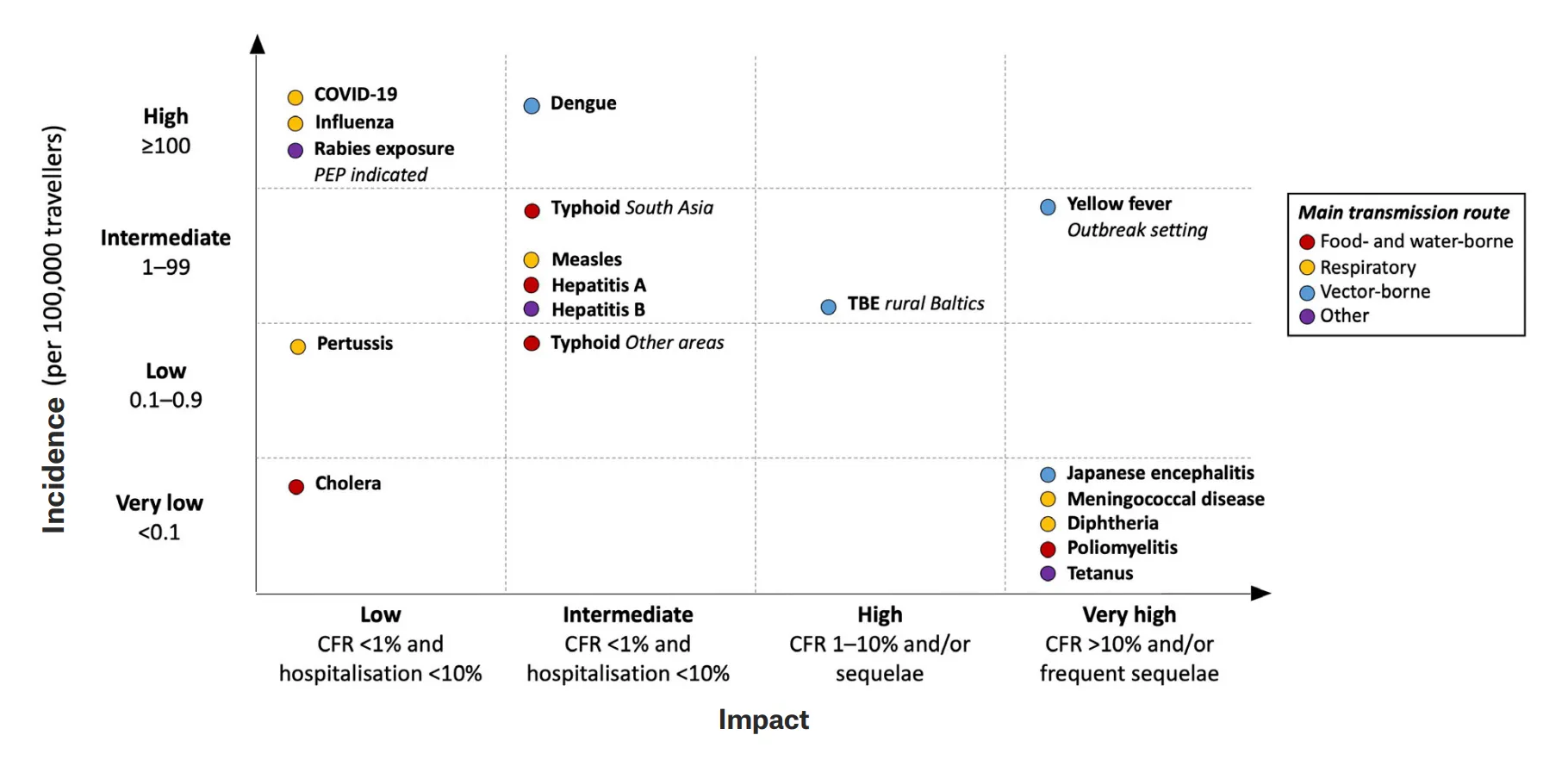
Figure adapted from Steffen R, Chen LH, Leggat PA. Travel vaccines — priorities determined by incidence and impact. J Travel Med 2023;30(7):taad085, via the 2025 AJGP article. Axes: incidence (per 100,000 travellers) vs impact (case-fatality rate and/or sequelae). A useful visual aid for pre-travel discussions — it’s why JE and yellow fever vaccination get pushed hard despite low absolute incidence, while pertussis/typhoid outside South Asia sit in the lower-priority corner.
Vaccines commonly available in Australia
Recreated from the AJGP’s Table 2 (itself drawn from the Australian Immunisation Handbook). Age limits are the minimum across all brands of that vaccine type — some brands have higher minimums.
| Transmission category | Disease | Vaccine type | Route | Lower age limit | Population recommendations |
|---|---|---|---|---|---|
| Food- and water-borne / faecal–oral | Cholera | Inactivated whole-cell recombinant | Oral | 2 years | Travellers at increased exposure risk (e.g. aid workers) or risk of severe disease (e.g. inflammatory bowel disease) visiting cholera-endemic or outbreak areas |
| Live-attenuated | Oral | 2 years | |||
| Hepatitis AB | Inactivated | IM | 1 year | Travellers to moderately to highly endemic areas for hepatitis A | |
| PoliomyelitisC | Inactivated | SC | 6 weeks | Travellers to areas where polio is circulating; booster every 10 years | |
| TyphoidB | Inactivated | IM | 2 years | Travellers to typhoid-endemic areas | |
| Live-attenuated | Oral | 6 years | |||
| Vector-borne | Japanese encephalitis | Live-attenuated | SC | 9 months | Travellers spending 1 month or more in endemic areas during transmission season; consider for shorter-term travellers |
| Inactivated | IM | 2 months | |||
| Yellow feverD | Live-attenuated | IM or SC | 9 months | Travellers to an area with yellow fever virus transmission risk | |
| Aerosol- or droplet-borne | COVID-19 | Inactivated | IM | 6 months | As per routine recommendations; may be given earlier than recommended interval if travel is imminent |
| DiphtheriaC | Inactivated toxoid | IM | 6 weeks | As per routine recommendations; booster for travellers to countries with limited health services if last dose >10 years ago, or >5 years ago for high-risk areas (e.g. Southeast Asia) | |
| Influenza | Inactivated | IM | 6 months | As per routine recommendations; can have a second dose if travelling to the Northern Hemisphere during influenza season (October–May) | |
| Meningococcal ACWY disease | Inactivated | IM | 6 weeks | Travellers to the "meningitis belt" of Sub-Saharan Africa or those attending mass gatherings (e.g. pilgrims to Hajj or Umra) | |
| Meningococcal B disease | Recombinant (inactivated) | IM | 6 weeks | As per routine recommendations | |
| MeaslesC | Live-attenuated | IM or SC | 6 months | Travellers born during or since 1966 should receive 2 doses of measles-containing vaccine unless documented evidence of prior vaccination or serological evidence of immunity | |
| MumpsC | Live-attenuated | IM or SC | 6 months | As per routine recommendations | |
| PertussisC | Acellular (inactivated) | IM | 6 weeks | As per routine recommendations; booster if last dose >10 years ago | |
| RSV | Recombinant (inactivated) | IM | 50 yearsE | As per routine recommendations | |
| RubellaD | Live-attenuated | IM or SC | 6 months | As per routine recommendations | |
| Varicella (chickenpox) | Live-attenuated | IM | 9 months | As per routine recommendations | |
| Zoster (shingles) | Recombinant (inactivated) | IM | 18 years | As per routine recommendations | |
| Blood-borne and sexually transmitted | Hepatitis B | Recombinant (inactivated) | IM | Birth | Travellers to intermediate/high-endemicity regions at increased risk of exposure or travelling long term or frequently |
| Human papillomavirus | Recombinant (inactivated) | IM | 9/10 years | As per routine recommendations | |
| Animal and environmental exposures | Rabies | Inactivated | IM or ID | Birth | Travellers to rabies-enzootic regions based on risk assessment considering likelihood of animal interaction and access to emergency medical attention |
| TetanusC | Inactivated toxoid | IM | 6 weeks | As per routine recommendations; booster if last dose >10 years ago; those at high risk of a tetanus-prone wound should have a booster if last dose >5 years ago |
Footnotes
- A — Age listed is the minimum for all brands of that vaccine type; some brands have higher minimums. Administering at the minimum age/interval may affect Australian Immunisation Register eligibility and childcare subsidy compliance — see the Handbook’s table of minimum acceptable ages for NIP-funded vaccines in infants.
- B — The combination hepatitis A–typhoid vaccine was removed from the Australian market in 2024; monovalent options remain available.
- C — Available in combination formulation (e.g. diphtheria-tetanus- pertussis-polio; measles-mumps-rubella).
- D — Only approved clinics can administer yellow fever vaccination — see health.gov.au’s yellow fever page.
- E — Also available on the NIP schedule for pregnant women between 28 and 36 weeks’ gestation.
Practical considerations
- Consult 4–6 weeks before travel for optimal protection, but even last-minute travellers benefit — a single hepatitis A dose is effective even given on the day of departure, and a yellow fever certificate becomes valid from 10 days after vaccination.
- Co-administration minimises visits and protection delays. Deltoid is the recommended IM site from 12 months of age; up to two injections can be given per site, 2.5 cm apart.
- Live injectable viral vaccines (MMR, yellow fever, Japanese encephalitis) should be given simultaneously or spaced ≥4 weeks apart. BCG can be given at the same time as, or any time after, other vaccines including MMR.
- Refer to a specialist travel medicine clinic where risk assessment or vaccine decisions are complicated — immunosuppression, pregnancy, extremes of age (especially for live vaccines like yellow fever), or complex multi-country itineraries needing vaccines less familiar to general practice.
- With the exception of rabies, most travel vaccine schedules are straightforward — the harder part is the logistics: a dedicated vaccine fridge stocked with the full range of travel vaccines lets a practice offer a “one-stop-shop” so both doctor and patient can be confident the agreed vaccines are actually given and the cold chain preserved, and a practice wanting to administer yellow fever vaccine itself needs accreditation as an approved yellow fever vaccine provider.
Recent changes
-
Rabies — pre-exposure prophylaxis now has 4 schedule options, with no preferential recommendation between them (choose based on the individual’s circumstances and preferences):
Schedule Route Doses Notes 3-visit IM or ID Days 0, 7, 21–28 Standard course 2-visit IM Days 0, 7 Short-term protection only 2-visit ID Days 0, 7 (2 injections/visit) Short-term protection only; not for adults >50y (poor seroconversion) 2-visit schedules must not be used in immunocompromised people. If further protection is needed after a 2-visit course, give a single IM booster at 1 year (adequate regardless of the original route, even if given later than 1 year). The ID route is off-label, restricted to providers experienced in the technique, and shouldn’t be used with chloroquine/mefloquine/hydroxychloroquine at the time of vaccination or within 1 month after (reduces immune response). Every traveller to an endemic area needs an animal-bite plan regardless of pre-exposure status — rabies immunoglobulin can be difficult to source in-country.
-
Japanese encephalitis — a risk for travellers to Asia and, since 2022, documented locally in south-eastern Australia. Decision aids (monash.edu/vaccinedecisionaids-je) and risk calculators (vaxical.com) can help with the risk–benefit discussion.
-
Mpox — recommended for people at risk of sexual exposure (e.g. GBMSM, sex workers), and worth considering for other travellers who may have sexual risk activities in countries with clade I transmission. Available only via state/territory health departments, not general practice stock. See Mpox — Vaccination for eligibility, the 2-dose schedule, side effects and time to protection.
-
RSV — Abrysvo (Pfizer, ≥60y and pregnancy) and Arexvy (GSK, ≥50y with risk conditions) became available in 2024. Funded on the NIP for pregnant women since early 2025; otherwise recommended for ≥75y and 60–74y with additional risk factors, but privately funded.
-
Dengue and chikungunya vaccines — not registered in Australia but accessible via the TGA’s Special Access Scheme; see Table below.
New, emerging or hard-to-source vaccines
Not routinely stocked in general practice — accessed via the TGA’s Special Access Scheme (SAS) or specific arrangements where noted.
| Disease | Vaccine type | Route | Lower age limit | Status and considerations |
|---|---|---|---|---|
| Chikungunya (Ixchiq) | Live-attenuated | IM | 18 years | Not registered; available via SAS. Consider for travellers to outbreak areas, particularly longer-stay and higher-severity-risk travellers |
| Chikungunya (Vimkunya) | Virus-like particle (inactivated) | IM | 12 years | Not registered in Australia |
| Dengue (Qdenga) | Live-attenuated, 2 doses 3 months apart | SC | 4 years | Not registered; available via SAS. Consider for travellers with laboratory-confirmed prior dengue infection travelling to risk areas for >4 weeks or on frequent trips |
| Tick-borne encephalitis (TBE) | Inactivated | IM | 1 year | Not registered; available via SAS. Consider for high exposure risk (hiking/camping in forested endemic regions) during spring/summer, or relocating to an endemic area |
| Mpox | Non-replicating live-attenuated | SC | Birth | Available only via state/territory health departments — see Mpox — Vaccination |
| Tuberculosis (BCG) | Live-attenuated | ID | Birth | Licensed vaccine currently unavailable; other vaccines available under special prescribing arrangement. Recommended for children <5y, particularly VFR travellers, going to countries with high TB incidence (>40/100,000/year) |
Two single-dose chikungunya vaccines are now available overseas: Ixchiq (live-attenuated, ≥18y) and Vimkunya (virus-like particle, ≥12y); neither is registered in Australia. Note on chikungunya vaccine safety: following reports of severe adverse events, Ixchiq (the live-attenuated option) was temporarily paused in older adults in the US and Europe in 2025; the pause was lifted after review, with age ≥65 retained as a precaution.
For dengue, a newer live-attenuated vaccine (Qdenga) given as two doses three months apart is available in Europe and, overseas, is considered for travellers aged ≥4 years with a history of dengue infection going to risk areas — the previously available Dengvaxia is being discontinued because of low global demand.
Yellow fever — a closer look
Yellow fever vaccine is highly effective and generally safe, but it’s the travel vaccine most likely to need genuine shared decision-making, particularly in older travellers — it can rarely cause serious, sometimes fatal, adverse events, and the Australian Immunisation Handbook singles out age ≥60 as a precaution requiring explicit risk counselling.
Recommendation: 1 dose for age ≥9 months travelling to an area with yellow fever transmission risk (includes expatriates and VFR travellers). An International Certificate of Vaccination or Prophylaxis (ICVP) has been valid for life under Australian policy since 16 June 2016, but only becomes valid 10 days after vaccination — factor this into last-minute travel planning. A booster after ≥10 years is recommended for specific groups: those pregnant or HIV-positive at the time of their 1st dose, extended stays in a high-risk location, travel to an area with an ongoing outbreak, or post-haematopoietic stem cell transplant.
Contraindications: anaphylaxis to a previous dose, any vaccine component, or eggs (though the vaccine has been safely given to some egg-anaphylactic children — discuss with an immunologist/allergist first); routine use in infants <9 months (outbreak settings may lower this to 6 months); severe immunocompromise; any history of thymus disorder (myasthenia gravis, thymoma, thymectomy, DiGeorge syndrome, thymic damage from chemoradiotherapy/GVHD) — this is a distinct and easy-to-miss contraindication, driven by an increased risk of vaccine-associated viscerotropic disease.
Precautions: adults ≥60 years have a higher risk of severe adverse events than younger adults — vaccinate only if genuinely travelling to an endemic country, and counsel on the (very low absolute) risk. Not recommended in pregnancy or when breastfeeding an infant <9 months except where exposure is genuinely unavoidable (vaccine-strain virus can transfer via breast milk, rarely causing probable vaccine-associated neurotropic disease in the infant — all reported cases resolved with normal neurological follow-up).
Adverse event rates by age:
| Age | Neurologic disease | Yellow fever–like illness (viscerotropic) | Severe allergic reaction | Total | Death |
|---|---|---|---|---|---|
| 60–69 | 1.6 | 1.0 | 1.8 | 4.4 | 0.5 |
| ≥70 | 2.3 | 2.3 | 1.8 | 6.4 | 1.1 |
Rates per 100,000 doses. The Handbook independently confirms vaccine-associated viscerotropic disease occurs in 3–4 cases per million doses overall, with older age and thymus disease history as the two identified risk factors — consistent with the table above.
For comparison, the risk of not vaccinating — estimated disease rates for travellers exposed for 2 weeks during peak transmission season (data based on local-resident exposure, likely an overestimate for typical travellers with less outdoor exposure and repellent use):
| Destination | Illness | Death |
|---|---|---|
| West Africa | 50 | 10 |
| South America | 5 | 1 |
Rates per 100,000 travellers. Between 1970–2011 there were just 9 reported cases of yellow fever in unvaccinated travellers — but a Brazil outbreak starting December 2016 infected 10 unvaccinated travellers over the following 15 months, 4 of whom died, underlining that low historical incidence doesn’t mean negligible risk during an active outbreak. West Africa’s transmission peaks July–October; South America’s peaks January–May. For destinations that don’t mandate vaccination, some older travellers may reasonably weigh non-vaccine precautions (repellent, covering clothing) more heavily — but this is a shared decision, not a default.