Paracetamol Overdose
Written 7th August 2020 - Last Update 19th August 2026
Paracetamol Overdose
Causes hepatotoxicity. Management of acute overdoses is well defined; staggered overdoses or supratherapeutic ingestions are more complex — call a toxicologist/Poisons Information Centre (13 11 26) if concerned.
Toxic dose
Acute overdose (single dose, or staggered/multiple deliberate doses taken over more than 2 hours):
-
10 g, or >200 mg/kg if the patient weighs <50 kg
- A staggered ingestion is still assessed on the nomogram, timed from the earliest dose — it is not the same as a repeated supratherapeutic ingestion (below), which does not use the nomogram at all
Repeated supratherapeutic ingestion (accidental or therapeutic-intent overuse over days, not a deliberate staggered overdose):
-
10 g in 24 hours
-
6 g/day for 48 hours
-
4 g/day with predisposing factors (e.g. alcohol misuse, malnutrition)
Paediatric accidental ingestion — a single accidental ingestion <200 mg/kg in an asymptomatic child can be managed with parental reassurance and avoiding further dosing for 24 hours, without testing. Intentional self-poisoning always warrants hospital referral for serum paracetamol measurement, regardless of the stated dose.
Clinical presentation (acute)
- Nausea, vomiting, RUQ pain
- Hepatic/renal failure
- Mild coagulopathy
Treatment
N-acetylcysteine (NAC) should be started within 8 hours of an acute overdose, using the two-bag regimen: 200 mg/kg over 4 hours, then 100 mg/kg over 16 hours.
-
For a single acute ingestion, use the paracetamol nomogram (check units before plotting) to decide on NAC.
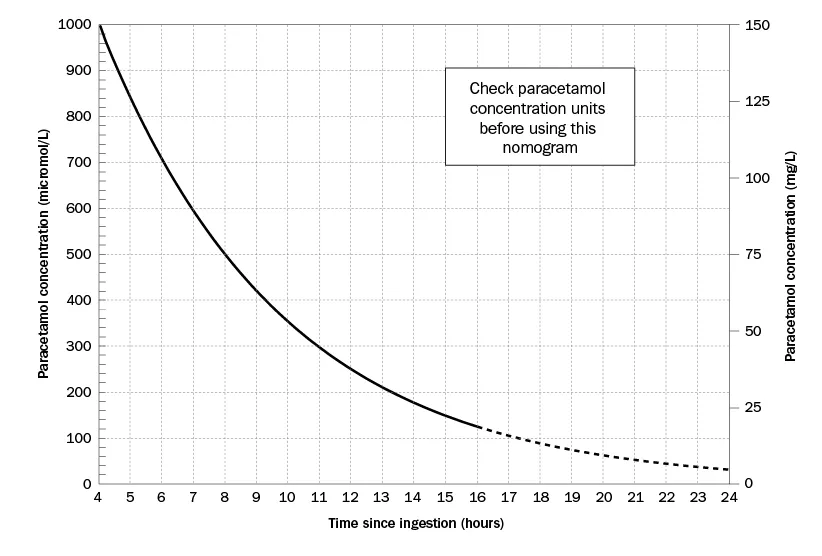
-
Do not use the nomogram for repeated supratherapeutic ingestion (a staggered deliberate overdose still uses it, timed from the earliest dose). Instead, treat if transaminases are elevated or paracetamol level >132 micromol/L.
From eTG.