Wegener's Granulomatosis (Granulomatosis with Polyangiitis)
Written 1st August 2020 - Last Update 27th August 2026
Wegener’s Granulomatosis (Granulomatosis with Polyangiitis)
“The one where people get haemoptysis and haematuria.” Granulomatosis with polyangiitis (GPA, formerly Wegener’s granulomatosis) is one of the three ANCA-associated vasculitides (AAV) — alongside microscopic polyangiitis (MPA) and eosinophilic granulomatosis with polyangiitis (EGPA) — a systemic vasculitis predominantly affecting small-to-medium vessels, typically in middle-aged adults. Cause unknown, though a complex interaction of genetics and environmental/microbial triggers driving the ANCA antibody response is implicated.
It is a multisystem disease with necrosis, granuloma formation and vasculitis, classically of the ear/nose/throat and lower respiratory tract. ENT involvement can present as sinusitis, nasal disease, subglottic stenosis (almost pathognomonic), otitis media, hearing loss or ear pain; oral lesions also occur. Lower respiratory involvement causes pulmonary infiltrates/ nodules, haemoptysis and pleuritis.
About 75% of patients develop glomerulonephritis — onset can be acute, at any disease stage, and can progress to chronic kidney failure. Uncommonly, an orbital mass (usually a sinus-disease extension) or necrotising scleritis occurs — these suggest sight-threatening disease requiring intensive treatment.
Epidemiology and pathophysiology
GPA is the most common of the three AAVs — in one national Dutch cohort of 230 AAV patients, 73% had GPA, 24% MPA and 4% EGPA, a distribution mirrored in other European registries (registry: statpearls-granulomatosis-polyangiitis; verified 2026-08-21). Estimated annual incidence is 10–20 per million (highest in colder climates), with European/American prevalence around 120–140 per million; onset is typically 45–60 years and more common in white than Black or Asian patients, though 3–7% of cases occur in children or adolescents (female:male ratio around 2:1 in children versus roughly 1:1 in adults) (registry: statpearls-granulomatosis-polyangiitis; verified 2026-08-21).
Two ANCA specificities do most of the pathogenic work: anti-proteinase-3 (PR3-ANCA), positive in roughly 75–80% of GPA, and anti-myeloperoxidase (MPO-ANCA), positive in around 10–15%, with fewer than 10% of GPA ANCA-negative. ANCA binding activates neutrophils, increasing endothelial adherence and degranulation and promoting neutrophil extracellular trap formation that damages the vessel wall — the basis of the pauci-immune necrotising vasculitis and the loosely-formed granulomas (distinct from the well-formed granulomas of sarcoidosis or tuberculosis) seen on biopsy. MPA, by contrast, is a necrotising small-vessel vasculitis without granuloma formation, less often involving the upper airway but with kidney involvement almost universal; EGPA is marked by tissue and peripheral eosinophilia, with asthma or allergic rhinitis typically preceding the vasculitic phase (registry: statpearls-anca-vasculitis; verified 2026-08-21).
Drug-induced ANCA vasculitis is a distinct differential worth actively excluding — a careful medication history matters, since the presentation (commonly rapidly progressive glomerulonephritis with a high-titre MPO-ANCA) can otherwise mimic idiopathic GPA/MPA. Implicated drugs include propylthiouracil, carbimazole/methimazole, hydralazine, minocycline, allopurinol and levamisole-contaminated cocaine; unlike idiopathic GPA/MPA, relapse after stopping the drug is uncommon and prolonged maintenance therapy is typically unnecessary (registry: statpearls-anca-vasculitis; verified 2026-08-21).
Demographics
Affects both sexes equally, all ages (mean age 41), more commonly in white than Black or Asian patients.
Clinical features
| System | Frequency | Features |
|---|---|---|
| Systemic | Fever 25–50%; weight loss >10% in 15–35% | Non-specific |
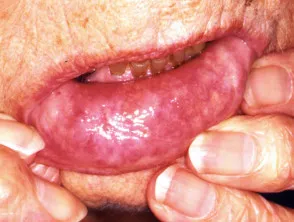
| Upper airway | 70% at onset, 92% overall | Sinusitis, nosebleeds/saddle nose, otitis media/hearing loss, painful mouth ulcers, “strawberry gums”, subglottic stenosis (hoarseness/stridor/airway obstruction) |
| Lung | 45% at onset, 87% overall | Cough, haemoptysis, pleuritic chest pain; CXR diffuse (67%) or isolated (58%) infiltrates |
| Kidney | 20% at onset, 85% overall | Oliguria, haematuria — close monitoring required in all patients |
| Eye | 28–58%, presenting feature in 8–16% | Proptosis, severe pain, vision loss |
| Skin | 40–50% | Ulcers, palpable purpura, nodules/papules/vesicles, pyoderma gangrenosum (rare), Raynaud (rare) |
| Musculoskeletal | 30–50% at onset, 65–75% overall | Myalgia, arthralgia, arthritis |
| Neurological | 22–50% overall (rarely presenting) | Peripheral nerve involvement (sensory/motor loss); CNS involvement <10% |
| GI | Unknown frequency | Abdominal pain, diarrhoea, bleeding |
| Cardiac | 12–30% | Pericarditis, angina, palpitations |
Diagnosis
- Confirmed by biopsy of affected tissue — a targeted biopsy of the most accessible/active site is preferred (necrotic areas should be avoided), and CT or ¹⁸F-FDG PET/CT can help select the biopsy site and increase yield given GPA’s patchy involvement (registry: statpearls-granulomatosis-polyangiitis; verified 2026-08-21).
- Most patients have a positive ANCA with a cytoplasmic (cANCA) pattern and anti-proteinase-3 (PR3) specificity.
- ANCA testing combines an immunofluorescence pattern with a PR3/MPO-specific immunoassay; while highly sensitive and specific for AAV overall, a positive result alone is not diagnostic — ANCA is also found in 15–20% of patients with SLE (especially lupus nephritis) and in some chronic infections. Localised disease (e.g. sinus-limited GPA) is less reliably ANCA-positive — only around 46% of one localised-disease cohort tested positive, and positivity there did not track with relapse risk (registry: statpearls-anca-vasculitis; verified 2026-08-21).
Classification criteria (2022 ACR/EULAR)
A weighted point score (≥5 required, after excluding vasculitis mimics, for classification as GPA in a patient already diagnosed with small/medium-vessel vasculitis): bloody nasal discharge/crusting/sinonasal congestion (+3), cartilaginous involvement (+2), conductive or sensorineural hearing loss (+1), cytoplasmic or PR3-ANCA positivity (+5), pulmonary nodules/mass/cavitation on imaging (+2), granuloma or giant cells on biopsy (+2), nasal/paranasal sinus inflammation on imaging (+1), and pauci-immune glomerulonephritis (+1); perinuclear or MPO-ANCA positivity (−1) and an eosinophil count above 1×10⁹/L (−4) count against a GPA classification. When tested in the validation dataset this criteria set had 93% sensitivity and 94% specificity (registry: statpearls-granulomatosis-polyangiitis; verified 2026-08-21).
Differential diagnosis
Broad, given GPA’s multisystem presentation — actively exclude before treating: other AAV (MPA, EGPA, drug-induced or renal-limited vasculitis), anti-glomerular basement membrane (Goodpasture) disease and mixed cryoglobulinaemia, other systemic autoimmune disease (SLE, sarcoidosis, rheumatoid vasculitis), infection (infective endocarditis, disseminated fungal or mycobacterial infection, streptococcal post-infectious glomerulonephritis) and malignancy mimics (lymphomatoid granulomatosis, lymphoma). Around 10% of patients presenting with rapidly progressive glomerulonephritis are double-antibody-positive (ANCA and anti-GBM) — a combination that changes management, since these patients benefit from plasma exchange as for anti-GBM disease (registry: statpearls-granulomatosis-polyangiitis; verified 2026-08-21).
Management (BSR 2025 ANCA-associated vasculitis recommendations)
The BSR published its first major update since 2014 for GPA, MPA and EGPA management in 2025 — a genuinely new treatment landscape, not just a refinement of the old cyclophosphamide-based approach:
- Induction (active GPA/MPA): intravenous pulsed cyclophosphamide or rituximab, combined with glucocorticoids. For active relapsing disease, rituximab is preferred.
- Avacopan (an oral C5a receptor inhibitor) is now recommended as a steroid-sparing agent — used with or without a short course of glucocorticoids (tapering over 4 weeks) — a genuinely new option allowing substantially reduced cumulative steroid exposure during induction. Recommended duration of use is 12 months (no data on longer use). The ADVOCATE trial that underpinned its approval found greater renal recovery and higher 1-year remission with avacopan versus a standard glucocorticoid taper (on top of rituximab or cyclophosphamide), with roughly two-thirds less cumulative glucocorticoid exposure and fewer infections/serious adverse events (registry: statpearls-granulomatosis-polyangiitis; verified 2026-08-21).
- Non-organ/life-threatening disease: methotrexate or mycophenolate mofetil may be considered as induction alternatives.
- Life- or organ-threatening disease: cyclophosphamide + rituximab combined can be considered.
- Maintenance: rituximab is preferred over other agents, dosed 500–1000mg every 4–6 months, continued for 24–48 months. Azathioprine and methotrexate are alternatives, generally reserved for patients with eGFR above 60mL/min/1.73m². Clinical assessment, not ANCA titre or B-cell count, should drive treatment decisions, and immunoglobulin levels should be checked before each rituximab dose (registry: statpearls-granulomatosis-polyangiitis; verified 2026-08-21).
- Adjuncts: trimethoprim-sulfamethoxazole (co-trimoxazole) prophylaxis against Pneumocystis jirovecii is recommended for patients on rituximab, cyclophosphamide or high-dose glucocorticoids. Induction glucocorticoids are typically started at 50–75mg/day prednisolone (weight-dependent) and tapered to 5mg/day by 4–5 months; a 2020 Cochrane review of renal vasculitis trials found a lower-dose steroid regimen was probably as effective as high-dose and may cause fewer infections (registry: cochrane-renal-vasculitis-2020, statpearls-granulomatosis-polyangiitis; verified 2026-08-21).
- Plasma exchange can be used for induction in glomerulonephritis with a creatinine above 300 micromol/L (and as salvage in more severe renal failure or alveolar haemorrhage unresponsive to IV glucocorticoids); a 2020 Cochrane review found plasma exchange “may reduce the need for dialysis” at 3 and 12 months but “may increase the number of serious infections” — routine use for alveolar haemorrhage alone is not recommended (registry: cochrane-renal-vasculitis-2020, statpearls-granulomatosis-polyangiitis; verified 2026-08-21).
Rituximab is TGA-approved for ANCA-associated vasculitis (since 2013) and has been PBS-subsidised in Australia since January 2016 for induction and re-induction of remission in GPA and MPA (registry: austprescr-rituximab-autoimmune; verified 2026-08-21).
(registry: bsr-anca-vasculitis-2025; verified 2026-07-23 — key facts corroborated via an independent secondary summary, RheumNow, since the primary academic.oup.com full text could not be independently fetched)
Limited disease not affecting a major organ (e.g. isolated sinus disease) may still be started with high-dose oral prednisolone plus another immunomodulatory drug (methotrexate or mycophenolate) rather than the above induction regimens.
Prognosis and monitoring
Disease course may be slowly or rapidly progressive, with no reliable way to predict which patients will have limited/milder disease versus severe generalised disease. Untreated severe disease has a high mortality rate (infection, lung/heart disease, renal failure, malignancy) — untreated, median survival is around 5 months with a one-year survival under 20%; with modern treatment, more than 80% of patients survive at least 8–9 years. Disease-related complications include hearing loss, saddle-nose deformity, subglottic stenosis and end-stage kidney disease; treatment-related complications (infection, and over the longer term, lymphoma or myelodysplastic syndrome) are common enough that regular disease-activity monitoring is required, with particular attention to kidney function; multiple specialists are often involved, and long-term follow-up is essential (registry: statpearls-granulomatosis-polyangiitis; verified 2026-08-21).