Sjögren Disease
Written 1st August 2020 - Last Update 13th August 2026
Sjögren Disease
An autoimmune disease mainly affecting the secretory glands of the eyes and mouth, impairing tear and saliva production (“sicca symptoms”) — dry eyes (keratoconjunctivitis sicca), dry mouth (xerostomia), and sometimes arthritis. Onset is slow; most patients have positive anti-Ro antibodies.
Patients with features of another autoimmune disease (systemic sclerosis, SLE, rheumatoid arthritis) alongside Sjögren are said to have an overlap syndrome (Sjögren secondary to that condition); without another condition present, this is primary Sjögren disease.
Demographics
- Primary Sjögren: female:male ratio ~9:1, onset 40–50 years
- Up to 2% of elderly women have been found to have primary Sjögren
Clinical features
Eyes: dry/gritty sensation, burning discomfort, decreased tear production, eye fatigue, photophobia — from corneal surface damage due to dryness.
Mouth: gradual onset over years — initially just a dryness sensation, progressing to difficulty swallowing dry food, difficulty speaking for extended periods, denture problems and increased tooth decay. Oral thrush is also more likely.
Skin: dry/rough skin (xerosis) in over half of patients, sometimes with itch, and reduced sweating; vaginal dryness may also occur. Most patients are more troubled by the dry eyes/mouth than by skin symptoms.
- Vasculitis occurs in ~10% of primary Sjögren, affecting the skin in about half of these (cutaneous small-vessel vasculitis — purple/reddish-brown spots from bleeding of small inflamed vessels, most prominent on the legs, presenting as flat patches, raised lumps, blisters, ulcers or urticaria-like weals).
- Other reported skin changes: annular erythema (noted in Japanese patients), livedo reticularis, erythema nodosum, diffuse hair loss, vitiligo, Raynaud phenomenon.
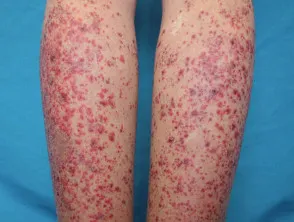
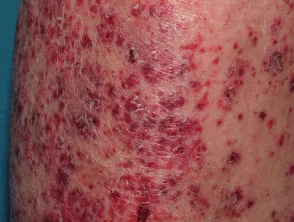
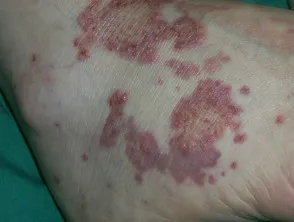
Other organ involvement:
- GI: rarely affected — dryness can cause oesophagitis or atrophic gastritis.
- Lungs: rarely serious; most common manifestation is a dry cough from small-airway dryness.
- Joints: up to 60% experience arthralgia or arthritis at some stage; usually non-erosive, without joint deformity.
- Kidneys: more commonly affected when Sjögren is part of an SLE overlap syndrome — interstitial nephritis, kidney stones, or glomerulonephritis.
- Vasculitis: can damage kidneys, lungs, nerves and joints; fever and anaemia may accompany it. Cryoglobulin-associated vasculitis carries a higher risk of internal organ involvement. Some patients with primary Sjögren and vasculitis have an underlying B-cell lymphoma.
Diagnosis (2016 ACR/EULAR criteria, per BSR 2023 guideline)
Classification requires a score of ≥4 from:
| Item | Score |
|---|---|
| Anti-Ro antibodies positive | 3 |
| Focus score ≥1 on lip (minor salivary gland) biopsy | 3 |
| Abnormal ocular staining score ≥5 | 1 |
| Schirmer’s test ≤5mm/5min (without anaesthetic) | 1 |
| Unstimulated salivary flow <0.1mL/min | 1 |
If lip biopsy is unavailable, salivary gland ultrasound may be used as an alternative to support the diagnosis. Other supportive tests: salivary scintigraphy, parotid sialography. A diagnosis is also strongly suggested by significant persistent sicca symptoms with polyclonal hypergammaglobulinaemia, positive ANA, and anti-Ro (SS-A)/anti-La (SS-B) antibodies (registry: bsr-sjogren-2023; verified 2026-07-23).
Baseline comorbidity screen at diagnosis: clinical exam, urine dip, FBC/U&E/LFT, immunoglobulins, C3/C4, TFTs, anti-tTG, CK, serum bicarbonate, anti-CCP, RF, vitamin D, anti-dsDNA.
Management
No cure — mainstay of treatment is replacing reduced secretions to minimise symptoms; immunosuppression is reserved for organ involvement (typically severe kidney or lung disease).
Dry eyes: preservative-free lubricant eye drops three to four times daily, more often if needed (registry: ajgp-dry-eyes-2021; verified 2026-08-13). A warm eye compress for 10 minutes daily is also recommended (registry: bsr-sjogren-summary-sheet-2024; verified 2026-08-13).
Dry mouth: saliva substitutes (gels, pastilles, sprays), good dental care; pilocarpine 5mg once daily, increasing stepwise to a maximum of 5mg six times daily, increases secretion from residual gland tissue (does not reverse gland damage). Stop smoking if relevant.
Dry skin: moisturisers/emollients, non-soap cleanser; a water-based lubricant for vaginal dryness.
Arthritis: NSAIDs first-line; prednisolone for severe disease or inadequate NSAID response; hydroxychloroquine is useful in some patients.
Systemic management: hydroxychloroquine is the usual first systemic agent; other DMARDs are considered for specific indications under specialist care.
Vasculitis: systemic steroids (prednisone) and immunosuppressants (e.g. azathioprine) as needed.
Avoid anticholinergic medications (tricyclic antidepressants, antipsychotics, antihistamines) where possible — these aggravate sicca symptoms.
Lifestyle: wear glasses outdoors, maximise dietary omega-3, avoid dry/ smoky environments, humidify the home, reduce sugar intake, meticulous dental care, drink plain water, stay active.
Pregnancy: if planning pregnancy, counsel about neonatal lupus and congenital heart block risk (anti-Ro/anti-La antibody transfer).
Special situations: early recognition of lymphoma is crucial for curative management — Sjögren carries the highest lymphoma risk of any rheumatic disease; long-term monitoring is required, especially in those at high risk.