Pain control in palliative care
Written 4th September 2020 - Last Update 10th July 2026
Pain control in palliative care
Barriers to effective pain management
Patient factors:
- Anxiety and depression
- Fear of addiction
- Fear of becoming tolerant to analgesics
- Fear of adverse effects from analgesics
- Inability to adhere to complicated regimens
- Inability to understand dosing recommendations
- Communication difficulties (language differences, cultural issues, intellectual impairment)
- Delirium
Clinician factors:
- Poor pain assessment skills
- Lack of knowledge of current therapeutic approaches
- Insufficient knowledge of, and uncertainty about, the role of opioid therapy
- Overestimation of the risks of opioid addiction and tolerance
- Concern about managing adverse effects from analgesics
- Concern about regulations for prescribing controlled prescription drugs
Assessment
History (SOCRATES-style):
- Site
- Onset
- Character
- Radiation/referral
- Associated symptoms
- Timing
- Exacerbating/relieving factors
Severity assessment — specifically ask the patient about:
- Average pain over the last 24 hours
- Worst pain in 24 hours
- Current pain severity
- Impact of the pain
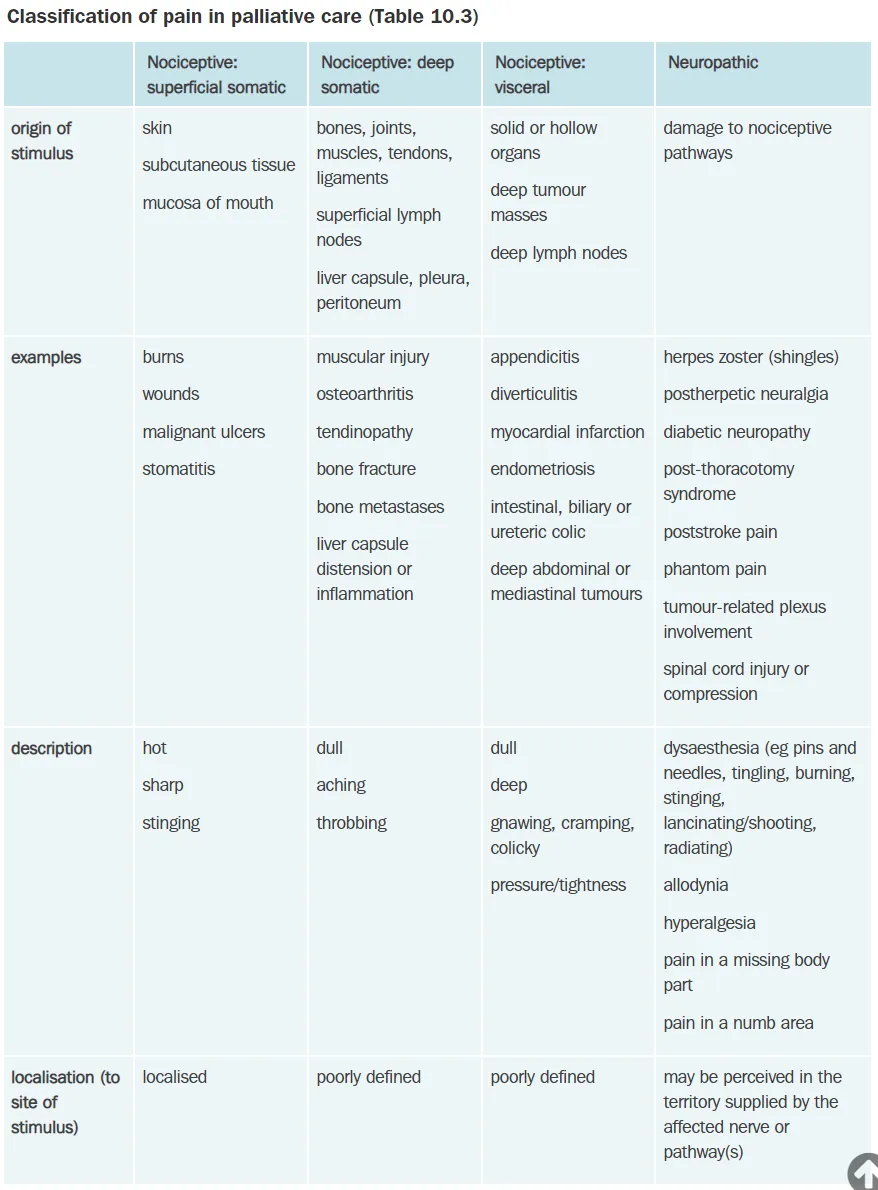
Types of pain
- Nociceptive — due to actual or threatened tissue damage. Receptive to conventional analgesia. Subdivided into somatic and visceral.
- Neuropathic — due to a lesion or disease of the nervous system disrupting normal conduction. Resistant to opioid analgesia alone.
Management
Non-pharmacological
- Psychological support for depression and anxiety
- Social support — assistance at home with ADLs, financial and spiritual needs
- Physio/OT/nursing support
- Heat/cold therapy, TENS, acupressure/acupuncture, massage
- CBT
- Aromatherapy, music therapy
Pharmacological
Nociceptive pain: paracetamol +/- NSAIDs for mild-to-moderate pain, provided the patient isn’t high risk for NSAIDs.
Neuropathic pain — one of:
- Amitriptyline 10–25 mg orally at night, increasing every 7 days to a usual maximum of 75 mg at night
- Nortriptyline 10–25 mg orally at night, increasing every 7 days to a usual maximum of 75 mg at night
- Pregabalin 25–75 mg orally at night initially, increasing to twice daily after 2–3 days then more slowly to a usual maximum of 300 mg twice daily
- Gabapentin 100–300 mg orally daily initially, increasing as tolerated every 4 days from once daily to 3 times daily, to a usual maximum of 2400 mg daily
- Clonazepam 0.5 mg orally/subcutaneously/sublingually twice daily, increasing to a maximum of 2 mg twice daily
- Duloxetine 30 mg orally daily initially, increasing to 60 mg daily after 1 week, and if tolerated to a maximum of 60 mg twice daily
Regarding pregabalin and gabapentin specifically — see the guideline update below: current prescribing requires an explicit misuse/abuse/dependence risk assessment, which wasn’t part of the framework when this note was written.
Antispasmodics (muscular pain):
- Clonazepam 0.5 mg orally/sublingually twice daily, OR
- Diazepam 2–5 mg orally up to 3 times daily, OR
- Baclofen 5 mg orally 3 times daily, increasing as required every 3 days up to 10–25 mg 3 times daily
Smooth muscle pain:
- Hyoscine butylbromide 10–20 mg orally 3–4 times daily, OR
- Hyoscine butylbromide 10–20 mg subcutaneously 4-hourly, OR
- Hyoscine butylbromide 60–80 mg/24 hours initially by continuous subcutaneous infusion, adjusted to effective dose (maximum 120 mg/24 hours)
Local mass effect pain:
- Dexamethasone 4–8 mg (up to 16 mg in spinal cord compression) orally or subcutaneously. After 3–4 days, adjust to the lowest effective dose.
- Side effects to watch for: insomnia, mental disturbance, hyperglycaemia, gastric irritation, increased infection risk, cushingoid features, proximal myopathy.
- Watch for withdrawal/adrenal insufficiency if used more than 3 weeks at low dose, or 2 weeks at high dose (>4 mg/day). Wean gradually: reduce by 2 mg every 5–7 days until reaching 2 mg daily, then by 0.5 mg every 5–7 days.
- Consider radiotherapy/chemotherapy options for bony pain.
Opioids in palliative care
Opioids provide the best relief of most pain and can improve quality of life and allow increased activity in the mid-to-later stages of palliative care. Use caution in severe renal and liver impairment — start low, go slow.
Initiation and titration:
- In opioid-naïve patients, start morphine immediate-release 2–5 mg hourly as needed, to a maximum of 3 consecutive hourly doses or 6 doses in 24 hours.
- Once a regular opioid requirement is established, use morphine modified-release 5 mg or 10 mg BD with a PRN dose as above. Review the PRN dose after 1–2 days (ideally 24 hours) to calculate the 24-hour modified-release requirement.
- Regularly review effectiveness by assessing: duration of effect of each regular dose, number of breakthrough doses required per 24 hours, reduction in pain severity, and tolerability.
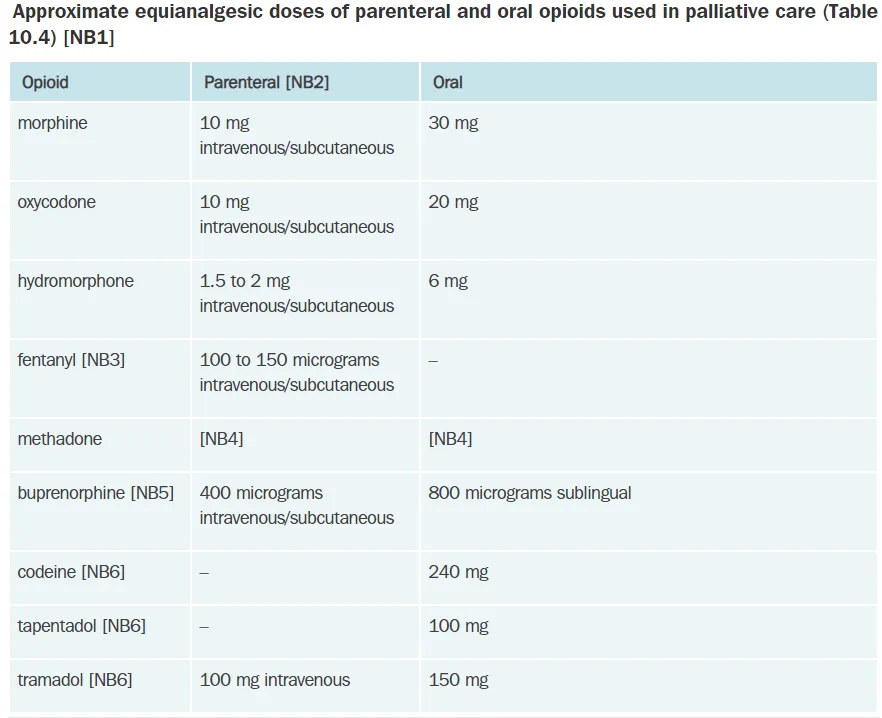
If regular opioid dosing exceeds 100 mg oral morphine equivalent per 24 hours, seek advice from a palliative care specialist — adverse effects become more common above this level.
Choice of opioid by organ impairment:
- Morphine is first-line, but use with caution in severe renal or liver impairment due to toxic metabolite build-up.
- Fentanyl, methadone and buprenorphine are used in severe renal impairment but still have issues in liver impairment.
- Hydromorphone can be used in moderate renal impairment (or low doses in severe renal impairment) but should be avoided in severe liver impairment.
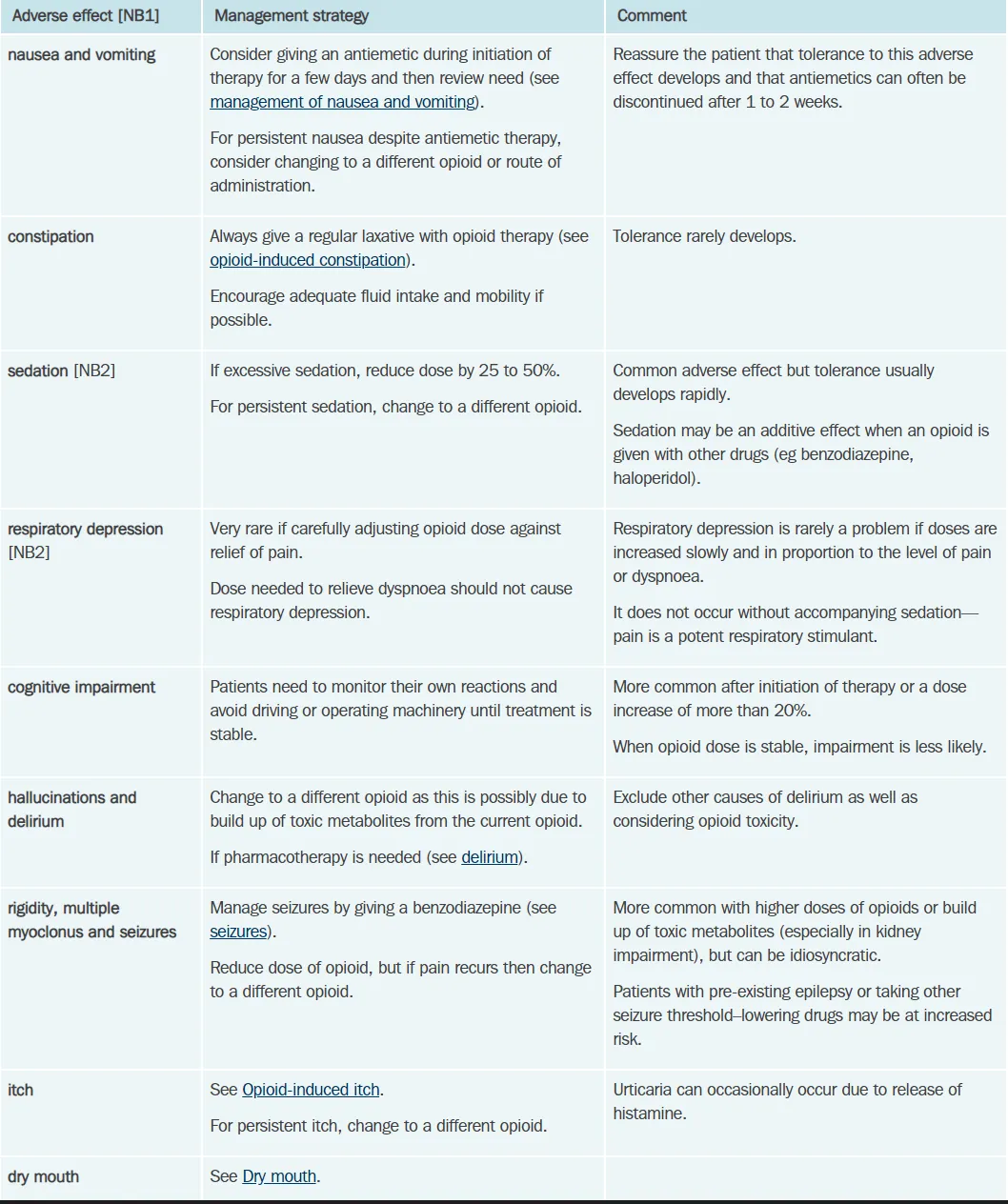
Common adverse effects and management strategies: