Umbilical Granuloma
Written 8th April 2020 - Last Update 30th August 2026
Umbilical Granuloma
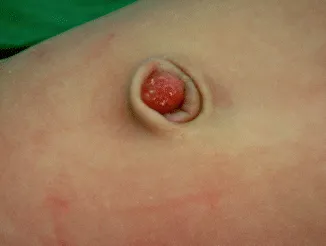
A common benign condition of infancy. It is usually noticed as a mass of red, friable granulation tissue at the base of the umbilical stump after the cord separates in the first few days after birth, often with persistent seropurulent discharge, and often only seen on careful examination of the base of an “innie” umbilicus.
Nodules are typically around 5 mm across, and form from excessive fibroblast proliferation and granulation tissue at the base of the umbilicus. They look moist, red and strawberry-like because of the prominent capillaries on the surface.
What else it could be
Congenital conditions such as patent urachus and persistent vitello-intestinal duct can mimic umbilical granuloma, but they present with discharge of urine or faeces from the umbilicus. Refer if either is suspected.
Evidence for treatment
A systematic review of 11 randomised trials in 890 infants compared silver nitrate, topical steroids, ethanol wipes, electrocautery, cryocautery, copper sulphate and common salt.
- Common salt achieved resolution in over 90% of cases in five studies and 54-80% in two
- Topical steroids, silver nitrate, copper sulphate and cryocautery achieved resolution in over 90%
- Ethanol wipes achieved 50-65%, the lowest healing rates
- Salt application caused no side effects; local side effects varied for the other agents
The overall GRADE of evidence was low, given small sample sizes and unclear or high risk of bias in most of the included studies.
Management
Common salt first. Salt is simple and effective with minimal complications, and is the reasonable first option. Many UK centres recommend common salt twice daily for two days as first-line therapy. Parents can apply it at home, washing it off after 10-30 minutes, for several days. Air the area regularly as well.
Protect the surrounding skin with petroleum jelly or liquid paraffin before applying any chemical agent.
Silver nitrate or copper sulphate are efficacious, but there are case reports of burning of the surrounding skin, so they need cautious application by an experienced clinician and usually more than one clinic visit.
Avoid potent topical steroids first-line. Clobetasol is an ultra-high-potency steroid and betamethasone is high-potency; applying them for 3-4 weeks to highly vascular granulomatous tissue risks systemic absorption and HPA-axis suppression, plus local hypopigmentation, atrophy and infection.
Ethanol wipes are inferior to the other options.
Large, pedunculated or persistent granulomas may respond to a double ligature applied to the neck of the granuloma. Refer to surgery if the lesion is not responding, if there is spreading periumbilical erythema, or if a congenital mimic is suspected.