Precocious Puberty
Written 16th April 2020 - Last Update 20th July 2026
Precocious Puberty
Puberty is trending earlier, presumed due to better health/nutrition and less chronic disease. True precocious puberty = signs of pubertal development before 8 years in girls, 9 years in boys. Must be distinguished from premature thelarche, premature adrenarche, and pseudopuberty (e.g. severe hypothyroidism). See also delayed puberty.
- Girls: accelerated growth with accelerated breast and pubic hair development.
- Boys: accelerated growth with enlargement of both testes, accelerated pubic hair and genital development.
- Because growth spurts and bone fusion both occur earlier, final adult height tends to be reduced.
- 20× more common in girls — usually central/idiopathic. Boys are more likely to have an underlying pathological cause (CNS lesion, congenital adrenal hyperplasia, or other serious pathology).
Central (gonadotropin-dependent) precocious puberty
Girls: ~90% idiopathic. Other causes: CNS lesions (hamartoma, other tumours), CNS irradiation (→ GnRH deficiency later, but can trigger early activation), gonadotropin-releasing/secreting tumours.
Peripheral (gonadotropin-independent) precocious puberty
- Girls: ovarian cysts (most common — presents as breast development then vaginal bleeding); ovarian tumours (rare).
- Boys: Leydig cell tumours (asymmetrical testicular enlargement); germ cell tumours (can be extratesticular, associated with high hCG).
- Both: congenital adrenal hyperplasia; adrenal/testicular/ovarian neoplasms; hypothyroidism; exogenous sex steroids (e.g. from a topical-treatment-using adult’s skin contact).
Initial evaluation
- Bone age X-ray
- Pelvic ultrasound
- Bloods: LH/FSH, oestradiol, testosterone, DHEAS, 17-OHP; GnRH stimulation testing as directed by paediatric endocrinology.
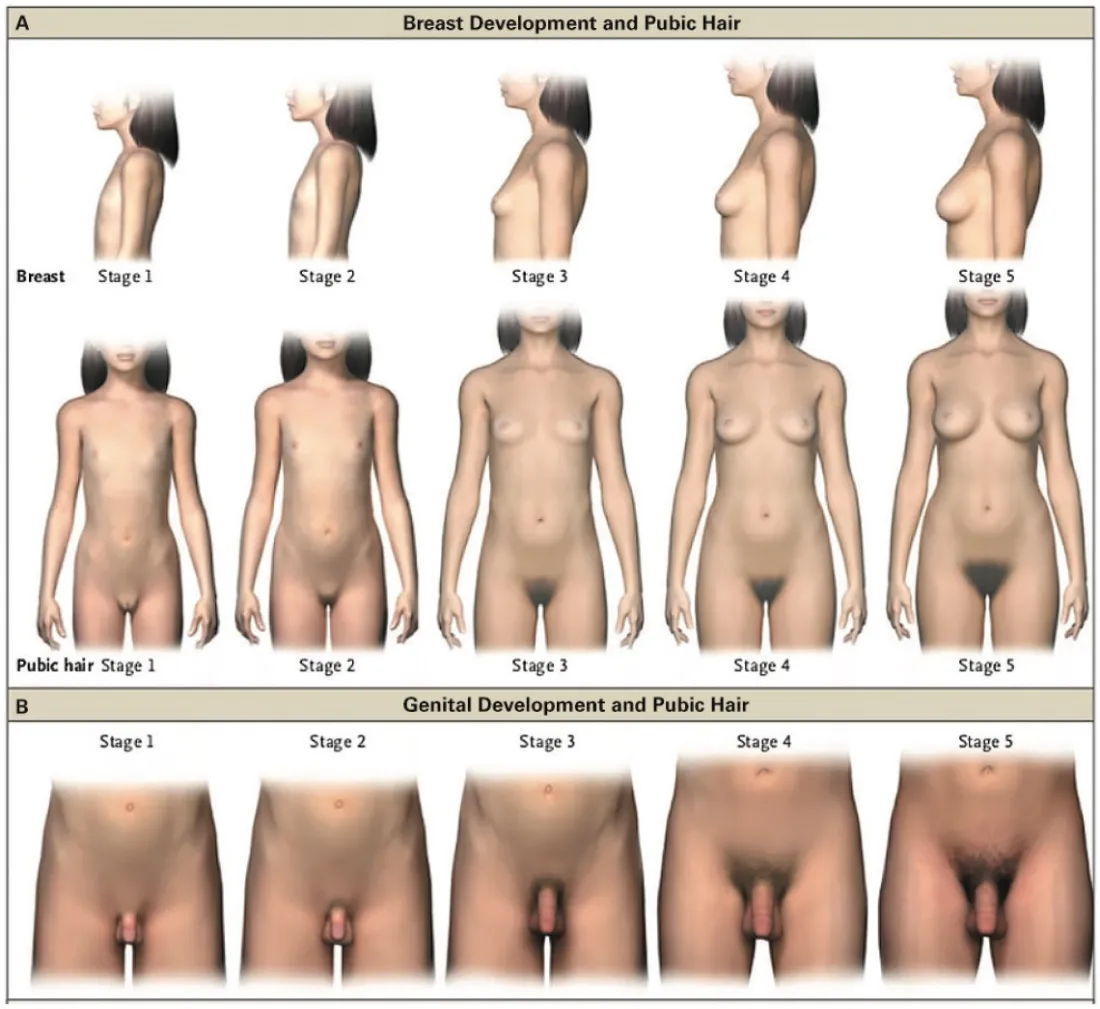
Normal onset of puberty: girls 8–13 years, boys 9–14 years.
Pubic hair scale (both sexes): Stage 1 no hair · Stage 2 downy hair · Stage 3 scant terminal hair · Stage 4 terminal hair filling the pubic triangle · Stage 5 terminal hair extending onto the medial thigh.
Female breast development: Stage 1 no glandular tissue · Stage 2 breast bud palpable under the areola (first pubertal sign — thelarche) · Stage 3 breast tissue palpable outside the areola, no areolar development · Stage 4 areola forms a “double scoop” raised above the breast contour · Stage 5 areolar mound recedes into the breast contour, with pigmentation and nipple protrusion.
Male external genitalia: Stage 1 testicular volume <4 mL (long axis <2.5 cm) · Stage 2 4–8 mL/2.5–3.3 cm (first pubertal sign — gonadarche) · Stage 3 9–12 mL/3.4–4.0 cm · Stage 4 15–20 mL/4.1–4.5 cm (spermarche) · Stage 5 >20 mL/>4.5 cm.
Management
Referral to paediatric endocrinology for investigation as above. Active treatment is not always required, and should only start after referral, assessment and family counselling.
- GnRH analogues (goserelin, leuprorelin depot) are used for central precocious puberty — not TGA-registered for this indication in Australia (off-label). Aim: delay pubertal progression to an age-appropriate/socially appropriate time and optimise final height.
- Gonadotropin-independent precocious puberty (e.g. McCune-Albright syndrome, testotoxicosis) does not respond to GnRH analogues unless it has triggered concurrent central puberty — refer these rare conditions to a specialist. In McCune-Albright syndrome, ovarian hyperfunction is often intermittent and other endocrine organs may be affected; an aromatase inhibitor (letrozole or anastrozole) is sometimes used to block autonomous oestrogen production.