Febrile Child
Written 16th April 2020 - Last Update 21st August 2026
Febrile Child
RCH Melbourne-aligned approach. Fever = body temperature >38°C. Use a tympanic thermometer in children >3 months; ideally axillary (3 minutes over the axillary artery) in children <3 months. Age bands below use corrected gestational age for infants born <37 or managed >42 weeks. Use the same body site and thermometer type for repeat readings where possible; skin (forehead/infrared) thermometers are unreliable, and in neonates a rectal temperature is only taken after an axillary screen suggests fever is still likely.
Key points
- Febrile neonates (≤28 days corrected age) need investigation including LP and IV antibiotics — admit.
- Febrile infants 28 days–3 months need investigation guided by appearance (well/unwell) and whether there’s an obvious infection source; this age group has a high risk of occult serious infection with no clear focus, warranting at least a truncated workup (CRP ± procalcitonin) even when well-looking.
- Babies <3 months with a serious bacterial infection can present with hypothermia and temperature instability, not just fever — unwell young infants can present with non-specific findings and may not have a fever at all.
- Not good predictors of illness severity: height of the fever, speed of onset, response to antipyretics, or a simple febrile seizure.
- Any febrile child who appears seriously unwell should be managed as suspected sepsis, irrespective of the degree of fever.
Background
The most common serious bacterial infection without a clear focus is UTI. Also consider pneumonia, meningitis, bone/joint infection, and skin/soft-tissue infection. Occult bacteraemia has fallen since pneumococcal vaccination (in immunised infants). By age, the organisms behind these SBIs shift: neonates are mostly infected with group B streptococci, Escherichia coli and other gram-negative enteric organisms, and Listeria monocytogenes. Infants and older children are more often infected with Streptococcus pneumoniae and Neisseria meningitidis, alongside other typical respiratory/urinary pathogens.
Prolonged/atypical fever: fever ≥5 days should prompt assessment for Kawasaki disease or PIMS-TS, particularly with a preceding COVID-19 history. Once fever has been present daily for ≥14 days without a diagnosis, it’s reframed as fever of unknown origin, with a broader differential (rheumatological disease, malignancy, less common infections). Teething does not cause fever. Post-vaccination fever is expected within 24 hours of immunisation for up to 2–3 days, but in an unwell child, fever should not be attributed to vaccination alone.
History: localising symptoms (cough, headache, photophobia, diarrhoea, vomiting, abdominal pain, musculoskeletal pain, rash); recent travel, sick contacts; immunisation status (especially <6 months with incomplete schedule); antibiotics already given (can mask signs of serious infection).
High-risk groups: prematurity, immunosuppression, chronic lung disease, congenital heart disease, previous invasive bacterial infection, Aboriginal and/or Torres Strait Islander children. RCH’s current list also adds oncological conditions, an in-situ central line, Pacific Islander or Māori background, and multiple health service presentations as high-risk markers warranting a lower threshold for investigation.
Examination — features suggestive of an unwell child
| Domain | Features |
|---|---|
| Colour | Pallor (incl. parent/carer report); mottled; blue/cyanosed |
| Activity | Lethargy/decreased activity; not responding normally to social cues; doesn’t wake, or only with prolonged stimulation, or won’t stay awake; weak, high-pitched or continuous cry |
| Respiratory | Grunting; tachypnoea; increased work of breathing; hypoxia |
| Circulation/hydration | Poor feeding; dry mucous membranes; persistent tachycardia; central CRT ≥3 sec; reduced skin turgor; reduced urine output |
| Neurological | Bulging fontanelle; neck stiffness; focal neurological signs; focal, complex or prolonged seizures |
| Other | Non-blanching rash; fever ≥5 days; swollen limb/joint; non-weight-bearing or not using a limb |
Pallor, poor feeding or decreased activity alone don’t necessarily indicate a seriously unwell child — but any of the above should prompt a closer look.
Non-infective differentials in an unwell young infant. Don’t anchor on sepsis alone. Bile-stained vomiting with abdominal distension suggests malrotation with volvulus. Cyanosis, a murmur, cardiac failure or poor/ absent peripheral pulses suggests congenital cardiac disease. Ambiguous genitalia with hypotension, dehydration, hyponatraemia/hyperkalaemia or hypoglycaemia suggests congenital adrenal hyperplasia. Unexplained bruising or injury should raise concern for non-accidental injury alongside the infective work-up.
Investigations and management by age
Any child who looks unwell should be investigated and admitted. If the child looks stable, investigate before giving antibiotics. In young infants and unwell children, don’t accept otitis media or URTI as the source without further assessment.
- <28 days: FBC, CRP, blood culture, urine culture (SPA/IDC), lumbar puncture, ± CXR — admit for IV antibiotics.
- 28 days–3 months:
- No unwell features and no obvious focus → urine MC+S, consider FBC/CRP/cultures.
- Unwell with no obvious source → investigate as for a febrile neonate (FBC, CRP, blood culture, urine culture, LP, ± CXR) and treat with IV antibiotics (empiric: flucloxacillin + ceftriaxone, or gentamicin if meningitis excluded).
- >3 months:
- No unwell features, no obvious source → consider no investigation, or urine MC+S if fever >48 hrs, or fever >24 hrs with a prior UTI.
- Unwell, no source → bloods (FBC/CRP/lactate), urine MC+S, ± LP, ± CXR.
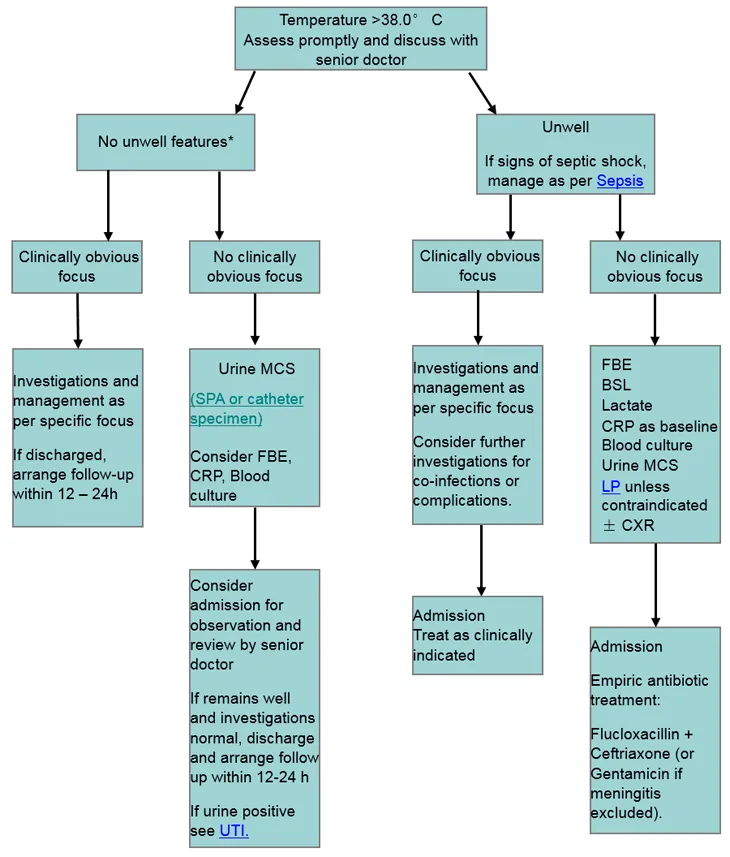
Practical notes on specimens: bag urine specimens should never be sent for culture, given high false-positive/contamination rates. Suprapubic aspirate is the gold-standard low-contamination method, with in/out catheter, midstream or clean-catch as alternatives depending on continence and how unwell the child is. When an LP is indicated it should be done without delay and, ideally, before antibiotics are given, unless contraindicated by impaired conscious state, focal neurological signs, coagulopathy or haemodynamic instability. In that situation, treat empirically for meningitis/encephalitis and perform the LP once the child is stable.
Manage according to the presumed source; send unwell-appearing children to hospital.