Congenital Airway Anomalies
Written 8th April 2020 - Last Update 28th August 2026
Congenital Airway Anomalies
Two congenital upper-airway structural anomalies presenting with neonatal noisy breathing/obstruction.
Choanal atresia
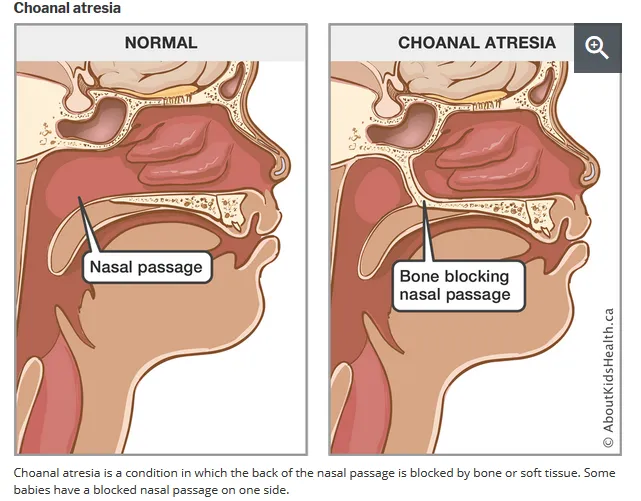
Congenital occlusion of the posterior nasal airway at the level of the posterior choanae. May be part of CHARGE syndrome (Coloboma, Heart defect, choanal Atresia, Retarded growth/development, Genital hypoplasia, Ear anomalies/deafness).
- Demographics: 1 in 5,000–8,000 live births.
History
- Bilateral — presents at birth with obvious airway obstruction and respiratory distress (neonates are obligate nasal breathers for the first 6 weeks). May show paradoxical cyanosis — cyanotic periods alternating with turning pink while crying/mouth-breathing.
- Unilateral — may present later, typically age 5–24 months, with persistent or foul-smelling unilateral nasal discharge and obstruction.
Examination
Obstruction demonstrated by inability to pass a 6F suction catheter into the nasopharynx from either nostril (or via nasendoscopy if available). Assess for other CHARGE-associated anomalies.
Investigations
Nasendoscopy (after decongestant + suction) to reveal the atretic plate; CT or MRI imaging.
Management
Bilateral choanal atresia in a neonate is a medical emergency — managed surgically.
Laryngomalacia & tracheomalacia
Neonates are obligate nose-breathers, so nasal congestion (mucus) often causes noisy breathing — normal saline drops/spray can help. The most common pathological cause of noisy breathing is laryngomalacia: a developmental anomaly causing stridor from collapse of the supraglottic structures during inspiration.
Natural history and management
Babies with mild laryngomalacia who are feeding well and thriving can be followed regularly in general practice. Advise parents that stridor may get louder over the first 6 months, but usually resolves by 12–18 months.
Refer to a respiratory paediatrician or otolaryngologist if there are associated complications — poor feeding, or gastro-oesophageal reflux.