Refractive Errors
Written 9th July 2020 - Last Update 23rd July 2026
Refractive Errors
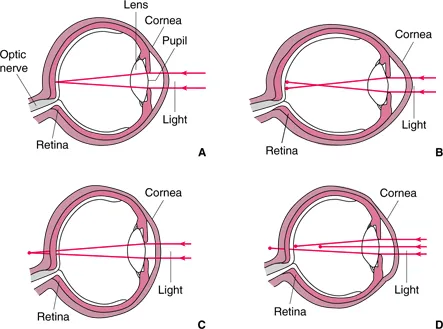
Refractive errors are failures of the eye to focus images sharply on the retina, causing blurred vision. In the emmetropic (normally refracted) eye, the cornea and lens focus light sharply on the retina; during accommodation, the ciliary muscles adjust lens shape to maintain focus.
Types
| Type | Mechanism | Effect | Correction |
|---|---|---|---|
| Myopia (nearsightedness) | Focus point falls in front of the retina — cornea too steeply curved and/or eye axial length too long | Distant objects blurred, near objects clear. Often progresses in children until growth stops | Concave (minus) lens |
| Hyperopia (farsightedness) | Focus point falls behind the retina — cornea too flat and/or axial length too short | Adults: both near and distant blurred. Children/young adults with mild hyperopia may see clearly via accommodation | Convex (plus) lens |
| Astigmatism | Non-spherical corneal/lens curvature — light of different orientations focuses at different points | Distorted vision at all distances | Cylindrical lens (no power along one axis, concave/convex along the other) |
| Presbyopia | Age-related loss of the lens’s ability to change shape for near focus, noticeable from the early-mid 40s | Near vision blurred | Convex (plus) lens — separate reading glasses, bifocals, or variable-focus lenses |
| Anisometropia | Significant difference (usually >3 dioptres) between the two eyes’ refractive error | Corrective lenses produce a difference in image size (aniseikonia) between the eyes, risking fusion difficulty or suppression of one image | Case-by-case; contact lenses can reduce aniseikonia vs spectacles |
Clinical features
- Blurred vision — distant, near, or both
- Headaches (from excessive ciliary muscle tone, or prolonged squinting/frowning)
- Ocular surface desiccation from excessive staring — irritation, itching, visual fatigue, foreign body sensation, redness
- In children: frowning/squinting when reading, excessive blinking or eye rubbing
Diagnosis
Visual acuity testing, refraction, and a comprehensive eye exam by an optometrist or ophthalmologist.
Management
- Eyeglasses — convex (hyperopia/presbyopia), concave (myopia), cylindrical (astigmatism)
- Contact lenses
- Refractive surgery
Source: MSD Manual — refractive error classification.