Age-Related Macular Degeneration
Written 16th July 2020 - Last Update 4th October 2020
Age-Related Macular Degeneration (AMD)
AMD is the leading cause of legal blindness in people over 50, contributing to 60% of all blindness in Australia. It predominantly affects the macula, with major consequences for driving, reading and detailed tasks.
Disease spectrum
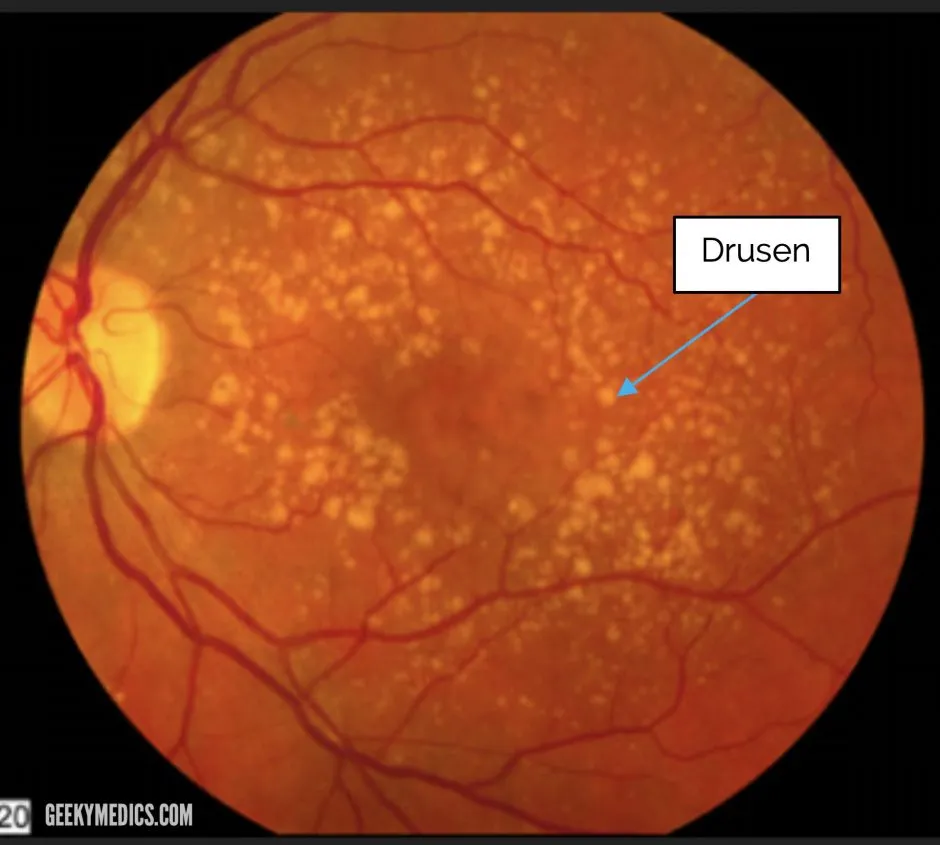
Progresses from early → intermediate (drusen accumulation beneath the retinal pigment epithelium) → late-stage disease, which has two forms that often coexist:
- Neovascular (“wet”) AMD — choroidal neovascularisation causing haemorrhage and fluid exudation
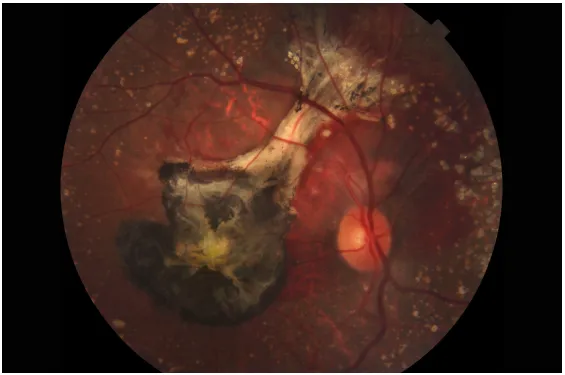
- Atrophic (“dry”) AMD — progressive geographic atrophy (GA) of the retinal pigment epithelium and photoreceptors
Early/intermediate AMD may be asymptomatic or cause only mild disturbance; late AMD causes significant central vision loss.
Risk factors (quantified)
- Age — the strongest, most consistent risk factor; risk rises ~11% per year of age, climbing sharply after 60
- Genetics — complement factor H (CFH), ARMS2 and HTRA1 polymorphisms confer ~2–3× odds; a first-degree relative with AMD roughly triples risk
- Sex — male sex carries higher odds (OR 1.63 vs female), despite AMD’s higher overall prevalence in women (reflecting female longevity)
- Fellow-eye risk — any AMD in one eye carries a 19–28% chance of bilateral involvement within 5 years; late AMD in one eye confers 27–68% risk of late AMD in the other eye within 5 years — vigilant contralateral-eye monitoring matters
- Smoking — pooled OR 1.86 vs non-smokers; accelerates unilateral-to-bilateral progression, with heavy exposure conferring ~3× risk of both geographic atrophy and neovascular disease
- Vascular risk factors — hypertension, cardiovascular disease and diabetes each significantly raise AMD risk; guideline-directed BP/lipid management may help mitigate progression as well as general health
- Other established factors: UV exposure, abdominal obesity, alcohol use, light iris colour
Clinical presentation
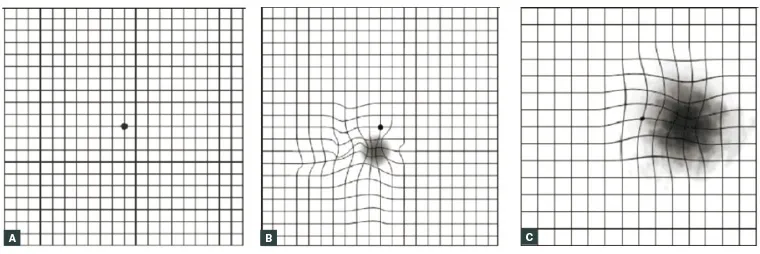
Early AMD is typically asymptomatic. The earliest functional change is delayed dark adaptation (early rod dysfunction) — patients may report difficulty in dim light or slow adaptation after glare, often before visible drusen or pigmentary change on exam. Mild metamorphopsia (distorted/wavy straight lines) or blurred central vision can develop in intermediate disease but are often subtle.
Amsler grid testing has limited sensitivity (~50%) for detecting central distortion — a normal Amsler grid does not exclude AMD. OCT (via optometry/ophthalmology) has much higher sensitivity for drusen, subretinal fluid or atrophy and should be arranged if AMD is suspected.
Referral pathway
- Early/intermediate AMD → optometry review + lifestyle modification; semi-urgent ophthalmology referral if progression is suspected
- Suspected wet AMD is an ophthalmic emergency — acute metamorphopsia, new central blur, scotoma or rapid vision loss warrant urgent same-week referral
Management
Lifestyle / secondary prevention (slows progression in early/intermediate disease)
- Smoking cessation
- AREDS2 supplementation — vitamins C, E, zinc, copper plus lutein/zeaxanthin (replacing the original AREDS1 beta-carotene formula). AREDS2 reduces 5-year risk of progressing from intermediate to late AMD by ~25%. AREDS2 (not AREDS1/beta-carotene) is specifically recommended for smokers and ex-smokers — beta-carotene significantly raised lung cancer risk in this group, while lutein/zeaxanthin carries no such risk and is equally or more effective. Practical note: Australian pharmacy AREDS2 supplements often provide only half the trial dose — doubling the daily tablets, or adding separate lutein/zeaxanthin, may be needed for an equivalent dose.
- Regular exercise — emerging evidence of a protective effect: one meta-analysis found higher physical activity associated with 8% lower odds of early AMD and 41% lower odds of late AMD
- Mediterranean-style diet rich in antioxidants and omega-3s
- Cardiovascular risk-factor optimisation (BP, lipids)
Wet AMD (specialist-led)
Regular intravitreal anti-VEGF injections — aflibercept, ranibizumab, faricimab and bevacizumab, all PBS-listed, improve or stabilise vision. Adherence is a major limitation — 17.5–30% patient-led non-adherence in systematic review data, driven by travel, carer burden, cost and treatment discomfort/dissatisfaction. Newer agents (faricimab, higher-dose aflibercept) aim for longer treatment intervals specifically to reduce this burden.
Dry AMD / geographic atrophy — genuinely new treatments
Previously “no treatment to reverse or halt the condition” — this has changed: intravitreal complement inhibitors now reduce geographic atrophy lesion growth in real-world data. Pegcetacoplan (a C3 complement inhibitor) has TGA approval — the first approved treatment specifically for dry AMD/GA. Avacincaptad pegol (C5 inhibition) is awaiting TGA approval. Neither is currently PBS-listed.