Peripheral Neuropathy
Written 10th June 2020 - Last Update 28th August 2026
Peripheral Neuropathy
An umbrella term for conditions affecting peripheral nerves:
- Mononeuropathy — one nerve (e.g. carpal tunnel syndrome, or peroneal neuropathy, below).
- Mononeuropathy multiplex — multiple single nerves, asymmetrically (see mononeuritis multiplex, below).
- Polyneuropathy — multiple nerves, symmetrically (e.g. Charcot-Marie-Tooth disease, below).
Presentation
Sensory: tingling, burning, numbness, unsteady gait.
Motor: weakness, clumsiness, wrist drop/foot drop.
Signs: LMN pattern — wasting, decreased reflexes, weakness, fasciculations; classic glove/stocking distribution.
Causes
Predominantly sensory
Vascular; infectious (leprosy); neoplastic (paraneoplastic syndrome — lymphoma, lung, ovarian cancer); degenerative (uraemia, B1/B12 deficiency — less often B3/5/6/E deficiency, hypoxic injury; amyloidosis); iatrogenic/intoxication (alcohol, neurotoxic drugs); autoimmune (amyloidosis); traumatic; endocrine (diabetes).
Predominantly motor
Degenerative (Charcot-Marie-Tooth disease, below); iatrogenic/intoxication (lead poisoning); congenital (Charcot-Marie-Tooth disease, porphyria); autoimmune (Guillain-Barré syndrome, chronic inflammatory demyelinating polyneuropathy).
By onset/pattern (additional differential)
- Acute onset: Guillain-Barré syndrome, porphyria, toxic (arsenic, nitrofurantoin), serum sickness (post-immunisation), diphtheria, malignancy, critical illness polyneuropathy, diabetes/uraemia (rarely).
- Predominantly motor: Guillain-Barré syndrome, porphyria, diphtheria, lead, Charcot-Marie-Tooth disease, diabetic amyotrophy.
- Predominantly sensory: leprosy, diabetic distal sensory polyneuropathy, B12/thiamine deficiency, malignancy, hereditary sensory and autonomic neuropathy, primary/familial amyloidosis, uraemia, Lyme disease, Sjögren syndrome.
- Radicular: diabetic truncal neuropathy, Lyme disease, Sjögren syndrome.
- Painful neuropathies: alcohol/nutritional deficiency, diabetes (acute painful neuropathy), HSAN type 1, arsenic, cryoglobulinaemia, Lyme disease, paraneoplastic sensory neuropathy, vasculitic neuropathies.
Causative drugs
Amiodarone, phenytoin, isoniazid, cytotoxics, nitrofurantoin.
Examination
Full neurological exam, defining the symptom distribution to guide diagnosis. Carpal tunnel syndrome and median/ulnar neuropathies can often be diagnosed clinically.
Investigations
Directed at the underlying cause:
- Glucose/HbA1c (diabetes), TSH, B12 (B1 levels are difficult to measure — contact the lab if suspicious, e.g. alcohol excess, bariatric surgery, poor nutrition).
- UEC/LFTs (uraemia); blood lead level and/or phenytoin level if relevant.
- Nerve conduction studies can confirm the diagnosis, though small-fibre neuropathies may show normal studies.
Refer early to neurology for diagnosis and management.
Peroneal (fibular) neuropathy
Common peroneal (fibular) nerve injury — usually at the fibular head, where it wraps around before splitting into the superficial and deep peroneal branches.
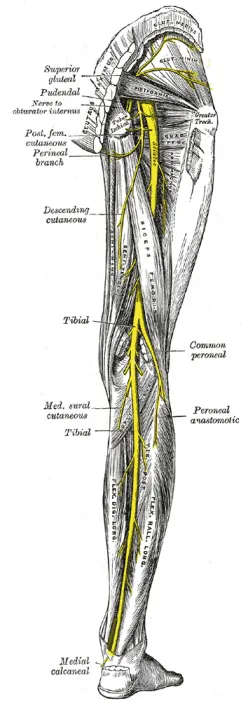
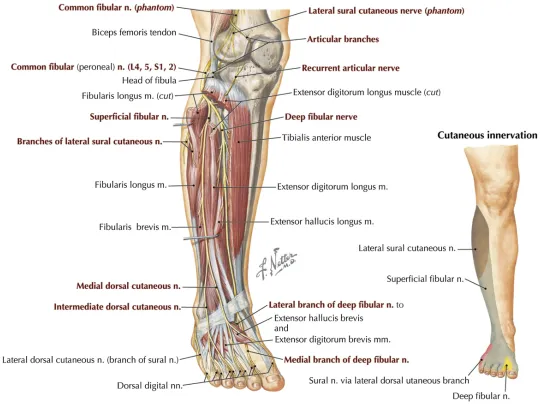
Presentation: foot drop (weakness of ankle dorsiflexion) — can also occur with L5 radiculopathy, but peroneal neuropathy has no associated leg pain.
Usually caused by external compression — habitual leg crossing, or prolonged bed rest. Can be exacerbated by recent significant weight loss (~10kg), which reduces subcutaneous fat cushioning over the nerve at the fibular head.
Investigation: nerve conduction studies to localise the lesion level.
Treatment: physiotherapy — strengthening exercises; stretching to maintain dorsiflexion range of motion. Surgical peroneal/fibular nerve decompression for refractory cases.
Mononeuritis multiplex
Multiple mononeuropathies arising at different times and to different degrees, affecting multiple individual nerves — not one condition, but a group of disorders. Characterised by multiple distinct nerve palsies with staggered onset (e.g. a radial nerve palsy in one arm and an ulnar nerve palsy in the other, at different times).
Causes:
- Acute: polyarteritis nodosa, diabetes.
- Chronic: carcinoma, SLE/rheumatoid arthritis, sarcoidosis, acromegaly/hypothyroidism, leprosy, idiopathic.
Charcot-Marie-Tooth disease
The most common inherited peripheral neuropathy. Autosomal dominant.
Presentation: progressive sensorimotor neuropathy from puberty — starts with leg weakness and distal sensory loss.
Examination: distal sensory loss; leg weakness; inverted champagne bottle appearance to the legs (distal muscle bulk loss); high-arched foot and hammer toes are common.
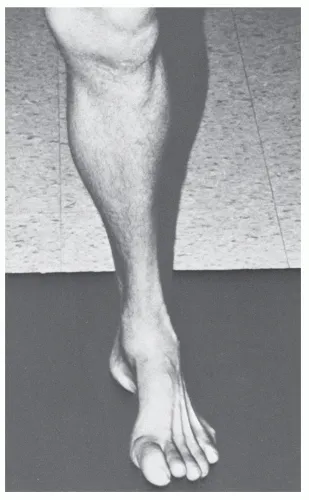
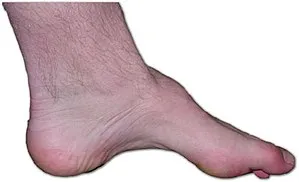
Investigations: electrodiagnostic studies; specific gene testing.
Management: refer to neurology for diagnosis. Management is supportive: physiotherapy/OT support; orthopaedic surgery for joint/foot deformities.