Open Fractures & Contaminated Limb Wounds
Last Update 5th September 2026
Open Fractures & Contaminated Limb Wounds
A fracture with any break in the overlying skin is an open fracture until proven otherwise — the wound does not need to sit directly over the fracture site, and it should be assumed to communicate with the bone regardless of where it lies. Open fractures carry a real risk of infection and non-union, and the single biggest modifiable factor is how quickly antibiotics go in.
For generic wound cleaning and suturing technique see Wound Care & Laceration Repair.
Classify it — Gustilo-Anderson
- Type I — wound under 1 cm, low energy, minimal soft-tissue damage.
- Type II — wound over 1 cm, low-to-moderate energy, moderate soft-tissue and muscle damage.
- Type III — high-energy, wound over 10 cm or significant contamination: IIIa severe soft-tissue crushing but adequate coverage, IIIb significant tissue loss needing flap coverage, IIIc any associated vascular injury.
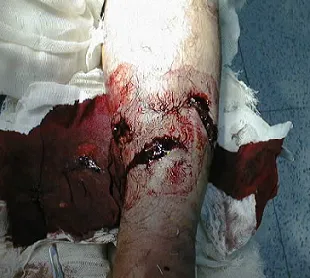
Image credit: Gustilo type 2 fracture.png — Doncovska, CC BY-SA 3.0, via Wikimedia Commons (https://commons.wikimedia.org/wiki/File:Gustilo_type_2_fracture.png).

You do not need a definitive Gustilo grade before referring — that’s usually confirmed in theatre — but noting size, contamination and soft tissue loss in your handover helps the receiving team triage.
The hour matters — antibiotics first
Antibiotic timing is the strongest driver of infection risk that urgent care controls directly. One study found antibiotics given within three hours of injury cut the infection rate roughly six-fold compared with later administration; a more recent study found a 0% infection rate when antibiotics were given within 66 minutes, rising to 17% beyond that. Don’t wait for X-ray, orthopaedic review or transfer to start antibiotics — give them as soon as the diagnosis is made. Infection risk tracks the zone of injury and the degree of periosteal stripping as much as the delay in treatment. Blunt-trauma open fractures carry higher infection rates than penetrating ones.
Cover gram-positive organisms for grade I–II wounds (a cephalosporin such as cefazolin); add gram-negative cover for grade III (an aminoglycoside such as gentamicin). Add high-dose penicillin for faecal or clostridial contamination, or a farmyard injury — clindamycin if truly penicillin allergic.
Every open fracture is a tetanus-prone wound — check vaccination status on every patient and give a tetanus-toxoid booster (dTpa) unless one has been given within the last 5 years; whether tetanus immunoglobulin is also needed depends on the wound and vaccination history, so involve the receiving team’s protocol rather than guessing.
Wound handling — photograph, then dress once
- Irrigate thoroughly — at least a litre of saline, or saline with an antiseptic — to remove gross contamination.
- Photograph the wound once, then cover it and leave it covered. Repeated uncovering to look at, photograph again, or show colleagues the wound measurably increases infection risk — get what you need the first time.
- Dress with a sterile or antiseptic-soaked dressing, and splint the limb in a well-padded splint to immobilise it for transfer.
- Do not attempt formal debridement or wound closure in urgent care — that is the receiving surgical team’s job.
Assessment before you get distracted by the wound
Open fractures usually follow significant trauma — check for other injuries and manage per standard trauma priorities (airway, breathing, circulation) before focusing on the limb. Assess and document distal neurovascular status and movement in every affected limb; a fracture fragment compressing a vessel needs the fracture reduced promptly rather than waiting for imaging. Air visible on X-ray in the soft tissues, or a visualised foreign body, also indicates an open injury even without an obvious skin wound.
Refer and transfer
Any open fracture needs urgent orthopaedic consultation and transfer to a service with theatre capability for formal debridement — this is not a “splint and review in clinic” injury regardless of how clean the wound looks. Definitive fixation timing is a surgical decision; your job is antibiotics, tetanus, a single clean dressing, splinting, and getting the patient there without delay. Formal debridement in theatre is time-sensitive without being a minutes-level race: current evidence supports debridement within 24 hours for type III fractures, and within 12 hours for type IIIB open tibia fractures, with antibiotics the priority in urgent care while awaiting transfer.