Bunions (Hallux Valgus) & Lesser-Toe Deformities
Last Update 25th August 2026
Bunions (Hallux Valgus) & Lesser-Toe Deformities
New page (2026): this common topic had no dedicated note — written from the AJGP 2020 review and established knowledge; flagged for verification.
Progressive deformity of the great-toe MTP joint: the great toe deviates laterally, the first metatarsal medially, producing a painful dorsomedial prominence. Adult prevalence ~23%; of Australian GP presentations, ~82% are female and ~80% aged ≥45. Bilateral deformity is common. The natural history is progression — long-term resolution with conservative care is unlikely.
Aetiology and assessment
- Exact cause unclear; strong heritable component (positive family history common). A causative link with footwear/high heels has not been shown. Pes planus and ligamentous laxity may contribute to the rare juvenile bunion (open growth plate, mostly girls).
- Pain is usually from the dorsomedial eminence; also transfer metatarsalgia (pain under the lesser MTP joints from loss of first-ray weight-bearing), associated hammer toes and plantar keratosis.
- Severe deformity alters gait and increases falls risk in the elderly.
- Examine the lower limb, foot and gait; check skin over the prominence (breakdown risk in diabetes/PVD). Weight-bearing AP, oblique and lateral X-rays before referral.
Non-operative management (first-line)
- Accommodative footwear — wide, deep toe box, low heel; podiatry for shoe stretching/modification (especially diabetes/PVD)
- Bunion cushion/padding over the medial eminence
- Orthotics (medial arch support; metatarsal dome for transfer metatarsalgia), toe spacers, splints/braces — may relieve symptoms but do not correct the deformity, and benefit may not last
- NSAIDs for pain (beware comorbidities in the elderly); avoid opioids.
A trial of non-operative care is advised, though a Cochrane review found limited overall benefit versus no treatment — set expectations accordingly.
Referral and surgery
- Refer to orthopaedics when there is a painful prominence, exhausted non-operative management and a suitable operative candidate — or urgently if impending skin breakdown/ulceration.
- Cosmesis alone is not an indication for surgery; pain relief is the goal, and footwear/cosmetic concerns can persist postoperatively.
- Smoking is a relative contraindication (wound complications, delayed union) — encourage cessation.
- Most patients get a corrective osteotomy (chevron/scarf ± soft-tissue procedure); severe deformity may need proximal osteotomy or TMT fusion; severe arthritis (hallux rigidus) may need MTP fusion. Simple bunionectomy has a high recurrence rate. Post-op: stiff-soled shoe, weight-bearing, ~6 weeks; no driving until back in normal footwear.
- Juvenile bunion: delay surgery until skeletal maturity where possible (recurrence and growth-plate risk).
Claw/hammer/mallet toe
Lesser-toe deformities, often associated with bunions/hallux valgus (above) and transfer metatarsalgia — distinguished by joint position:
| Claw Toe | Hammer Toe | Mallet Toe | |
|---|---|---|---|
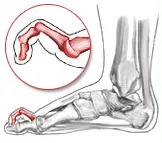 | 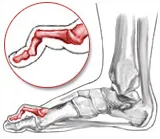 | 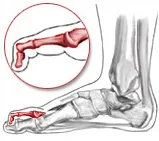 | |
| MTP | hyperextension | normal (slight extension) | normal |
| PIP | flexion | flexion | normal |
| DIP | flexion | extension | flexion |
- Hammer toe — the most common; usually the 2nd toe; typically older women; painful corns form over the prominent PIP joint. Good footwear helps less than expected, though a high toe box does; podiatry for foam/gel inserts; surgery if failing conservative care (common) — responds well.
- Claw toe — may follow neurological disease (classically polio; also consider peripheral neuropathy). Podiatry first, then surgical referral.
- Mallet toe — as above: podiatry, then surgery if refractory.