Back: Paediatric Spinal Deformity
Written 15th February 2020 - Last Update 25th August 2026
Back: Paediatric Spinal Deformity
Two structural spinal deformities of adolescence — scoliosis (coronal-plane curvature) and Scheuermann disease (sagittal-plane kyphosis).
Adolescent idiopathic scoliosis
- Demographics: adolescent females, from ~age 10.
- History: often asymptomatic — usually picked up on screening or incidentally.
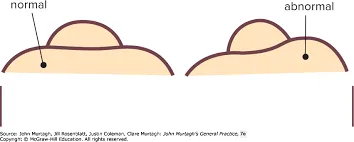
- Examination: the forward bend (Adams) test — have the patient bend forward as far as possible and look along the spine for asymmetric rib/ shoulder-blade prominence.
- Investigations: X-ray — measure the Cobb angle.
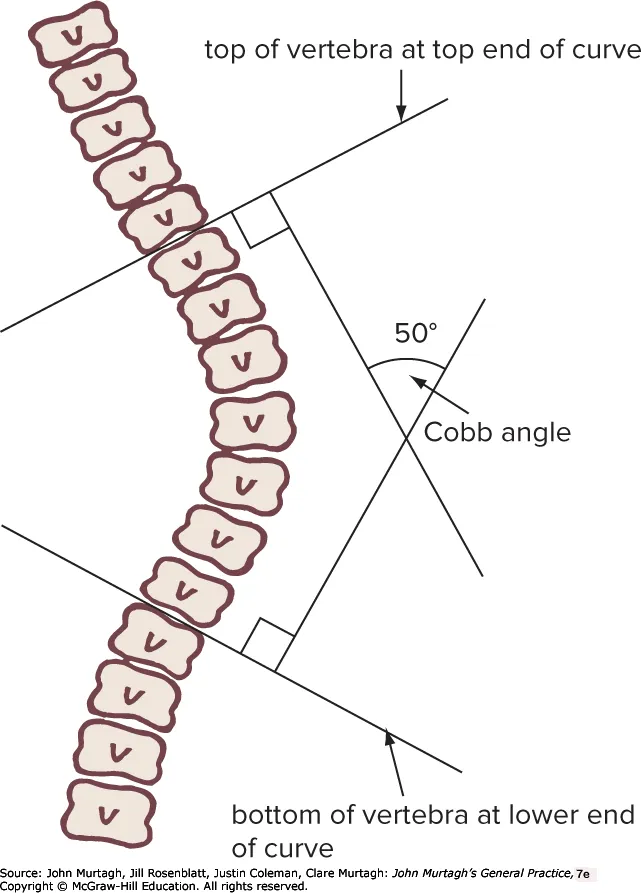
Management by Cobb angle:
| Still growing | Growth complete |
|---|---|
| <20° — observe | <45° — leave |
| 20–30° — optional brace | ≥45° — operate |
| 30–40° — brace | |
| >45° — operate |
Scheuermann disease
Adolescent structural thoracic kyphosis from anterior vertebral wedging. See also thoracic back pain (approach).
- Demographics: age 11–17; males > females.
- History: increasing thoracic kyphosis over 1–2 months.
- Examination: noticeable thoracic kyphosis; short hamstrings — cannot touch toes.
- Investigations: X-ray shows Schmorl’s nodes and anterior vertebral body wedging.
- Management:
- extension exercises and postural correction
- avoid sports involving heavy lifting or bending
- bracing or surgery for serious deformity.