Post-traumatic Stress Disorder
Written 28th May 2020 - Last Update 13th August 2026
Post-traumatic Stress Disorder
A maladaptive response to a potentially traumatic event (PTE) involving threatened or actual death, serious injury, or sexual violation — directly experienced or witnessed. Complex PTSD (an ICD-11 diagnosis) additionally involves emotional dysregulation, a negative view of self, and impaired relationships.
Diagnosis
DSM-5 describes four symptom clusters, present for more than 1 month (if <1 month, consider Acute Stress Reaction; if less severe, consider Adjustment Disorder):
- Re-experiencing — intrusive distressing memories, distressing dreams, or dissociative reactions; intense distress when reminded of the event.
- Avoidance — avoiding internal or external reminders.
- Negative cognitions (≥2 needed) — inability to recall an important aspect of the event; persistent negative expectations about self/others/the world; distorted self- or other-blame; reduced interest in activities, reduced positive emotion, or feeling detached from others.
- Altered arousal/reactivity (≥2 needed) — irritable/aggressive behaviour; reckless/self-destructive behaviour; hypervigilance or exaggerated startle; reduced concentration or sleep disturbance.
Epidemiology
50–75% of people report at least one potentially traumatic event (PTE) in their lifetime. Australian 12-month PTSD prevalence is 4.4%; lifetime prevalence in community samples is estimated at 5–10%. Risk factors for developing PTSD include gender, age at trauma, race, lower socioeconomic status, and previous trauma. Phoenix Australia guidelines identify Aboriginal and Torres Strait Islander peoples, refugees and asylum seekers, and military and ex-military personnel as special populations needing tailored guidance — veteran population estimates run around 8% lifetime and 5% current (point) PTSD prevalence, not a 12-month figure as this page previously stated.
Presentation
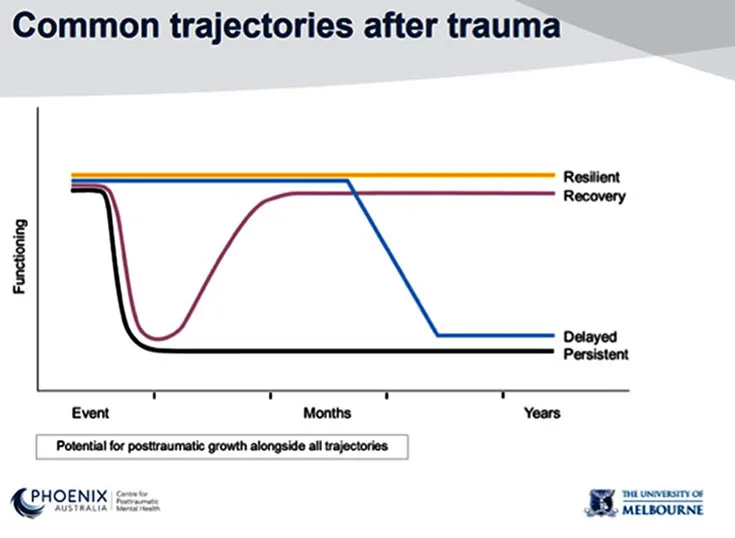
PTSD presents variably — sometimes with repeated non-specific medical complaints, or initially as comorbid depression. Most develops soon after the trauma, but presentation can be delayed by avoidance, stigma, or normalisation of symptoms. Delayed-onset PTSD is a recognised clinical phenomenon, though it can occasionally also reflect malingering where there’s secondary gain.
Management
Trauma-focused psychological treatment is first-line: trauma-focused CBT, cognitive processing therapy, or EMDR. These aim to help the patient confront distressing memories, reduce avoidance, re-address their interpretation of the event, and manage the associated arousal/distress.
Pharmacotherapy shouldn’t be used in preference to psychological therapy, but is appropriate for concurrent depression, or as an augmentation alongside psychological treatment:
- SSRIs with trial evidence: fluoxetine, paroxetine, sertraline (venlafaxine as an SNRI alternative) — but avoid paroxetine in young people given an increased risk of suicidal thoughts.
- Refractory cases may need an adequate trial of ≥2 SSRIs/SNRIs before other options are considered.
- For nightmares/sleep disturbance specifically, prazosin has been used (1 mg at night for 2 days, then 2 mg at night) — evidence is conflicting, so weigh this against other sleep strategies.