Arboviral Fevers
Written 12th August 2020 - Last Update 28th August 2026
Arboviral Fevers
Mosquito-borne viral febrile illnesses with an overlapping clinical picture (fever, rash, arthralgia) and differential diagnosis — see also malaria, Japanese encephalitis and filariasis for other mosquito-borne infections with a distinct clinical picture.
Dengue fever
A flavivirus spread by Aedes mosquitoes — widespread across South-East Asia and the South-West Pacific, and endemic in far North Queensland.
Murtagh triad — fever + severe aching (especially headache) + rash.
Clinical features: abrupt fever, malaise, headache, retro-orbital pain, severe backache, myalgia, nausea and prostration. Fever may subside for ~2 days then return (saddleback pattern). Rash: maculopapular (rubelliform) and often petechial (even without thrombocytopenia).
Severe (haemorrhagic) dengue — more likely on re-infection with a different serotype; may present with plasma leakage/shock, bleeding and abdominal pain, and can be life-threatening.
Investigations: FBC — leukopenia and thrombocytopenia. NS1 antigen (early) and dengue IgM/IgG (IgM best from ~day 5).
Management: supportive — fluids, rest and paracetamol. Avoid NSAIDs, aspirin and corticosteroids (bleeding risk) and avoid empirical antibiotics. Monitor for warning signs of severe dengue.
Zika
An Aedes-borne flavivirus, most common in Central/South America (no risk above ~2000 m). Also transmitted sexually and vertically (mother to fetus).
Most infections are asymptomatic. When symptomatic: mild fever, rash, arthralgia, conjunctivitis — a dengue-like syndrome, usually resolving in 4–7 days.
Complications: congenital microcephaly and other fetal anomalies; Guillain–Barré syndrome.
Investigations and management: Zika PCR and IgM/IgG — acute serum (within 5 days of onset) and convalescent serum (2–3 weeks later). To exclude asymptomatic infection after travel, test from 4 weeks after the last possible exposure. Supportive care (rest, fluids, paracetamol; avoid aspirin/NSAIDs until dengue excluded). Pregnancy/conception advice is central — avoid travel to active-transmission areas in pregnancy, and observe recommended waiting periods before conceiving after possible exposure (donating blood/travel- deferral rules apply, e.g. deferral before travel to receptive parts of Queensland).
Chikungunya
An Aedes-borne alphavirus with a dengue-like picture — abrupt fever with prominent, often prolonged polyarthralgia/arthritis; rash is common. Rarely haemorrhagic. Found in tropical South-East Asia, Indian Ocean islands, Africa, and the Americas.
Diagnosis: chikungunya IgM/IgG (± PCR early). Management: supportive (fluids, paracetamol; avoid NSAIDs/aspirin until dengue excluded). Arthralgia can persist for weeks to months. Vaccine: Ixchiq has been approved overseas (US FDA 2023) for travellers to endemic areas; confirm Australian availability/recommendation status before advising patients.
Ross River fever / Barmah Forest
Australia’s commonest mosquito-borne diseases — alphaviruses occurring in all states (more common in mosquito-prone areas), typically in the 20–40 age group.
Murtagh triad — polyarthritis + fever + rash.
Major: symmetrical polyarthritis (fingers, wrists, ankles, knees, feet), widespread maculopapular rash, myalgia. Minor: fever, headache, nausea, fatigue on exertion. Signs: joint swelling, tenosynovitis (wrists/ankles), rash, mild lymphadenopathy.
Investigations and management: Ross River / Barmah Forest virus IgM and IgG. Differential: viral hepatitis, rubella, dengue, rheumatoid arthritis, rheumatic fever. Supportive — reassurance (most resolve in 2–6 weeks; most feel normal by ~3 months; a minority have a chronic arthritic phase lasting 18 months+), rest, and analgesia (ibuprofen, paracetamol). Barmah Forest virus causes a very similar but usually milder illness.
West Nile fever
A Culex-borne flavivirus (birds are the reservoir), present in the USA, the Nile delta and the Middle East. Kunjin virus is the Australian subtype.
~80% asymptomatic. ~20% develop West Nile fever — fever, headache, fatigue, body aches, nausea/vomiting, rash, lymphadenopathy. ~1 in 150 develop neuroinvasive disease — high fever, neck stiffness, stupor/disorientation, coma, tremor, convulsions, weakness/paralysis.
Investigations and management: West Nile IgM/IgG. Neuroinvasive disease needs hospital admission; otherwise supportive care.
Yellow fever
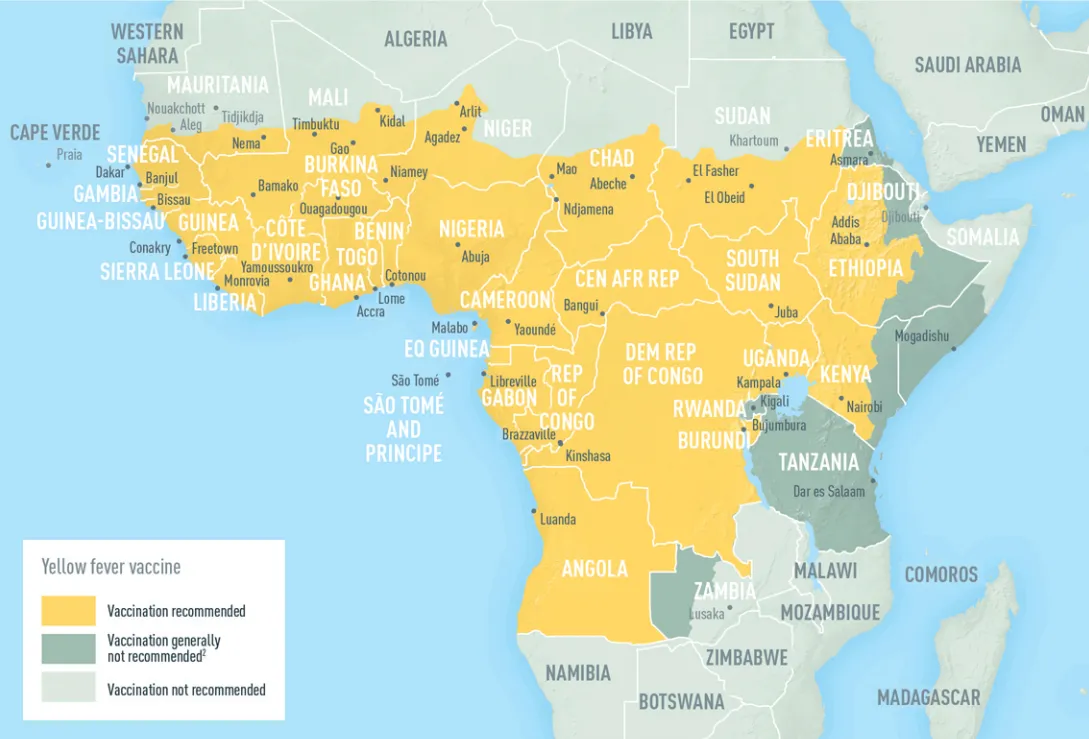
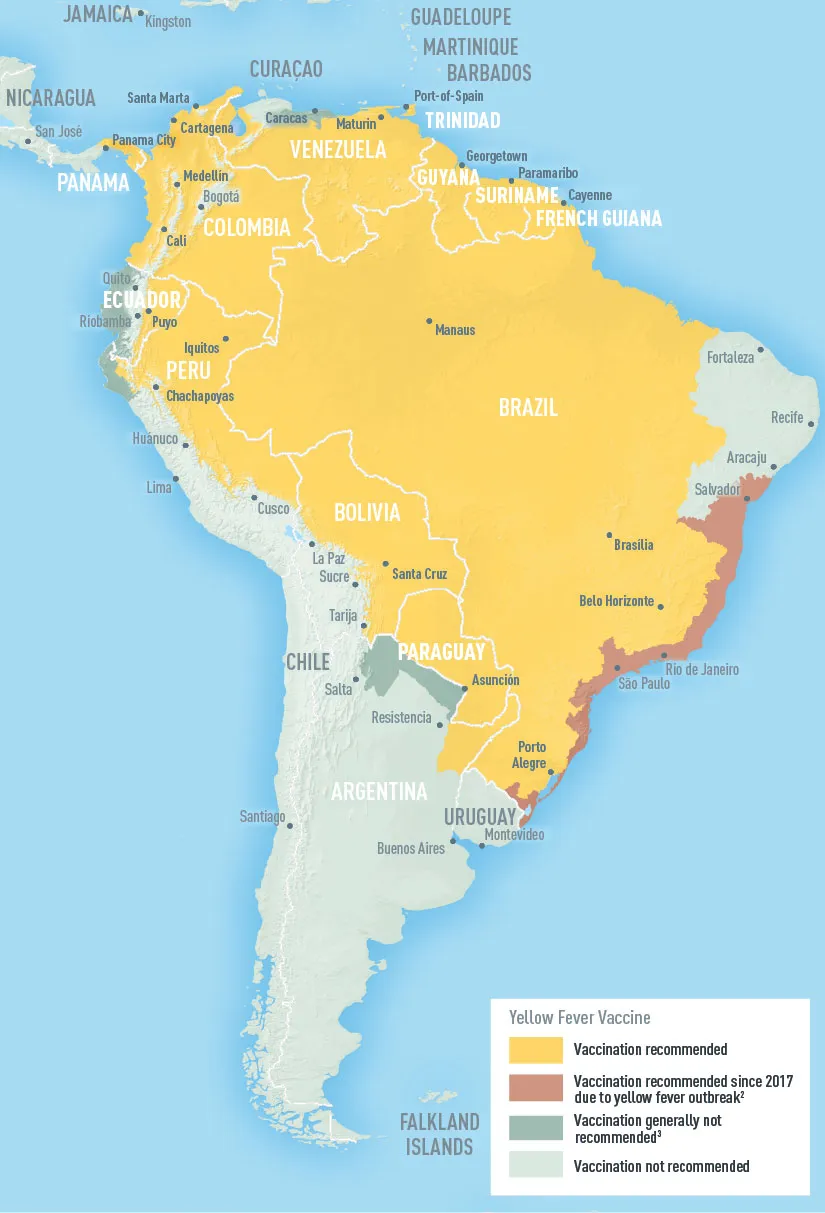
A mosquito-borne flavivirus of sub-Saharan Africa and tropical South America. A flu-like illness that can progress to severe disease (jaundice, haemorrhage, multi-organ failure) and death.
Vaccination: prevented by a live attenuated vaccine. A single dose now confers lifelong protection and certificate validity (WHO removed the 10-year booster requirement in 2016). Some countries require a valid International Certificate of Vaccination or Prophylaxis (ICVP) for entry.
Contraindications (live vaccine): infants <9 months; severe immunocompromise; thymus disorders (including myasthenia gravis).
Precautions:
- Age >60 — higher risk of serious adverse events, but vaccinate if genuine travel to an endemic area.
- HIV — may be given unless significantly immunocompromised.
- Pregnancy/breastfeeding — avoid unless travel to a high-risk area is unavoidable; advise against travel to risk areas instead.