Inherited Bleeding Disorders
Written 25th July 2020 - Last Update 30th August 2026
Inherited Bleeding Disorders
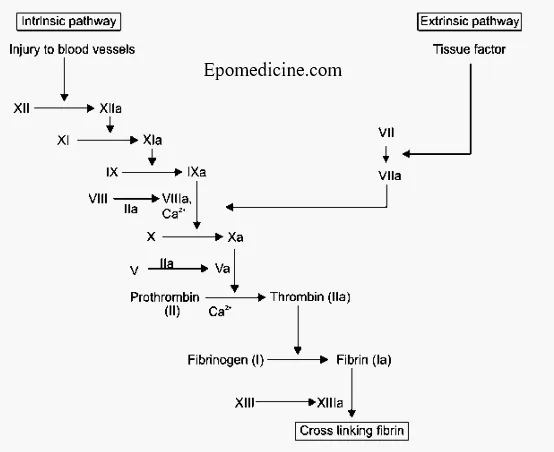
Coagulation screen by disorder:
| Haemophilia A/B | vWD | Vitamin K deficiency | |
|---|---|---|---|
| PT | Normal | Normal | ↑ |
| APTT | ↑ | ↑ | ↑ |
| TT | Normal | Normal | Normal |
| Platelets | Normal | Normal | Normal |
Pattern recognition:
- Mucocutaneous bleeding (menorrhagia, epistaxis, easy bruising, prolonged bleeding after dental work) → platelet-type/vWD pattern.
- Spontaneous haemarthroses and deep muscle bleeds → factor-deficiency (haemophilia) pattern.
- X-linked family history (affected males, carrier females) → haemophilia A/B. Autosomal history → vWD.
Von Willebrand disease (vWF deficiency + defective platelet adhesion)
The most common inherited bleeding disorder — affects ~1% of the unselected population, though clinically significant disease is closer to 125 per million.
Subtypes:
- Type 1 (~70-80% of cases) — partial quantitative vWF deficiency, autosomal dominant, incomplete penetrance. Usually mild.
- Type 2 (2A/2B/2N/2M) — qualitative vWF defects, autosomal dominant. 2A is the most common variant; 2B is hypersensitive to ristocetin-induced platelet aggregation.
- Type 3 — complete quantitative deficiency, autosomal recessive, severe bleeding.
Clinical features: equal sex incidence; normal platelet count; prolonged bleeding time; prolonged APTT with normal PT; positive vWF antigen; menorrhagia and epistaxis common; hemarthroses rare (unlike haemophilia) — a qualitative defect (type 2N) can mimic haemophilia and is sometimes misdiagnosed as such. Bleeding is worsened by aspirin/NSAIDs.
Diagnosis: vWF antigen, vWF activity (ristocetin cofactor assay — <30 IU/dL is diagnostic), and factor VIII activity. Platelet count and PT are normal.
Treatment:
- No specific treatment needed for most mild cases.
- Avoid aspirin, NSAIDs, and IM injections; caution with surgical/dental procedures.
- Desmopressin (DDAVP) — trial in type 1 and most type 2 (not 2B); raises vWF/factor VIII release from endothelium, response lasts up to 12 hours. Useful for minor bleeding and minor procedures. Type 3 does not respond (no vWF to release).
- vWF/factor VIII concentrate — for type 3, severe type 1/2, or when DDAVP response is inadequate, and for major bleeding/surgery.
- Tranexamic acid — useful adjunct for mucosal bleeding; avoid in gross haematuria (clot retention risk).
Haemophilia A (factor VIII deficiency) and B (factor IX deficiency, Christmas disease)
X-linked recessive — almost always only males affected; female carriers can rarely be symptomatic (skewed X-inactivation, or a haemophiliac father with carrier mother). Haemophilia A is more common (1 in 5,000 male births, ~80-85% of all haemophilia) than B (1 in 30,000).
Severity is set by residual factor activity:
- Severe (<1% activity) — spontaneous bleeding, usually presents in infancy.
- Moderate (1-5%) — bleeds with minor trauma; recurrent joint bleeds in up to 25%.
- Mild (5-40%) — bleeds only after significant trauma/surgery; often diagnosed incidentally.
Clinical features: spontaneous haemarthroses (knees, elbows, ankles) are almost pathognomonic and become more frequent with age; repeated joint bleeds cause haemophilic arthropathy. Prolonged APTT; normal PT, TT and platelet count — the two are distinguished only by specific factor VIII/IX assays. Older patients treated with plasma-derived factor concentrate before viral inactivation became standard may carry HIV/hepatitis B/C; a falling platelet count in this context should raise suspicion of HIV-associated ITP.
Treatment:
- Factor VIII (haemophilia A) or factor IX (haemophilia B) concentrate — for acute bleeds and prophylaxis; recombinant products preferred.
- Desmopressin (DDAVP) — an option for mild/moderate haemophilia A only (raises endogenous factor VIII); no effect on factor IX, so not useful in haemophilia B.
- Emicizumab — a bispecific antibody that mimics activated factor VIII; used for prophylaxis in haemophilia A, including patients with factor VIII inhibitors, under specialist care.
- Gene therapy — valoctocogene roxaparvovec (haemophilia A), etranacogene dezaparvovec (haemophilia B); specialist haematology only.
- Avoid aspirin/NSAIDs and IM injections.
- Inhibitors (alloantibodies against factor VIII/IX) complicate 20-30% of severe haemophilia A and 5-10% of mild/moderate disease — suspect when bleeding fails to stop despite factor replacement that previously worked; confirm with a Bethesda assay and manage with the haemophilia treatment centre.
When to refer: any suspected inherited bleeding disorder, or a patient with a known disorder facing surgery/dental work/pregnancy, goes to a haemophilia treatment centre or haematology — comprehensive-care models reduce joint damage and bleeding complications.