Smoking Cessation
Written 8th February 2020 - Last Update 15th August 2026
Smoking Cessation
Smokers over 50 have roughly a 50% lifetime chance of dying from a smoking-related disease. On average, a 40-year-old who smokes will have made around 20 unsuccessful quit attempts — treat relapse as expected, not a failure.
The 5A’s framework
Ask about smoking status at every opportunity → Assess nicotine dependence and barriers to quitting → Advise to quit, clearly and personalised to the patient → Assist with a quit plan and pharmacotherapy → Arrange follow-up.
Pharmacotherapy
| Option | Notes |
|---|---|
| Nicotine replacement therapy (NRT) | Patch or gum/lozenge/inhalator formulations; ~8–12% quit rate. Combination NRT (patch + a short-acting form) is more effective than either alone. |
| Varenicline (Champix) | Partial agonist at the α4β2 neuronal nicotinic ACh receptor — blocks nicotine binding (reducing reward) while the partial-agonist effect reduces withdrawal symptoms. The most effective single pharmacotherapy — 35–40% quit rate. Start 7 days before the target quit date. Dosing: 0.5mg once daily for 3 days → 0.5mg twice daily for 4 days → 1mg twice daily for 11–13 weeks. Main side effect is nausea, managed by the dose ramp-up. |
| Bupropion (Zyban) | An antidepressant (NDRI) also effective for smoking cessation; a second-line option to varenicline/combination NRT. |
Vaping (e-cigarettes) — TGA reforms since the original note
Nicotine vaping products became prescription-only in Australia from October 2021. Since then, three further reform dates matter:
- 1 January 2024 — import of single-use disposable vapes banned.
- 1 July 2024 — the Vaping Reforms Act 2024 commenced, creating one national framework: vapes can only be legally supplied through pharmacies, not general retail (tobacconists, vape shops, convenience stores) — and any doctor can prescribe a therapeutic vape under normal prescription arrangements, without the special-access-scheme approval previously required.
- 1 October 2024 — vapes with nicotine ≤20mg/mL became available without a prescription directly from a pharmacist (for patients aged 18+, pharmacist-assessed as clinically appropriate). A prescription is still required for higher-strength vapes or for anyone under 18.
RACGP’s position (Supporting Smoking Cessation guideline): vaping is a second-line cessation aid — offer it to adults who have tried and not succeeded with first-line therapy (combination NRT or varenicline), not as a first-line option, and not to people who don’t already smoke.
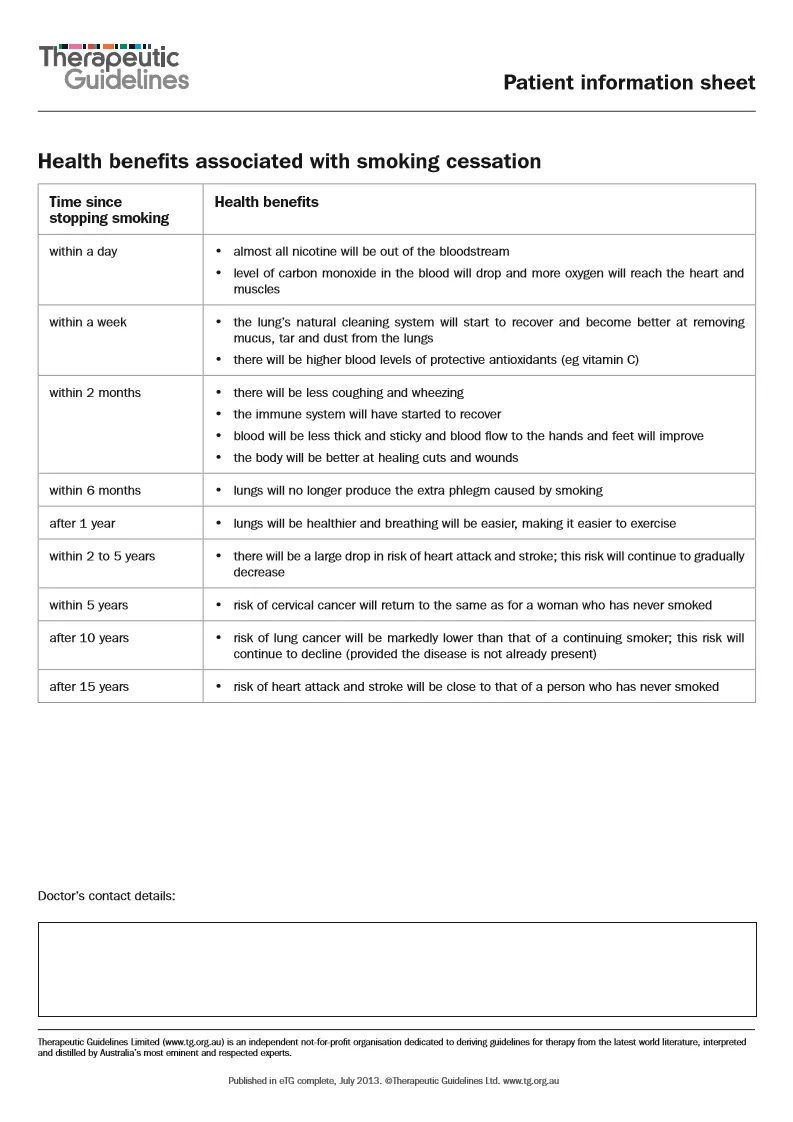
Health Benefits of Ceasing Smoking
See eTG’s patient information leaflet:
<<etg_health-benefits-associated-with-smoking-cessation_table8.3.pdf>>
(cited by name only per the eTG citation policy).