Metabolic Dysfunction-Associated Fatty Liver Disease (MAFLD)
Written 17th March 2020 - Last Update 10th July 2026
Metabolic Dysfunction-Associated Fatty Liver Disease (MAFLD)
Naming: MAFLD, not MASLD
Internationally, a 2023 multisociety Delphi consensus renamed NAFLD/NASH to MASLD/MASH (metabolic dysfunction-associated steatotic liver disease). GESA’s 2024 Australian primary-care consensus statement deliberately retained MAFLD instead: MAFLD has positive diagnostic criteria (steatosis plus overweight/obesity, type 2 diabetes, or ≥2 metabolic risk factors) and explicitly allows coexisting causes of liver disease — including significant alcohol use — to be present alongside it, matching how patients typically present, undifferentiated, in primary care. MASLD, by contrast, requires excluding significant alcohol use and other liver disease first. Both terms describe largely the same condition; this page uses MAFLD, as GESA recommends for Australian primary care.
Why it matters
NAFLD/MAFLD is generally benign but can progress to significant hepatic inflammation and fibrosis (historically termed NASH/MASH); up to 20% of those with steatohepatitis progress to cirrhosis and hepatocellular carcinoma (HCC), and up to 40% of those with cirrhosis die from liver-related disease. MAFLD is the most common liver condition in Australia and worldwide, and the incidence of MAFLD-related cirrhosis and HCC is rising.
Who should be assessed
Adults with obesity, type 2 diabetes, or ≥2 metabolic risk factors (central obesity, hypertension, hypertriglyceridaemia, low HDL, or prediabetes) should be assessed for MAFLD. NAFLD/MAFLD affects an estimated 25–45% of people and is strongly associated with obesity and type 2 diabetes.
History: often asymptomatic; ask about impaired glucose tolerance, insulin resistance, dyslipidaemia, and alcohol intake, medications, and risk factors for viral hepatitis/iron overload (needed to exclude other causes).
Examination: BMI and waist circumference (central obesity); blood pressure; signs of chronic liver disease/hepatomegaly (bruising, leukonychia, clubbing, palmar erythema, spider naevi, gynaecomastia).
Diagnosis and initial work-up
Liver ultrasound is the first-line test to diagnose hepatic steatosis in those at high risk. Baseline investigations: LFTs (AST/ALT), FBC, INR, fasting glucose or HbA1c, fasting lipids. In those with elevated aminotransferases, evaluate for hepatitis B/C and iron overload. Screen for harmful alcohol use, and assess for other common causes of steatosis and liver disease in everyone.
Assessing liver fibrosis risk
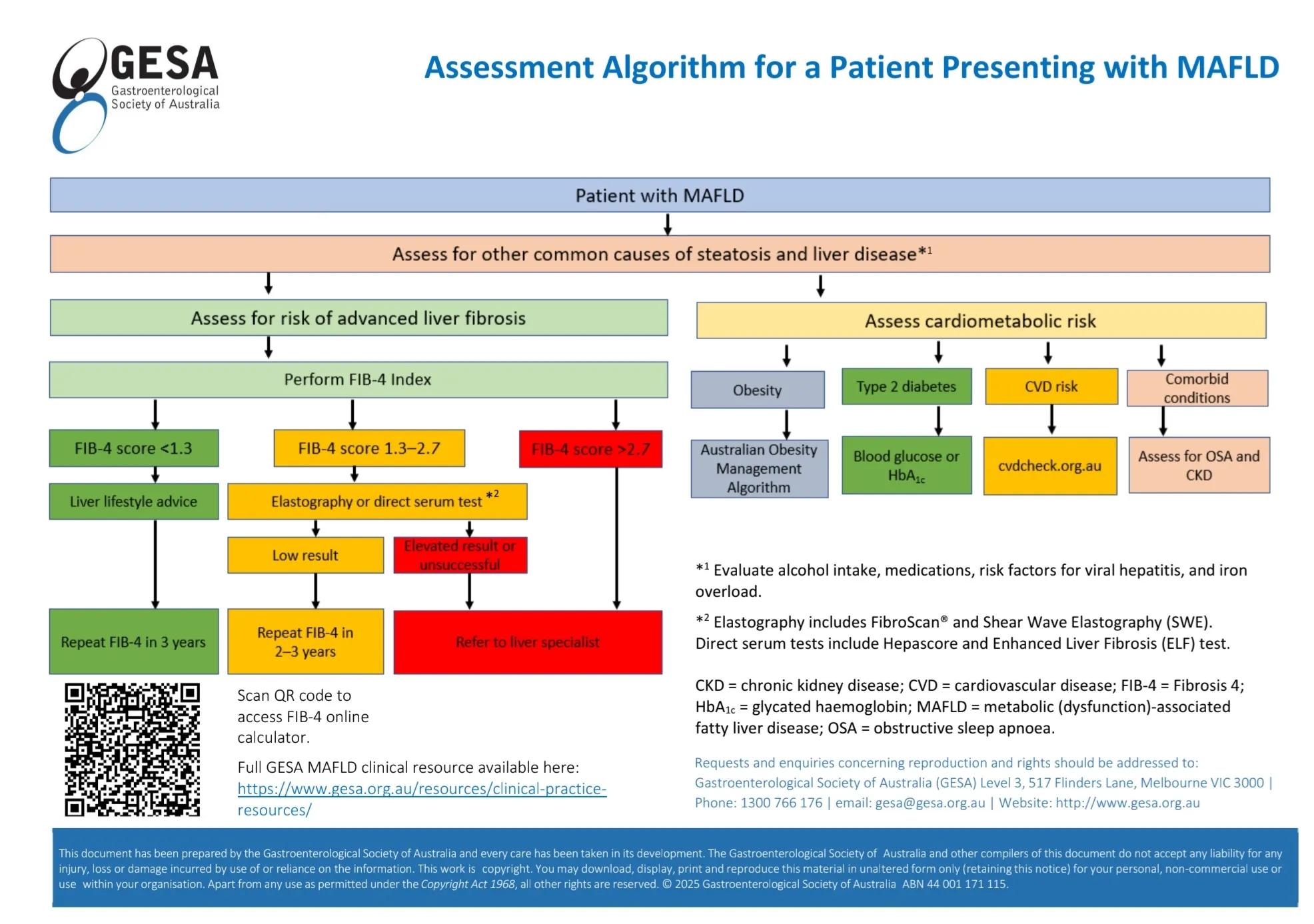
This is the area with the clearest updated guidance. GESA recommends the FIB-4 Index as the first-line non-invasive test to help “rule out” advanced liver fibrosis (a free online calculator is available; the GESA algorithm image below has a QR code link):
- FIB-4 <1.3 (low risk) — >95% negative predictive value for advanced fibrosis. Give liver-healthy lifestyle advice; repeat FIB-4 in 3 years.
- FIB-4 1.3–2.7 (indeterminate) — second-line testing with liver elastography (FibroScan/vibration-controlled transient elastography, or shear wave elastography) or a direct serum fibrosis test (Hepascore, Enhanced Liver Fibrosis/ELF test). If unavailable, refer to a clinician with liver expertise. A low second-line result → repeat FIB-4 at least every 3 years; an elevated or unsuccessful result → refer.
- FIB-4 >2.7 (high risk), or elevated direct serum/elastography results, or clinical/laboratory/imaging evidence of cirrhosis → refer to a liver specialist.
This replaces the note’s original approach of the NAFLD Fibrosis Score (age, BMI, diabetes/impaired fasting glucose, AST, ALT, platelets, albumin) as the primary triage tool — FIB-4 is now GESA’s recommended first-line test, with the NAFLD Fibrosis Score/Fibroscan as before mainly relevant as an alternative or second-line option.
Assessing and monitoring comorbidities
GESA frames MAFLD assessment as inseparable from cardiometabolic risk assessment, alongside the liver-specific work-up above:
- Obesity — assess per the Australian Obesity Management Algorithm.
- Type 2 diabetes — screen with fasting glucose or HbA1c if not already diagnosed; monitor for incident diabetes per current Australian guidelines.
- Cardiovascular disease risk — assess/monitor per current Australian guidelines (e.g. cvdcheck.org.au).
- Obstructive sleep apnoea and chronic kidney disease — consider baseline assessment for both.
- Monitor weight, BMI and/or waist circumference at least annually.
Management
Lifestyle modification remains first-line: diet, exercise and behavioural therapy, and controlled/slow weight loss — even 5% weight loss can produce histological improvement in steatohepatitis. Manage blood glucose and lipids alongside this.
Follow-up: low-risk patients on the FIB-4 pathway are followed as above (repeat FIB-4 at least every 3 years). For people ≥75 years, ongoing fibrosis monitoring should be individualised by comorbidities and life expectancy rather than applied routinely.
Cirrhosis: patients with confirmed or suspected cirrhosis need referral to a clinician with liver expertise. Those with cirrhosis who are candidates for HCC therapy should have 6-monthly HCC surveillance with imaging ± serum AFP. Acute referral is still required for abnormal LFTs with bilirubin 100–200, ascites, or encephalopathy.