Hearing Loss — Acute & Chronic
Written 3rd July 2020 - Last Update 27th August 2026
Presentation: Loss of Hearing — Acute and Chronic
Sensorineural hearing loss
Sudden loss (<72 hours): the aetiology of sudden sensorineural hearing loss (SSNHL) is often unclear, but may include viral cochleitis, microvascular events, or autoimmune inner ear disease. Patients often awaken with sudden hearing loss. Spontaneous improvement occurs in about 2 in 3 patients, but recovery may not be complete — more likely in younger patients and where losses mainly affect higher tones.
The cause is idiopathic in over 70% of cases. Where a cause is found, it is most often infectious/inflammatory (often viral), neoplastic, autoimmune, vascular, traumatic, or iatrogenic. Bilateral SSNHL is exceedingly rare, but it can occur. When it does, consider ototoxic medication (e.g. aminoglycosides or chemotherapy), syphilis, or certain autoimmune or vascular conditions. Patients with bilateral SSNHL are often older, have a positive antinuclear antibody titre, and have a higher prevalence of vascular disease.
SSNHL is a time-critical emergency — treat urgently with high-dose corticosteroids to reduce cochlear damage from the underlying inflammatory process, with the aim of preserving long-term hearing function. Arrange urgent ENT review (via emergency if needed) rather than waiting for outpatient assessment — earlier treatment gives better odds of hearing recovery. Antiviral drugs are sometimes added on the theory that the deafness has a viral cause. A Cochrane review of four randomised trials (257 participants) found no statistically significant advantage in the use of antivirals in the treatment of idiopathic sudden sensorineural hearing loss when added to steroid therapy.
For SSNHL presenting more than 30 days after onset, urgent ENT referral should still be arranged to assess candidacy for intra-tympanic corticosteroid injection — steroid infiltrated directly into the middle ear space, diffusing via the round window into the inner ear. A systematic review and meta-analysis found intra-tympanic dexamethasone equivalent to oral steroid therapy as primary treatment, but with greater improvement in hearing outcomes as salvage treatment, with a mean improvement of 13.3 decibels.
Hyperbaric oxygen therapy (HBOT) is a reasonable adjunct for acute ISSHL, best started early. A Cochrane review of seven small, generally poor-quality trials (392 participants) found an absolute improvement in average pure-tone audiometric threshold following HBOT, with a mean difference 15.6dB greater with HBOT. There was a 22% greater chance of improvement with HBOT, with a number needed to treat of 5 to achieve one extra good outcome. The review found no evidence of a beneficial effect of HBOT on chronic ISSHL — loss present six months or more — and its authors do not recommend the use of HBOT for chronic hearing loss. The best results are seen when treatment starts within 14 days of symptom onset, typically combined with steroids. Treatment pressure is usually 2.0–2.5 ATA for 90 minutes daily, for 10 to 20 sessions depending on response. Middle-ear barotrauma is the most common complication of hyperbaric oxygen therapy, occurring in around 13% of treatments and usually self-limiting. In Australia, there are nine publicly funded hyperbaric facilities with comprehensive cover, worth considering for referral where HBOT may be of benefit.
Long-standing loss (>30 days) — consider:
- Presbycusis (age-related sensorineural hearing loss) — progressive, symmetrical, high-frequency hearing loss with ageing. It is the most common cause of hearing loss worldwide and is estimated to affect approximately two-thirds of adults aged 70 or older. The World Health Organization estimates that by 2025, among those aged 60 and above, greater than 500 million will have significant age-related hearing loss. Hearing aids are the mainstay of treatment and have been shown to have a significantly positive effect on quality of life and communication. Cochlear implants can be offered to patients with severe bilateral hearing loss that is not improved with hearing aids. Presbycusis is a diagnosis of exclusion — an acute, unilateral, or neurologically-associated presentation should prompt referral rather than being attributed to ageing alone.
- Acoustic neuroma — a benign 8th cranial nerve tumour (vestibular schwannoma). Presents with unilateral sensorineural hearing loss, often with unilateral tinnitus, vertigo, and occipital pain, ± other 8th nerve symptoms. Found in ~6% of patients presenting with asymmetrical sensorineural hearing loss. Vestibular schwannomas have an average growth rate of 1.4mm per year. Observation may be considered in patients with small tumours under 1.5cm, multiple medical comorbidities, no growth, and stable symptoms. A large review of 1000 vestibular schwannoma resections found a 98% complete resection rate with a 68% hearing preservation rate and 1.1% mortality. Hearing preservation was significantly higher with radiosurgery than with microsurgery in a retrospective comparison, at 57.5% versus 14.4%, and other reviews have confirmed preservation rates approaching 70% with radiosurgery compared to 37.5% with surgery. Multiple tumours in the same patient should bring attention to syndromic associations such as neurofibromatosis type 2, schwannomatosis, and Carney complex.
- Ménière’s disease — paroxysmal attacks of vertigo (± vomiting), tinnitus, and unilateral deafness. It is a condition characterised by two episodes or more of vertigo with aural symptoms (hearing loss, aural fullness, tinnitus). The vertiginous episodes typically last from 20 minutes to 12 hours. The hearing loss is predominantly a low frequency SNHL, and the tinnitus is characteristically “roaring” in nature. The underlying mechanism is thought to be endolymphatic hydrops — an increase in the pressure of the fluids in the chambers of the inner ear. Diuretics are commonly used to try to reduce vertigo, hearing loss, tinnitus, and aural fullness. However, a Cochrane review found there is no good evidence about the effect of diuretics on the symptoms of Ménière’s disease, and further research is needed — there were no trials of high enough quality to meet the review’s inclusion standard. If a patient with SSNHL experiences concomitant vertigo, this typically indicates a poorer prognosis for recovery of hearing loss.
Asymmetric sensorineural hearing loss is defined as a difference between ears of >10dB across 2 consecutive frequencies (bone conduction), or >15dB at 1 frequency (bone conduction), without a clear cause (e.g. trauma or noise-induced loss).
Causes of sudden-onset hearing loss (SOHL) by anatomical site
Outer ear (conductive): foreign body; wax; otitis externa; other ear canal pathology (e.g. exostoses); trauma (syringing).
Middle ear (conductive): otitis media with effusion; haemotympanum; ossicular chain discontinuity; trauma; barotrauma; iatrogenic (post-operative); tympanic membrane perforation; cholesteatoma.
Inner ear (sensorineural): idiopathic; infective (viral/bacterial — HIV, CMV, HSV, mumps, rubella, syphilis); noise-induced; trauma (temporal bone fracture); ototoxic drugs; autoimmune (SLE, granulomatosis with polyangiitis, Cogan syndrome, relapsing polychondritis, ulcerative colitis); tumour (vestibular schwannoma, leukaemia, myeloma); vascular (cerebrovascular disease, sickle cell disease); perilymphatic fistula; barotrauma; neurological (multiple sclerosis, CVA, migraine); other (diabetes, sarcoidosis); non-organic hearing loss.
Red flags for SOHL
Concurrent head trauma; neurological signs or symptoms; unilateral middle ear effusion (examine the post-nasal space).
SSNHL is defined as hearing loss of ≥30dB over at least 3 contiguous frequencies, over ≤72 hours. Some definitions instead use a lower threshold over a shorter window — a 10–20dB loss across 2–3 frequencies within 12 hours. Hearing loss can range from mild impairment to total loss, and may be temporary or permanent — regardless of cause or degree, rapid assessment and early treatment is vital.
Assessment
Conditions affecting the external and middle ear typically cause conductive hearing loss (CHL); inner ear conditions typically cause sensorineural hearing loss (SNHL) — though not mutually exclusive, and a combination gives mixed hearing loss. Clinical pearl: otoscopic examination in SSNHL is usually normal, whereas acute hearing loss secondary to conductive causes more often has a positive finding. Clinical examples of sudden conductive hearing loss include otitis externa (pain, swelling and purulent canal debris), otitis media (pain, red TM ± fevers), and acute TM perforation from infection or barotrauma.
History: which ear, or both? Associated/precipitating activity (physical or acoustic trauma, foreign body, infection)? Medical history of autoimmune disease, diabetes, vascular disease, sarcoidosis? Medication history of ototoxic drugs (aminoglycosides, frusemide, NSAIDs, quinine, high-dose salicylates, cisplatin)? Family history of otosclerosis? Risk factors for acoustic neuroma — unilateral tinnitus, vertigo, family/personal history of neurofibromatosis type 2.
Examination: head and neck for lymphadenopathy; bony sinuses for tenderness (mainly mastoid); cranial nerve exam; otoscopy for canal/TM abnormalities. Tuning fork test (512Hz) for bone/air conduction (Rinne and Weber). Take care interpreting Rinne’s test in total SNHL (a “dead” ear) — bone conduction can sound louder than air conduction on the affected side, giving a false-negative (“conductive-pattern”) result. Free-field testing — stand 60cm behind the patient and have them repeat a whispered word; if unable to hear, repeat at 15cm (doesn’t differentiate SNHL from CHL, but useful as a screening step before formal audiometry).
Investigations
Arranged by the GP or ENT specialist depending on local resources and access — especially important if there’s a poor initial response to treatment.
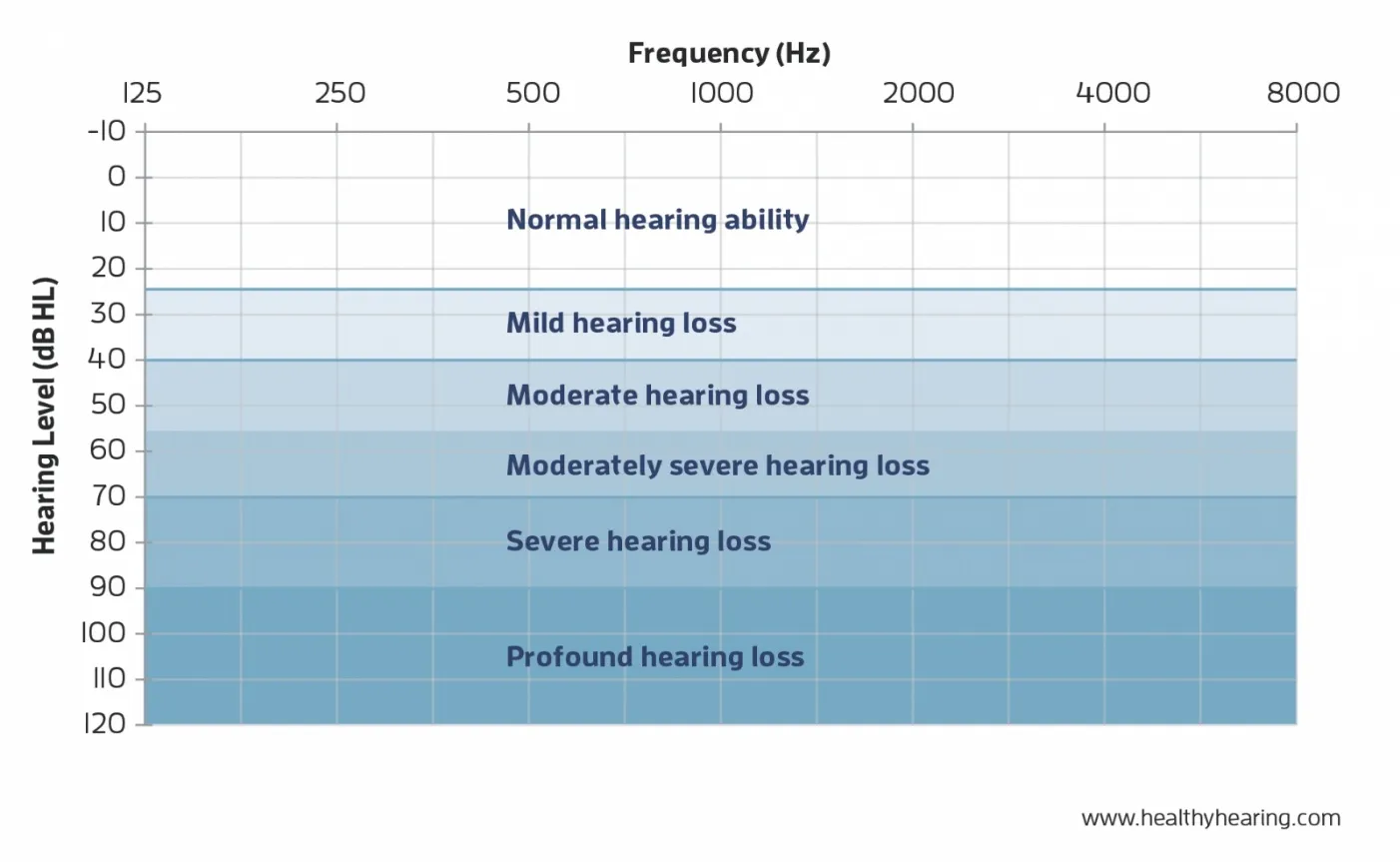
Pure tone audiogram (PTA) is the initial audiological test, distinguishing CHL from SNHL via air and bone conduction thresholds; determines presence, degree, and type of hearing loss. Serial PTAs track treatment response. Most speech falls in the 250–6000Hz range; normal hearing is 0–25dB across the frequency range — inability to hear at 25dB indicates an abnormality. Audiogram remains the gold-standard, most definitive test for diagnosing SSNHL; if a same-day audiogram isn’t available, do not delay corticosteroid treatment while awaiting it, since delay to treatment worsens outcomes.
Tympanometry assesses tympanic membrane mobility and middle ear function — fluid in the middle ear gives a “flat” trace (type B tympanogram), consistent with CHL.
Flexible nasoendoscopy (or mirror examination of the nasopharynx) visualises the post-nasal space for possible masses.
The most recently updated guidelines and systematic review from the American Academy of Otolaryngology Head and Neck Surgery do not recommend obtaining routine laboratory tests in patients with idiopathic SSNHL, though a tailored clinical approach is still recommended if an underlying aetiology such as vascular or autoimmune disease is suspected.
If sudden SNHL, arrange urgent ENT review (via emergency) and consider, guided by clinical suspicion rather than as a routine bundle, blood tests: FBC; ESR; U&E; fasting BGL; fasting cholesterol/triglycerides; viral titres (HIV, CMV, HSV, mumps, rubella); FTA-Abs for syphilis (or VDRL); Lyme titres (rare — consider for patients returning from endemic areas); TFTs/anti-thyroid antibodies; ACE; ANCA; ANA; rheumatoid factor; anti-CCP; antiphospholipid antibodies.
Imaging: MRI if suspected vestibular schwannoma, demyelination, or small-vessel ischaemia; CT if suspected acoustic neuroma or to evaluate the middle ear ossicles. MRI of the internal acoustic meatus with contrast is the most sensitive and specific test for detecting retrocochlear pathology and can detect cerebellopontine angle tumours as small as 1 or 2mm. It is recommended that an MRI be performed within three months of onset in all patients with SSNHL.
Management
Management depends on the cause (see individual condition pages) — except SSNHL, which needs urgent high-dose corticosteroids regardless of the underlying cause being worked up, given the narrow window for preserving hearing. Patients who have experienced only one episode of SSNHL, particularly when idiopathic, are unlikely to have another episode, but should understand the emergency nature of any recurrence. A repeat audiogram in 6–12 months to ensure hearing levels are stable might be useful. Hearing rehabilitation devices are generally indicated, particularly if the hearing loss is moderate–severe or if it is affecting the patient’s quality of life. In Australia, patients aged under 26 or over 75 are eligible for a government hearing aid subsidy — worth flagging to patients near either threshold.