Acute Otitis Media
Written 2nd July 2020 - Last Update 28th August 2026
Acute Otitis Media
Condition
Commonly a viral infection, but can be bacterial or have both a viral and bacterial aetiology. Regardless of cause, usually self-limiting — spontaneous resolution occurs in more than 80% of children within 2–3 days. In bacterial AOM, the most common pathogens are Streptococcus pneumoniae, non-typeable Haemophilus influenzae, and Moraxella catarrhalis.
Acute otitis media is common and age-concentrated: peak incidence is between 6 and 12 months of age, and around 80% of children experience at least one episode during childhood, becoming much less frequent after age 5 as the angle of the Eustachian tube changes with growth. Pain resolves without treatment in around 60% of children within 24 hours and 80% within 3 days; children under 2 years are less likely to resolve spontaneously and more likely to need antibiotics for that reason alone.
Risk factors
A preceding viral upper respiratory tract infection is the single most common risk factor, via Eustachian tube dysfunction. Others include: absence or shorter duration of breastfeeding; passive smoke exposure and daycare attendance (repeated exposure to large numbers of other children, at home or in day care, is one of the most important sociodemographic risk factors); male sex; adenoid hypertrophy; pacifier use; immunocompromise (including HIV, diabetes, and primary immunodeficiencies); gastro-oesophageal reflux; craniofacial or palatal abnormalities impairing Eustachian tube function (e.g. cleft palate); and a family history of recurrent AOM in a parent or sibling. Lower socioeconomic status is also independently associated with higher risk.
Diagnosis
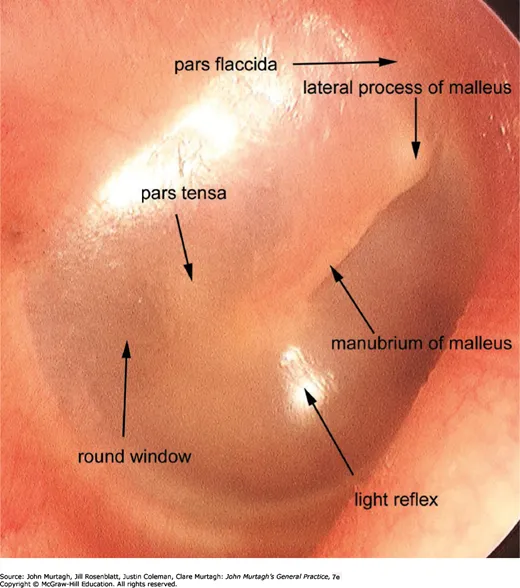
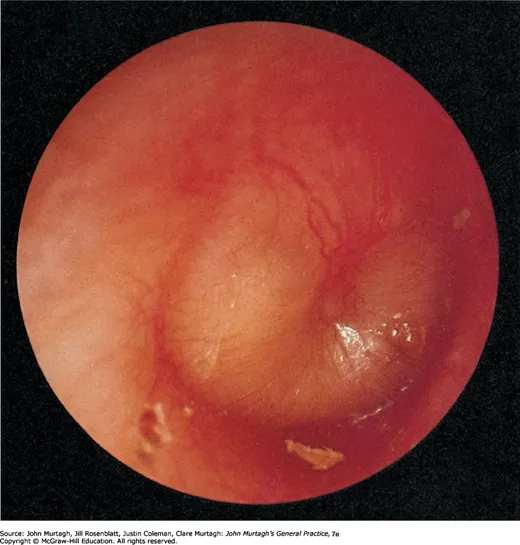
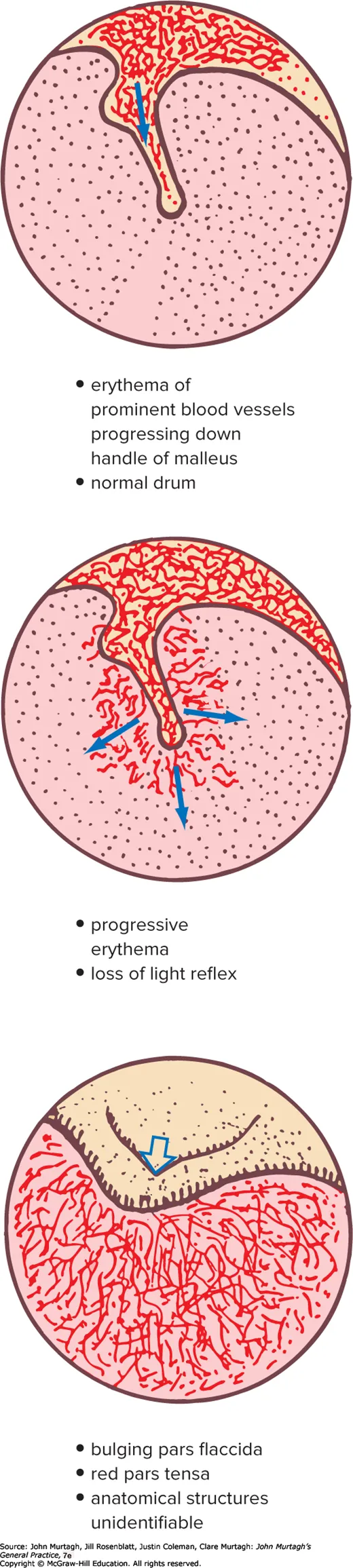
Characterised by middle ear inflammation and middle ear effusion. Diagnosed if there is acute onset of either:
- Bulging of the tympanic membrane (strongly suggestive of middle ear inflammation).
- Otorrhoea (indicative of tympanic membrane perforation and middle ear effusion, provided acute diffuse otitis externa has been excluded).
Management
Adequate and regular analgesia is the mainstay of treatment, whether or not antibiotics are used. For most children, antibiotic therapy can be safely withheld.
Antibiotics are required for:
- Infants younger than 6 months.
- Children younger than 2 years with bilateral infection.
- Children who are systemically unwell (e.g. lethargic, pale, very irritable) — fever alone is not an indication.
- Children with otorrhoea.
- Aboriginal and Torres Strait Islander children — see the Recommendations for clinical care guidelines on the management of otitis media in Aboriginal and Torres Strait Islander populations.
- Children at high risk of complications (e.g. immunocompromised).
For other children, antibiotic therapy has limited benefit (shared decision-making): initial antibiotic therapy doesn’t improve pain at 24 hours; for every 100 children treated, only 5 will be better at 2–3 days as a result; antibiotics only shorten symptom duration by ~12 hours; and antibiotics can cause harm (diarrhoea, rash, more serious hypersensitivity reactions, bacterial resistance).
Advise the patient/carer to return if symptoms worsen or don’t improve within 48–72 hours — antibiotics may be required then. Alternatively, offer a delayed prescription if the patient won’t be able to return.
Antibiotic regimen: amoxicillin (15mg/kg) 500mg three times daily for 5 days, or amoxicillin (30mg/kg) 1g twice daily for 5 days, or cefuroxime (15mg/kg) 500mg twice daily for 5 days, or trimethoprim/sulfamethoxazole (4+20mg/kg) 160+800mg twice daily for 5 days.
Inadequate response by 48–72 hours: amoxicillin/clavulanate (22.5+3.2mg/kg) 875+125mg twice daily for 5–7 days (age ≥2 months), or (15+3.75mg/kg) three times daily for 5–7 days (age 1–2 months).
Chronic otorrhoea: oral antibiotics plus ciprofloxacin 0.3% ear drops, 5 drops twice daily until free of discharge for at least 3 days.
Complications
Complications are grouped as intratemporal (tympanic membrane perforation, cholesteatoma, tympanosclerosis, mastoiditis, labyrinthitis, facial nerve palsy, and progression to chronic suppurative otitis media) and intracranial (meningitis, subdural empyema, brain abscess, extradural abscess, lateral sinus thrombosis, otitic hydrocephalus) — the intracranial group is rare but carries significant morbidity and mortality. Mastoiditis was the most common life-threatening complication of otitis media in the pre-antibiotic era; it is now rare in developed countries, though risk remains elevated in the same groups already flagged for mandatory antibiotic treatment above (Aboriginal and Torres Strait Islander children in remote communities, children with immunodeficiency syndromes). Recurrent or persistent disease in the 6–24-month age window is the main driver of long-term harm, since conductive hearing loss during this critical period can impair speech and language development.
High-risk population management algorithms
For high-risk populations (per the ATSI otitis media clinical care guidelines), management of AOM without perforation follows a structured review-and-escalation pathway: analgesia; amoxicillin 50mg/kg/day for at least a week; review at 4–7 days; if the bulging eardrum persists, continue high-dose amoxicillin (90mg/kg/day) for another week and review weekly; discuss prophylactic antibiotics (amoxicillin 25–50mg/kg once or twice daily) if there have been ≥3 episodes in the last 6 months or ≥4 in the last year (recurrent AOM). AOM with perforation follows a similar structure, adding topical antibiotics (e.g. ciprofloxacin 2–5 drops 2–4 times daily after dry-mopping) if discharge/bulging persists after 4–7 days — persistent discharge through an easily visible perforation for weeks despite appropriate treatment defines chronic suppurative otitis media (see Chronic Suppurative Otitis Media).
Recurrent otitis media
Risk factors for recurrent bacterial otitis media: group child care; allergic rhinitis; adenoid disease; structural anomalies (e.g. cleft palate, Down syndrome); smoke exposure (cigarettes, wood fires); socioeconomic disadvantage (e.g. crowded housing).
Management: ensure the child is up to date with Streptococcus pneumoniae vaccination (Prevenar 13). If recurrent infection occurs, manage as for acute otitis media above and consider referral to an otolaryngologist. Frequent recurrences may require myringotomy and insertion of tympanostomy tubes (grommets) — insertion of tympanostomy tubes appears to reduce acute otitis media, with an effect similar to antibiotics. Antibiotic prophylaxis reduces acute otitis media episodes only modestly (e.g. from 1 to 0.94 episodes per year).