Osteoporosis
Written 18th June 2020 - Last Update 27th August 2026
Osteoporosis
Definition
Low bone mineral density (BMD) and micro-architectural deterioration of bone tissue, leading to decreased bone strength and increased fracture risk.
Defined by T-score — the SD difference between a patient’s BMD and that of a healthy young adult of the same sex:
| T-score | Category |
|---|---|
| > -1.0 | Normal |
| -1.0 to -2.5 | Osteopenia |
| < -2.5 | Osteoporosis |
Demographics
- Women > Men; risk increases with age
- Age 50–69: 3% of men, 13% of women
- Age >70: 13% of men, 43% of women
History & Examination
- Silent disease — generally asymptomatic
- Vertebral fractures often cause no symptoms; suspect in patients with acute low back pain and fracture risk factors, though this presentation only occurs about a third of the time
- Minimal trauma fracture (a fracture from a fall from standing height or less) may be the first presenting symptom
- >3 cm loss of height on examination is suggestive of an underlying vertebral crush fracture
Risk Factors
Major risk factors:
- Female sex
- Age >70
- History of minimal trauma fracture
- Height loss >3 cm and/or back pain suggestive of vertebral fracture
- History of falls
- Family history of hip fracture (parental)
- Premature menopause / hypogonadism
- Prednisone >7.5 mg for >3 months
- BMI <20
- Low physical activity
- Poor balance
- Relevant medications or medical conditions (below)
Other risk factors: smoking, alcohol >2 units/day, vitamin D deficiency.
Medications: glucocorticoids, excessive thyroxine, anti-androgen/oestrogen therapy, SSRIs, glitazones, PPIs, some anti-epileptics, some antipsychotics.
Medical conditions: rheumatoid arthritis, Cushing syndrome (endo/exogenous), hyperparathyroidism, hyperthyroidism, CKD, chronic liver disease, coeliac disease/malabsorption, depression, organ or bone marrow transplant, HIV, diabetes.
Investigations & Risk Assessment
DXA (dual-energy X-ray absorptiometry) is the gold standard for detecting osteoporosis. Detection relies on screening at-risk individuals.
Practical assessment: if someone >50 (postmenopausal woman, or man >50) has a minimal trauma fracture, consider them to have osteoporosis. BMD via DXA is not required to start treatment in this situation — it may help exclude non-fragility causes of fracture.
Spine X-ray: consider if there is well-documented height loss >3 cm, kyphosis, or unexplained back pain.
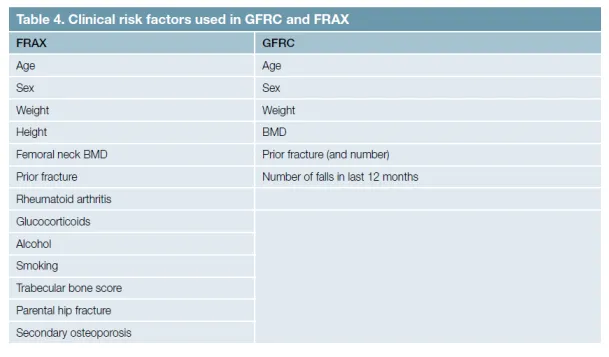
Fracture risk calculators (FRAX, Garvan Fracture Risk Calculator) give additional information on future fracture risk and help guide treatment decisions, but do not affect PBS medication criteria.
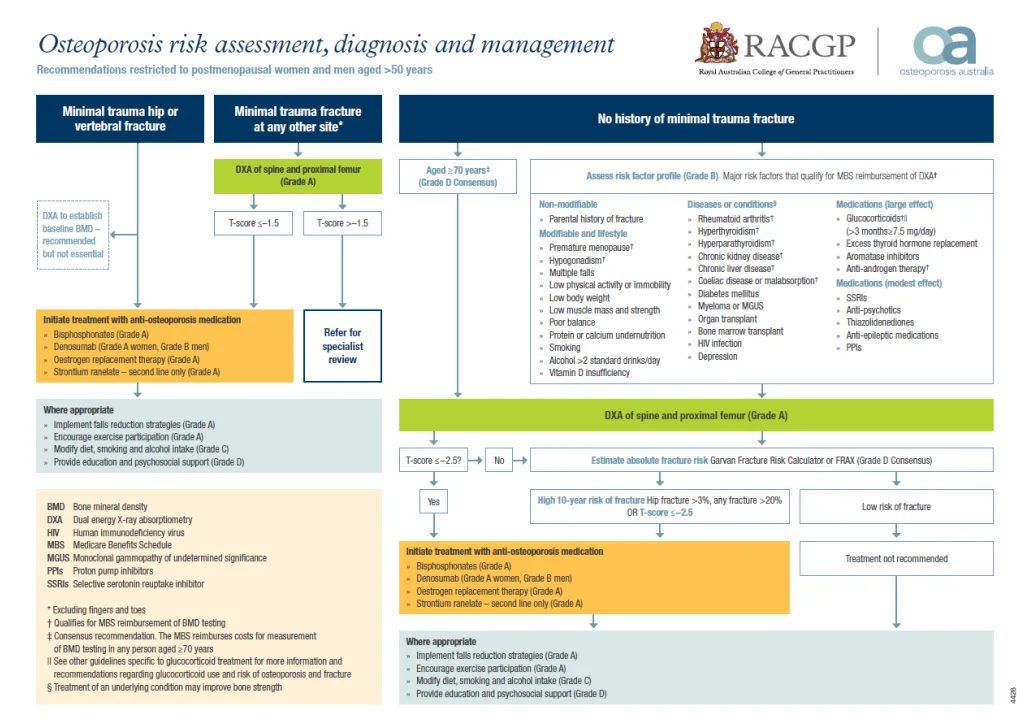
Treatment thresholds (RACGP guideline flowchart)
Minimal trauma fracture:
- Hip or vertebral fracture — treat; DXA not required first
- Non-hip/non-vertebral fracture — do DXA and treat if T-score < -1.5
Very high risk (treat):
- T-score ≤ -3.0 AND a fracture within the last 2 years, OR
- FRAX ≥30% (major osteoporotic fracture) or hip fracture risk >4.5%
Risk factors without a fracture — do BMD, then treat if:
- T-score < -2.5, OR
- T-score -1.5 to -2.5 AND FRAX >20% (major osteoporotic fracture) or >3% (hip)
Management
Non-pharmacological
Diet/lifestyle:
- Adequate calcium intake — target >1300 mg/day (typical Australian intake is only ~700 mg/day). Encourage dairy (low-fat milk is fine), firm tofu, almonds, sesame seeds, dried figs.
- Sun exposure: ~15% body surface area exposed for 10 min/day in summer (before 10am/after 3pm) or 7–30 min/day in winter (midday) — varies with skin tone and latitude.
- Vitamin D target 50–100 nmol/L (above 125 nmol/L may be detrimental). If deficient (<50 nmol/L), supplement 1000–4000 IU/day depending on severity and recheck in 3 months; once in target range, maintain at 1000 IU/day.
- Smoking cessation, reduce alcohol.
Calcium/vitamin D supplementation: evidence for supplementation alone reducing fracture risk is poor, except in institutionalised patients — but supplementation is still important as an adjunct in patients on active drug therapy, and should be corrected before starting bisphosphonates or denosumab.
Exercise:
- Resistance training (e.g. weights) and balance training improve bone density and reduce falls risk.
- Walking alone has minimal benefit and may increase falls risk.
- Best: high-impact activity — skipping, jumping, strength training; also jogging, tennis, volleyball, stair climbing, step aerobics.
- Balance training — e.g. Tai Chi, exercise-physiologist-led programs.
Pharmacotherapy
Bisphosphonates (decrease osteoclast activity; deposit in bone, allowing infrequent dosing):
- Alendronate 10 mg daily or 70 mg weekly (
$10/4 months); risedronate 5 mg daily or 35 mg monthly ($20/4 months) — risedronate has more tolerable GI side effects than alendronate. - Zoledronic acid (IV, annual infusion) — easier adherence than oral dosing, and has a mortality-reduction benefit post-fracture. Causes an acute-phase inflammatory reaction (fever, myalgia) typically lasting ~12 hours, occasionally 3–4 days.
- Side effects: oesophageal erosions/strictures, gastric ulcers; medication-related osteonecrosis of the jaw (MRONJ — incidence 0.02–0.3% on antiresorptive therapy, rising to 2.5% with invasive dental treatment; risk rises after >4 years of therapy); atypical (subtrochanteric) femur fractures (incidence 3.2–50 per 100,000 person-years of bisphosphonate treatment, falling substantially after a treatment pause). A dental check before starting antiresorptive therapy is recommended, but treatment should not be delayed for it unless dental risk is particularly high.
- Contraindications: active upper GI disorders (Barrett’s, strictures, duodenal ulcers).
- Oral bisphosphonates have poor absorption — take in the morning with a full glass of plain water, at least 30 minutes before food or drink, and remain upright during this time and until after eating. The gap needed from calcium, iron, magnesium and antacid supplements is drug-specific, not a single figure. Alendronate’s own counselling information specifies a gap of at least 30 minutes from calcium. Risedronate’s own counselling information specifies a longer gap of at least 2 hours from calcium.
- PBS criteria: age >70 + T-score < -2.5 (primary prevention); minimal trauma fracture, radiologically proven with year documented (established osteoporosis); or current corticosteroid >7.5 mg/day + T-score < -1.5.
Denosumab (Prolia): inhibits RANK ligand, preventing RANK activation on the osteoclast surface (reducing bone resorption).
- 60 mg SC every 6 months (~$283/6 months).
- Better BMD gains than bisphosphonates; no renal clearance required (useful in CKD).
- Not used for glucocorticoid-induced osteoporosis.
- Side effects are minimal but include hypocalcaemia on starting treatment (particularly with CKD — correct hypocalcaemia/vitamin D deficiency first) and a slightly increased risk of cellulitis.
- Discontinuation is a real issue: the anti-resorptive effect is not sequestered in bone, so it wears off within months of stopping — bone resorption and fracture risk (including vertebral rebound fractures) increase again. Doses should not be delayed by more than 4–6 weeks. Plan a transition to another anti-resorptive agent before stopping.
- PBS criteria: age >70 + T-score < -2.5 (primary prevention); or minimal trauma fracture, radiologically proven with year documented (established osteoporosis).
Anabolic (bone-forming) agents — generally for patients with fractures despite bisphosphonate therapy, or very high risk:
- Teriparatide — synthetic PTH; directly stimulates new bone formation. Used in severe osteoporosis; can be combined with denosumab, or used before starting an anti-resorptive. Downside: daily SC injection, and multiple side effects.
- Abaloparatide — a teriparatide analogue; approved by the Pharmaceutical Benefits Advisory Committee (August 2025) for first- and second-line very-high-risk osteoporosis treatment, but not yet PBS-listed as of mid-2026 — check current status before assuming it’s subsidised.
- Romosozumab (Evenity) — increases bone formation and decreases resorption; better fracture-reduction than alendronate in trials. Typically used for ~1 year, then followed by an anti-resorptive agent to maintain the gain. Dosing: 2 injections once monthly.
- Was originally PBS-listed (1 April 2021) for severe osteoporosis in patients who had a fracture while already on anti-resorptive therapy. A prior version of this note claimed PBS access had since been expanded to first-line — this could not be independently re-verified (the PBS utilisation review sourced for that claim only describes the original 2021 criteria); check the current PBS Schedule online before assuming broader access.
- TGA safety update (Dec 2023, signal review dated Oct 2023): romosozumab use is now also contraindicated in patients with a history of myocardial infarction or stroke, following a pharmacovigilance signal investigation into cardiovascular risk — check for cardiovascular risk factors/history before prescribing.
Other options:
- Hormone therapy (MHT) — oestrogen therapy for postmenopausal women; not safe for long-term use, weigh side effects. Current Australian menopause guidance recommends considering MHT as first-line therapy for osteopenia itself (T-score ≤ -1.8) in women aged under 65, regardless of whether menopausal symptoms are present — not just as an add-on for symptom relief.
- Strontium ranelate — second-line, for patients intolerant of first-line therapy; has fallen further out of favour internationally due to cardiovascular safety signals — confirm current local availability/PBS status before recommending it.
Duration of therapy & monitoring
- Regularly reassess fracture risk.
- Repeat BMD every 2 years is helpful in at-risk patients to determine whether they’ve crossed into PBS-funded treatment territory.
- Ongoing BMD monitoring isn’t needed unless ceasing or changing treatment is being considered.
- Bone turnover markers can supplement BMD for monitoring adherence/response: CTX (C-terminal telopeptide, a resorption marker; fasting sample; target suppression <200 mcg/L) for antiresorptive therapy, and PINP (procollagen type 1 N-terminal propeptide, a formation marker) particularly for monitoring anabolic agents like teriparatide, typically reassessed ~3 months after starting.
- Consider a treatment cessation (“drug holiday”) every 5–10 years if there are no recent fractures and BMD is no longer in the osteoporotic range — noting the denosumab-specific rebound-fracture caveat above, which makes stopping that particular agent higher-risk than stopping a bisphosphonate.