Urticaria & Angioedema
Written 15th March 2020 - Last Update 21st July 2026
Urticaria & Angioedema
Condition
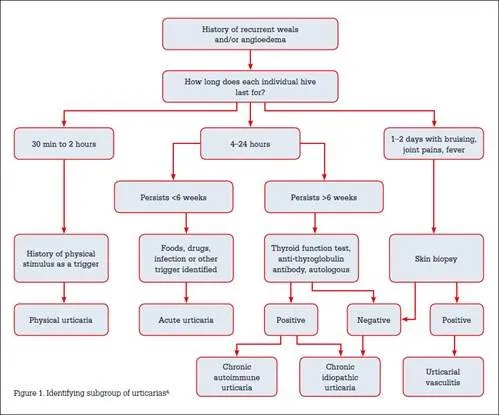
Urticaria is very common — most people experience it at some point. Acute urticaria is often allergy-based and self-limiting. Chronic urticaria (lasting >6 weeks) is uncommon to trace to an allergic cause and is considered an autoimmune disease.
History and examination
Acute urticaria — identify triggers: insect bites, drugs (antibiotics, aspirin, NSAIDs, codeine, laxatives, ACE inhibitors), food (in young children, most commonly peanut butter, strawberries, cow’s milk, fish, eggs), infection (viral most common in children; bacterial and chronic infections such as sinusitis/abscesses also implicated), physical causes (cold, pressure, vibration, exercise, sun), and history of atopy. Symptoms usually last <24 hours; bruising is a red flag for vasculitis.
Physical urticaria subtypes — a physical stimulus can exacerbate urticaria from another cause, or be the sole trigger:
- Dermographic — triggered by stroking/rubbing the skin.
- Cholinergic — triggered by exercise, heat, emotion, or food; usually small papules.
- Pressure — triggered by sustained pressure; delayed onset, may be painful.
- Cold — triggered by wind, cold drinks, or swimming; can cause anaphylaxis on cold-water exposure in severe cases; consider cryoglobulinaemia if systemic.
- Aquagenic — triggered by water contact.
- Solar — triggered by sunlight; seen in erythropoietic protoporphyria.
Management is as for urticaria generally (below).
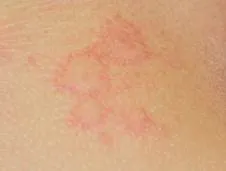
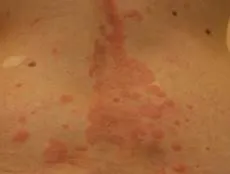
Examination: distinct raised pink papules/plaques scattered randomly; the epidermis should be normal — scaling or weeping means it isn’t urticaria.
Mimics and special considerations
- Urticarial vasculitis — individual hives lasting >48 hours, may have fever/arthralgia.
- Cryoglobulinaemia — lesions over buttocks/lower extremities, may occur with hepatitis B/C.
- Mastocytosis — lesions provoked by very mild physical trauma (dermatographism).
- Polymorphic eruption of pregnancy — presents with abdominal striae, spares the face/palms/soles/periumbilical area.
Angioedema is often confused with urticaria but differs importantly: it affects mucosae as well as skin (GI tract, respiratory tract), is not itchy, and swelling may last several days. Most cases (especially with concurrent urticaria) are histamine-mediated and managed like urticaria — antihistamine first; a short course of prednisolone 25–50mg once daily (child 1mg/kg up to 50mg) for a few days if more severe/troublesome. It does not respond to adrenaline (adrenaline is only for anaphylaxis, not isolated angioedema).
Bradykinin-mediated angioedema (e.g. hereditary angioedema, or ACE-inhibitor-induced) does not respond to antihistamines/steroids and needs specialist-led therapy: icatibant (bradykinin B2-receptor antagonist) for acute attacks, purified C1-esterase-inhibitor concentrate for acute and prophylactic treatment, tranexamic acid for prophylaxis, and lanadelumab as a newer prophylactic option — fresh frozen plasma is an older approach, largely superseded by these targeted agents where available.
ACE-inhibitor-induced angioedema typically occurs within the first week of treatment but can present as late as years in — it’s driven by raised bradykinin (reduced ACE-mediated bradykinin breakdown), not histamine, which is why antihistamines/steroids/adrenaline don’t help. Stop the ACE inhibitor immediately and permanently — do not rechallenge. ARBs may be used instead but monitor closely (a much lower, non-zero cross-reactivity risk). ACE inhibitors are contraindicated in anyone with a personal history of hereditary angioedema.
Hereditary angioedema (HAE) is rare — an inherited deficiency of C1-esterase inhibitor, also driving bradykinin-mediated (not histamine-mediated) swelling. Onset is typically in childhood, attacks are classically trauma-triggered, and — unlike allergic angioedema — HAE does not present with urticaria, a useful bedside distinguishing feature.
Investigations
Acute urticaria with an obvious trigger needs no investigation; suspected food allergy can be confirmed with a placebo-controlled oral challenge, then an elimination diet if a single food is identified. Chronic urticaria has limited useful investigations: skin biopsy if lesions are tender, last >24 hours, or show bruising; FBC/ESR/CRP/U&E/LFT/TFT to screen for other causes; skin prick testing has a poor yield (positive in only ~3.3% of cases).
Management
Acute urticaria usually resolves within days even without an identified cause; treatment is not always needed unless symptoms are troublesome. Cool baths, compression, calamine lotion, and non-sedating ± sedating antihistamines (H1 ± H2) help. The evidence base for adding systemic glucocorticoids in uncomplicated acute urticaria is thin — a 2025 review of NICE guidance and Cochrane/PubMed RCTs found only 2 of 23 identified studies met inclusion criteria; reserve steroids for genuinely severe flares or angioedema rather than reaching for them routinely.
Chronic urticaria: avoid aggravating factors (excess alcohol, heat, aspirin/NSAIDs/codeine/ACE inhibitors); non-medicated lotions (menthol in aqueous cream, calamine) and cool compresses.
Medications (stepwise algorithm):
- First line — monotherapy with a less-sedating antihistamine (cetirizine 10mg, desloratadine 5mg, fexofenadine 180mg, or loratadine 10mg, once daily — a second afternoon dose may help since urticaria often flares in the evening). Sedating antihistamines are reserved for patients with sleep disturbance from itch, not as routine first-line. If one agent is ineffective or too sedating, try a different one (cetirizine is the most sedating of this group).
- Updosing — if symptoms persist, increase the dose of the less-sedating antihistamine over 2–4 weeks, up to 4× the standard dose (in two divided doses) — safe and effective in adults; use with caution/specialist input in young children.
- Add or switch to a leukotriene antagonist (montelukast 10mg daily, or paediatric dosing) for a short trial if updosing fails or isn’t tolerated — TGA safety alert: montelukast has been linked to neuropsychiatric adverse effects (behavioural change, depression, suicidality) in all age groups — warn patients/carers and stop if these occur.
- While awaiting specialist referral (or as an alternative if preferred) — trial an H2 antagonist (famotidine, nizatidine, or ranitidine) and/or doxepin 10–20mg at night in adults (a tricyclic with potent antihistamine activity; not recommended in the elderly, warn about next-day sedation).
- Specialist care — omalizumab (anti-IgE monoclonal antibody, monthly subcutaneous injection, can be self-administered or given in general practice once initiated by a specialist) is the standard specialist option; systemic immunosuppressants (ciclosporin, sulfasalazine, mycophenolate, methotrexate) if omalizumab fails/isn’t tolerated.
Oral corticosteroids are not part of the routine chronic urticaria ladder in current guidance (reserved for severe acute flares/angioedema) — avoid long-term use given hypertension, hyperglycaemia, weight gain, osteoporosis, and peptic ulcer risk.