Tinea
Written 2nd March 2020 - Last Update 27th August 2026
Tinea
Caused by dermatophytes, which can infect the skin, scalp or nails.
- The typical rash is annular or arcuate (with a definite edge and central clearing as it expands), scaly and itchy.
- Tinea of the feet (tinea pedis) is particularly common in adults, and less so in children, it is often associated with tinea of the groin (tinea cruris) — maceration in the lateral toe webs, as localised small blisters on the feet, or as diffuse scaling on the soles. It often spreads to the nails, which become discoloured, thickened and dystrophic.
- Tinea of the scalp (tinea capitis) mainly occurs in children. A kerion is an acute form of tinea capitis, in which a large, boggy, pustular mass appears on the scalp.
Tinea pedis
The most common form of tinea. More common in males and adolescents/young adults.
Risk factors: occlusive footwear; excessive sweating; underlying immunodeficiency; steroid use; poor peripheral circulation.
Clinical features: asymmetrical/unilateral. Presents in one of three ways:
- Itchy erosions, especially between the 4th/5th toes.
- Scale covering the sole or sides of the feet (moccasin pattern).
- Small/medium-sized blisters affecting the inner aspect of the foot.
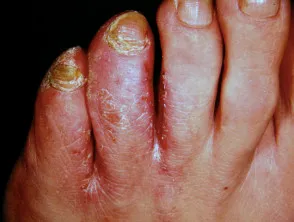
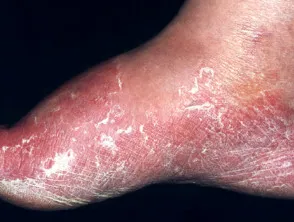
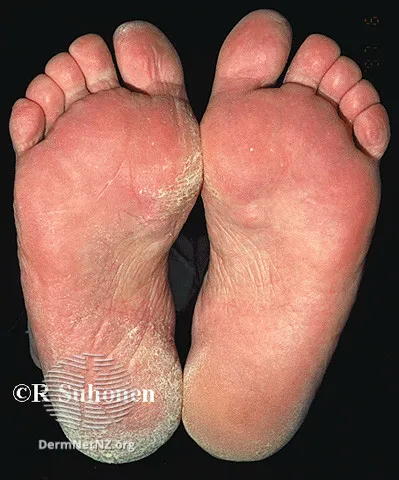
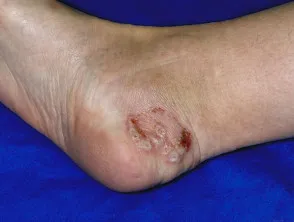
Tinea incognito
This is the term used for unrecognised tinea infection due to modification with corticosteroid treatment. The lesions are enlarging and persistent, especially on the groins, hands and face. The sequence is initial symptomatic relief of itching, stopping the ointment or cream, then relapse.
Tinea cruris
A common infection of the groin area in young men, usually athletes, commonly caused by a tinea infection, though there are other causes of a groin rash. The dermatophytes responsible for tinea thrive in damp, warm, dark sites. Infection often comes from the feet (tinea pedis) or nails (tinea unguium) originally — the feet should be inspected for evidence of tinea pedis. It is transmitted by towels and other objects, particularly in locker rooms, saunas and communal showers.
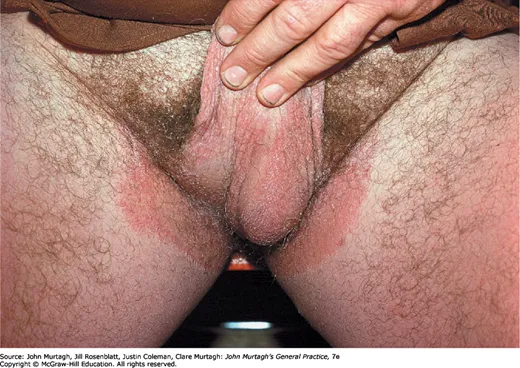
Clinical features:
- Itchy rash; more common in young males.
- Strong association with tinea pedis (athlete’s foot).
- Usually acute onset; more common in hot months (a summer disease) and in physically active people.
- Related to chafing in the groin (e.g. tight pants, and especially synthetic jock straps).
- Scaling, especially at the margin; well-defined border.
- If left untreated, the rash may spread, especially to the inner upper thighs, while the scrotum is usually spared. Spread to the buttocks indicates T. rubrum infection.
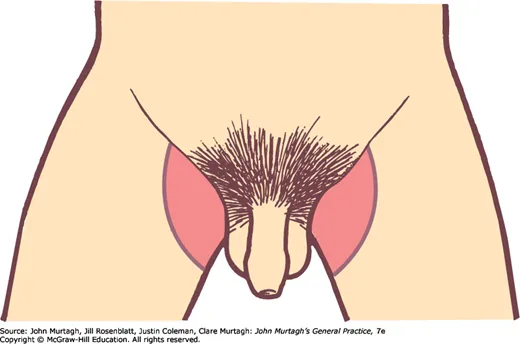
Diagnostic aids:
- Skin scrapings should be taken from the scaly area for preparation for microscopy and culture.
- Wood’s light may help the diagnosis, particularly if erythrasma is suspected.
- PCR testing is now available in some Australian laboratories and is preferred over microscopy and culture (MCS) for its faster turnaround and superior sensitivity/specificity — traditional fungal culture can take up to 6 weeks to result.
Terbinafine-resistant tinea (T. indotineae)
Be aware of emerging terbinafine resistance: high rates of terbinafine-resistant T. interdigitale/T. indotineae (a newly recognised, often markedly inflammatory dermatophyte, previously called T. mentagrophytes genotype VIII) have been reported in India, Europe and, more recently, Australia — including in patients with no relevant travel history, indicating local transmission. If treatment fails despite good adherence, consider both alternative diagnoses and terbinafine-resistant species, and send scrapings for culture/susceptibility testing (or PCR where available) before escalating or changing therapy — rather than simply extending or repeating the same terbinafine course. Avoid topical corticosteroids, which can mask and worsen the appearance (“tinea incognito”, already noted above) and may contribute to under-recognised spread of resistant strains.
Management
Topical (localised infection of trunk/face/limbs/between fingers or toes): apply topical terbinafine 1% cream or gel once or twice daily for 7–14 days or an imidazole topical preparation (e.g. miconazole or clotrimazole cream). Apply tolnaftate dusting powder twice daily when almost healed, to prevent recurrence. If itch is severe, a mild topical hydrocortisone preparation can be added. Fastidious drying of skin folds; keep areas dry; don’t share towels; wear shoes (e.g. thongs) in shared bathrooms to prevent reinfection.
Oral therapy — indications: widespread/established infection (especially feet); inadequate response to topical therapy; recurrence soon after topical therapy; inappropriate treatment with steroids already tried; scalp/palms/soles of feet; inflammatory, hyperkeratotic, or vesicular presentations. For persistent or recurrent eruption, use oral terbinafine 250mg daily for 2 weeks, or fluconazole 150mg once weekly for 6 weeks, or griseofulvin 500mg daily for 8–12 weeks.
To reduce the chance of reinfection:
- Treat the feet if tinea pedis is present.
- Dry the groin carefully after bathing, using a separate towel.
- Do not share towels, sheets or personal clothing.
- Avoid wearing occlusive or synthetic clothing.
- If overweight, try to lose weight to reduce chafing and sweating.
Differential: groin rash (intertrigo)
| Category | Causes |
|---|---|
| Skin disorders | Psoriasis, seborrhoeic dermatitis, dermatitis/eczema |
| Fungal | Candida, tinea |
| Other | Erythrasma, contact dermatitis |
Dosing summary (eTG)
For all areas except scalp or nails:
- Terbinafine 250mg daily for 2 weeks
- OR fluconazole 150mg once weekly for 6 weeks
- OR itraconazole 50mg (Lozanoc) daily for 2 weeks (tinea cruris/corporis) or 4 weeks (tinea pedis) — note itraconazole preparations are not bioequivalent, dosing depends on the specific brand
- OR griseofulvin 500mg daily for 8–12 weeks (cheaper but less effective, needs longer treatment; hyperkeratotic or hair-bearing-area infection may need even longer)
Longer treatment may be needed depending on response
For Scalp (incl Kerion) — topical antifungal therapy is ineffective for scalp tinea; oral therapy is required:
- Terbinafine 250mg daily for 4 weeks
- OR griseofulvin 20mg/kg (up to 500mg) daily for 6–8 weeks
- OR (if terbinafine/griseofulvin contraindicated/not tolerated, for Trichophyton/Microsporum species) itraconazole or fluconazole
Take scrapings and plucked hairs for culture to confirm scalp tinea before treating (excluding kerion) — false-negative culture is more common on the scalp than elsewhere. Don’t stop oral therapy on clinical improvement alone — continue until culture is negative, hair has regrown, and the scalp is no longer inflamed. Scalp tinea doesn’t usually cause permanent alopecia.