Seborrhoeic Dermatitis
Written 3rd March 2020 - Last Update 11th July 2026
Seborrhoeic Dermatitis
Condition
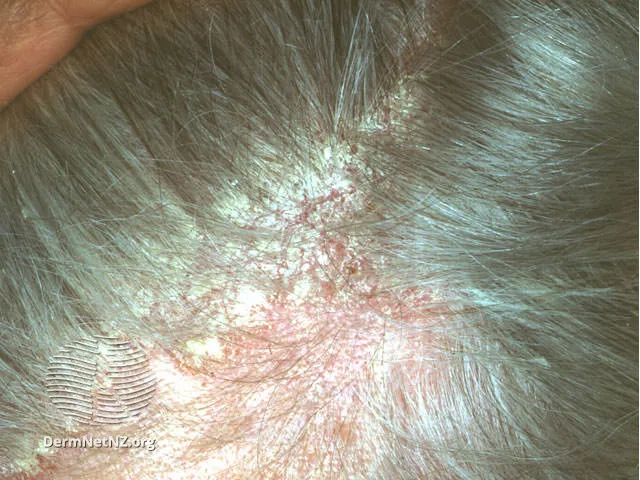
Affects the sebaceous-rich areas of the face, scalp, flexures, scrotum, and trunk. Dandruff is an uninflamed scalp-only form with bran-like scale. Begins in adolescence, peaks in young adult life, then again in the elderly. Facial disease mainly affects the medial cheeks, nose, and nasolabial folds — the most common cause of a “butterfly” facial rash (differentiate from the malar rash of acute cutaneous lupus, which characteristically spares the nasolabial folds; rosacea can also co-exist). Malassezia yeast is thought to contribute, which is why antiyeast shampoos work.
Severe or recalcitrant seborrhoeic dermatitis is an indicator condition for HIV testing — offer testing regardless of behavioural/epidemiological risk factors.
Infantile seborrhoeic dermatitis (cradle cap) is a distinct, self-limiting condition, not covered here.
Management
Scalp: standard shampoo daily first-line (including for dandruff). If ineffective/severe, antiyeast shampoo (zinc pyrithione, selenium sulfide, ketoconazole, or coal tar) twice weekly–daily — response can wane, so rotate between shampoos. If still inadequate, add a topical steroid lotion (easier than cream on hair-bearing skin) nightly for 7 nights: betamethasone dipropionate 0.05%, methylprednisolone aceponate 0.1%, or mometasone furoate 0.1%. If thick scale persists, add a tar preparation (e.g. coal tar 1% emulsion, or LPC 3–6% + salicylic acid 3% in aqueous cream) at night, washed off next morning with antiyeast shampoo. For refractory disease, replace the antiyeast shampoo with clobetasol propionate 0.05% shampoo twice weekly (antiyeast shampoo the other 5 days).
Face/flexures/scrotum: low-irritant cleanser; wash hair often with antiyeast shampoo (yeast can spread scalp→face). First-line: a combination steroid+antifungal cream (hydrocortisone+clotrimazole 1%+1%, or hydrocortisone+miconazole 1%+2%) once–twice daily for up to 2 weeks. If ineffective, use a topical steroid (desonide 0.05% or methylprednisolone aceponate 0.1%) and an antifungal cream (bifonazole/clotrimazole/econazole/ ketoconazole/miconazole) separately, once–twice daily for up to 2 weeks. If that fails, a weak tar preparation (LPC 1–2% in aqueous/sorbolene cream) daily for up to 2 weeks. Maintenance: regular emollient once clear; relapses are common — repeat a short (~7-day) course of the same regimen.
Trunk: treated as for face/flexural/scrotal disease, but a stronger tar preparation (LPC 3–6% + salicylic acid 2–6%) can be used if needed, once– twice daily for up to 4 weeks.
Refer to dermatology for severe flares or disease not responding to topical therapy.