Scarlet Fever
Written 2nd March 2020 - Last Update 21st July 2026
Scarlet Fever
Condition
Most common in children aged 5–15. Results when a Group A Streptococcus pyogenes organism produces erythrogenic toxin. Prodromal symptoms prior to the acute exanthem: malaise, sore throat, fever (may include rigors), and vomiting. A throat swab should be taken.
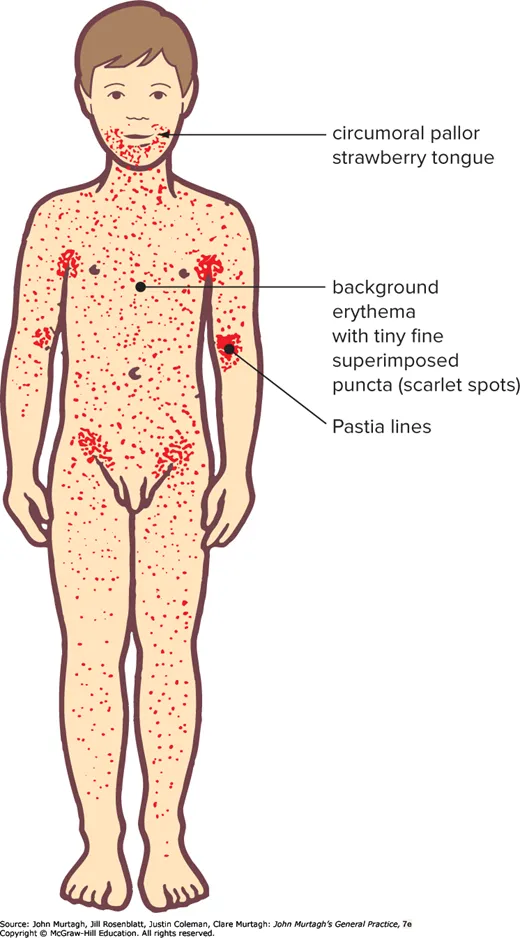
Features of the rash
- Appears 12–48 hours after the start of fever.
- Usually starts below the ears, neck, chest, armpits, and groin, before spreading to the rest of the body over 24 hours.
- Punctate and red — a “boiled lobster” or sunburnt appearance; blanches on pressure.
- Prominent on the neck, axillae, cubital fossa (Pastia lines), groin, and skinfolds; absent or sparse on the face, palms, and soles.
- Circumoral pallor.
- Tongue discolouration — white initially, becoming red and bumpy (“strawberry tongue”).
- Feels like fine sandpaper.
- Lasts about 5 days, with fine desquamation.
Diagnosis
Throat swab; anti-deoxyribonuclease B and antistreptolysin-O titres.
Treatment
- Phenoxymethylpenicillin 500mg twice daily for 10 days, or
- Cephalexin 1g twice daily for 10 days, or
- Azithromycin 500mg daily for 5 days.
Children can return to school 24 hours after starting antibiotics and once feeling well.