Pyoderma Gangrenosum
Written 15th March 2020 - Last Update 10th September 2020
Pyoderma Gangrenosum
Condition
An uncommon autoinflammatory disorder, likely due to neutrophil dysfunction involving T lymphocytes and cytokines. Affects males and females of any age, more often over 50. Characterised by a rapidly enlarging, very painful ulcer with blue, undermined borders, and by pathergy — new lesions appearing after local trauma.
Clinical features
Usually starts suddenly, often at the site of a minor injury, as a small pustule, red bump, or blood blister. The skin breaks down into an ulcer that can deepen and widen rapidly; the edge is characteristically purple and undermined. Very painful. Several ulcers may develop simultaneously or over months to years.
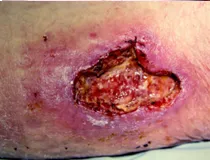
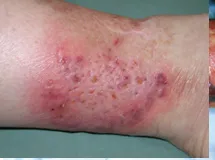
Diagnosis is usually clinical, based on the characteristic pain and appearance; a pathergy test (skin prick causing a papule/ulcer) is usually positive.
Investigations
Wound swab to check for superimposed infection (infection is not the cause). Biopsy to rule out other causes of ulceration. Blood tests are not generally helpful, though ANCA may be positive.
Management
Per eTG: seek expert advice; oral corticosteroids can be started — prednisolone 25 mg (0.5 mg/kg up to 25 mg) daily for 2 weeks, then taper according to response. Careful wound care with removal of necrotic tissue; antibiotics only if a pathogen is isolated on swab. Surgical debridement is not recommended — trauma can worsen ulceration (pathergy). Specialist options include intralesional steroid injection, cryotherapy, laser ablation, imiquimod, topical tacrolimus, or systemic therapy (steroids, methotrexate, isotretinoin, dapsone).