Granuloma Annulare
Written 15th March 2020 - Last Update 11th July 2026
Granuloma Annulare
Condition
A common condition of unknown cause, thought to be a delayed hypersensitivity reaction within the dermis mediated by TNF-alpha. Localised granuloma annulare (most common in children) is sometimes associated with autoimmune thyroiditis, though it does not clear with treatment of the thyroid disease. Extensive/generalised granuloma annulare is associated with diabetes, hyperlipidaemia, and rarely lymphoma/HIV/solid tumours. Affects children, teenagers and young adults more often than older adults.
Clinical features
Smooth, discoloured, thickened ring-shaped/annular plaques with a slightly depressed centre; resolves spontaneously over a few months.
- Localised form — usually affects the fingers or backs of the hands over joints, particularly the knuckles; also common on the top of the foot, ankle, or elbows.
- Generalised/extensive form — usually adults, widespread skin-coloured, pinkish, or slightly mauve patches, commonly around skin folds of the trunk, axilla, and groin.
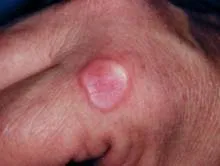
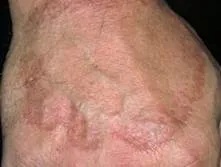
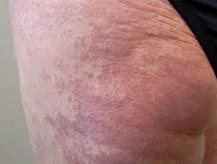
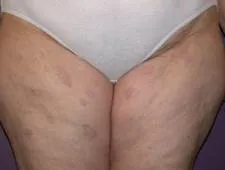
Frequently misdiagnosed as tinea — consider granuloma annulare in an annular lesion not responding to antifungal treatment.
Investigations
Usually a clinical diagnosis, confirmed with biopsy if atypical or unclear — biopsy appearance is characteristic. Refer for dermatology advice if the diagnosis remains unclear.
Management
Often no treatment is needed, as lesions resolve over a few months; if persistent for years, unsightly, or tender, treatment options exist but are not always successful. For localised lesions: betamethasone dipropionate 0.05% or mometasone furoate 0.1% ointment, with or without occlusion, twice daily for a minimum of 4–6 weeks. If unresponsive, refer for expert options (intralesional steroid injection, cryotherapy, laser ablation, imiquimod, topical tacrolimus, or systemic therapy — steroids, methotrexate, isotretinoin, dapsone).