Erythema Nodosum
Written 15th March 2020 - Last Update 10th September 2020
Erythema Nodosum
Condition
A hypersensitivity reaction of unknown cause involving deep dermal and subcutaneous tissue. Occurs in anyone but most common in women aged 25–40 (3–6x more common than in men, except before puberty). Associated with:
- Infections — streptococcal, TB, yersinia, chlamydia, hepatitis B, psittacosis, dermatophytosis, histoplasmosis.
- Inflammatory bowel disease — ulcerative colitis, Crohn’s disease.
- Sarcoidosis.
- Drugs — sulfonamides, the combined oral contraceptive pill, amoxicillin, NSAIDs, bromide, salicylate, iodide.
- Malignancy — lymphoma, leukaemia.
- Pregnancy (2–5%).
Clinical features
Painful, erythematous, indurated plaques and nodules, usually on the lower legs (particularly the anterior tibia, rarely the face), 3–20 cm in diameter, erupting over one to several weeks. Lesions evolve from bright/ deep red to a brownish/yellowish/green bruise-like appearance (erythema contusiformis) as they resolve over 2–3 weeks without scarring, though less inflammatory forms can take months. Recurrence is common. May be accompanied by fever, malaise, and arthralgia. Diagnosis is clinical — a biopsy is not needed; if performed, it must be deep enough to include fat, and biopsies on the lower legs carry a real risk of scarring/poor healing.
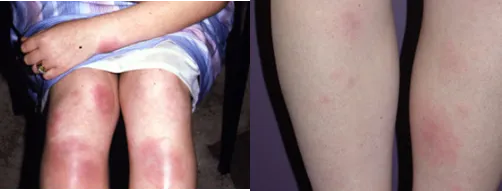
Differentials: scleroderma, vasculitis, necrobiosis lipoidica, rheumatoid nodules. Rare complications include encapsulated fat necrosis or a mobile encapsulated lipoma.
Investigations
FBC, ESR, U&E, throat swab, streptococcal serology, and chest X-ray are reasonable to identify an underlying cause.
Management
Treat the underlying cause where identifiable (e.g. tonsillitis). If symptoms are severe with no contraindication to oral corticosteroids: prednisolone 25 mg (0.5 mg/kg up to 25 mg) daily for 2 weeks, then taper according to response. Compression bandaging/stockings may assist recovery.