Erysipelas
Written 2nd March 2020 - Last Update 21st July 2026
Erysipelas
Condition
A superficial form of cellulitis involving the skin. Often starts around the nose, sometimes with an underlying sinus or dental infection that should be investigated. Abrupt onset, often with fever, chills, and shivering. Most often affects infants and the elderly, but can affect any age group.
See Cellulitis & Skin/Soft-Tissue Infection for the shared assessment, mimics and admission criteria.
Risk factors (similar to other forms of cellulitis): previous episode(s) of erysipelas; breaks in the skin barrier (insect bites, ulcers, chronic skin conditions — psoriasis, athlete’s foot, eczema); current or prior injury (trauma, surgical wounds, radiotherapy); in newborns, umbilical cord exposure or vaccination-site injury; nasopharyngeal infection; venous disease (gravitational eczema, leg ulceration) and lymphoedema; immune deficiency/compromise (diabetes, alcoholism, obesity, HIV); nephrotic syndrome; pregnancy.
Clinical features
Predominantly affects the lower limbs, but when it involves the face can have a characteristic butterfly distribution on the cheeks and across the bridge of the nose. The affected skin has a very sharp, raised border; is bright red, firm, and swollen; may be finely dimpled (orange-peel-like); may blister and, in severe cases, become necrotic. Bleeding into the skin can cause purpura. Cellulitis doesn’t usually show such marked swelling, but shares pain and warmth with erysipelas. In infants, it often occurs in the umbilicus or napkin region. Bullous erysipelas can result from streptococcal infection or co-infection with Staphylococcus aureus (including MRSA).
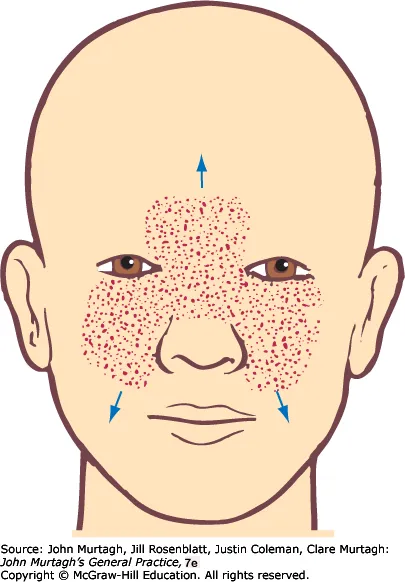
Causative organisms: unlike cellulitis, almost all erysipelas is caused by Group A beta-haemolytic streptococci (Streptococcus pyogenes). Staphylococcus aureus (including MRSA), Streptococcus pneumoniae, Klebsiella pneumoniae, Yersinia enterocolitica, and Haemophilus influenzae have also rarely been found to cause erysipelas.
Complications (rare): abscess, gangrene, thrombophlebitis, chronic leg swelling; infections distant to the site (infective endocarditis, septic arthritis, bursitis, tendonitis); post-streptococcal glomerulonephritis; cavernous sinus thrombosis; streptococcal toxic shock syndrome.
Treatment
Confirmed S. pyogenes:
- Phenoxymethylpenicillin 500mg four times daily for 5 days, or procaine penicillin 1.5g IM daily for at least 3 days.
- Penicillin hypersensitive: cephalexin 500mg four times daily for 5 days (delayed non-severe), or clindamycin 450mg three times daily for 5 days (immediate or delayed severe).
- With systemic features: benzylpenicillin 1.2g IV four times daily.
Staphylococcus aureus:
- Severe/potentially life-threatening: flucloxacillin/dicloxacillin 2g IV four times daily, or cefazolin 2g IV three times daily, or vancomycin IV (MRSA), or clindamycin 600mg IV three times daily (MRSA), or lincomycin 600mg IV three times daily (MRSA).
- Less severe: flucloxacillin/dicloxacillin 500mg four times daily for 5 days, or cephalexin 500mg four times daily for 5 days (delayed non-severe hypersensitivity).
- MRSA or delayed severe penicillin hypersensitivity: trimethoprim/sulfamethoxazole 160/800mg twice daily for 5 days, or clindamycin 450mg three times daily for 5 days.
- Community-based parenteral antimicrobial therapy: cefazolin 2g IV daily plus probenecid 1g orally daily, or cefazolin 2g IV twice daily.