Dermatitis & Eczema Variants
Written 3rd March 2020 - Last Update 28th August 2026
Dermatitis & Eczema Variants
Five named dermatitis/eczema subtypes without a dedicated hub of their
own — see dermatitis.md for the general atopic dermatitis/eczema
framework and pompholyx-dyshidrotic-eczema.md for the hand/foot
vesicular variant.
Asteatotic eczema
Caused by severe dry skin, especially in winter or at high altitude; most common in elderly patients. Very itchy, with a characteristic “crazy paving”/crackled appearance (eczema craquelé).
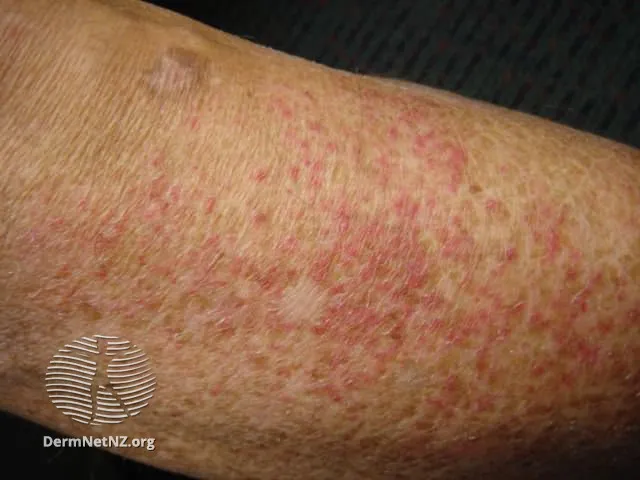
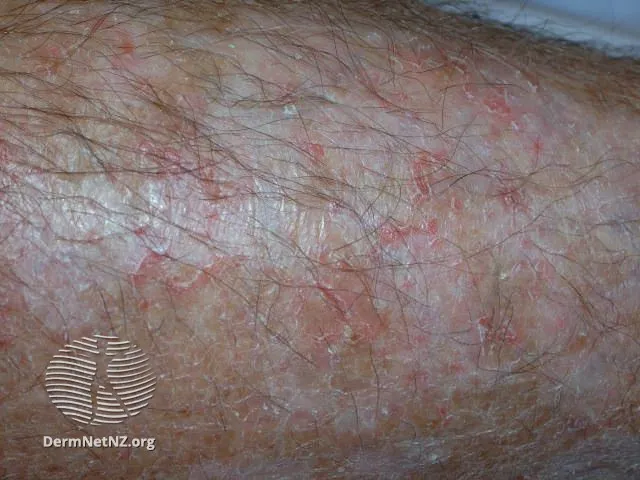
Can be a sign of hypothyroidism, or occur in patients taking diuretics or lipid-lowering drugs — worth a brief systemic review if recurrent/atypical.
Management: correct the underlying dry skin with frequent emollients. If not settling, add a topical steroid: methylprednisolone aceponate 0.1% ointment/fatty ointment, or triamcinolone acetonide 0.02% ointment, once daily until clear (usually 1–2 weeks). Continue emollients once clear to prevent recurrence. Refer to dermatology if not clearing after ~4–6 weeks.
Nummular (discoid) eczema
Occurs from middle to late life, though can also occur in children. Round or oval plaques without central clearing, scaling, intensely itchy, prone to secondary infection due to scratching. Bilateral but asymmetrical distribution; well-circumscribed lesions 1–3 cm.
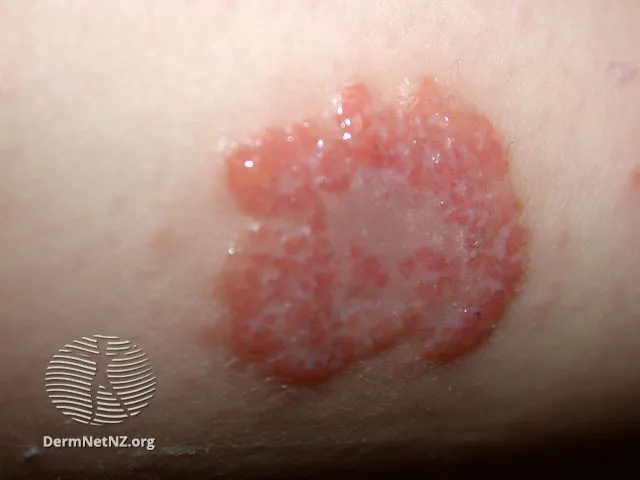
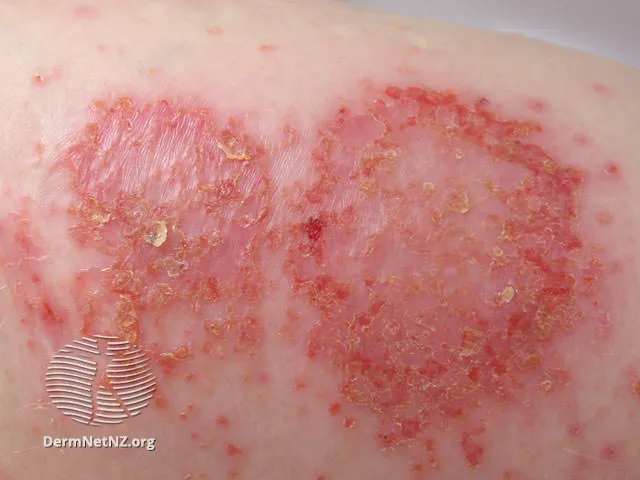
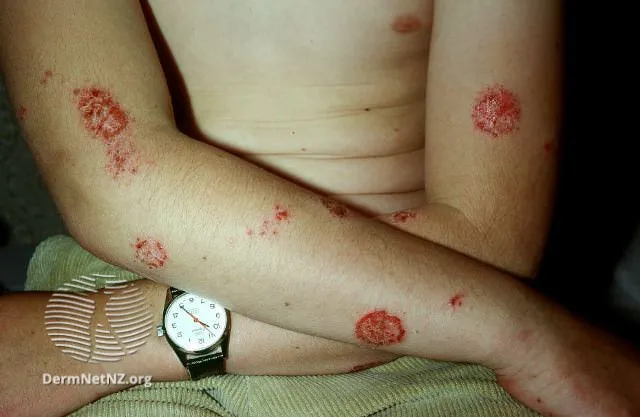
Investigations: if discharging or crusted, swab for bacterial infection.
Management: potent topical steroid ointment (e.g. betamethasone dipropionate 0.05%, betamethasone valerate 0.1%, or mometasone furoate 0.1%) once–twice daily for 2 weeks — an ointment base is preferred over cream (better plaque penetration, less stinging). If not clearing within 2 weeks, step up to an optimised-vehicle formulation (e.g. betamethasone dipropionate 0.05% in optimised vehicle) once daily for up to 4 weeks, under occlusion if localised or a wet-dressing/soak-and-smear technique if widespread. If moist or crusted, swab for bacterial culture and treat infection as for infected atopic dermatitis. Refer to dermatology if unresponsive to a more potent steroid with modified dressing.
Lichen simplex
A localised, chronic, lichenified dermatitis caused by repetitive scratching and rubbing. It is usually secondary to underlying dermatitis, fungal infection, or neuropathy. Occurs in adults (rare in children), more common with anxiety/OCD.
History and examination: chronic itch. Exaggerated skin markings, dry/scaly surface, leathery induration, broken-off hairs, pigmentation. Commonly affects the back of the scalp and neck, scrotum/vulva, wrists/forearms, and lower legs.
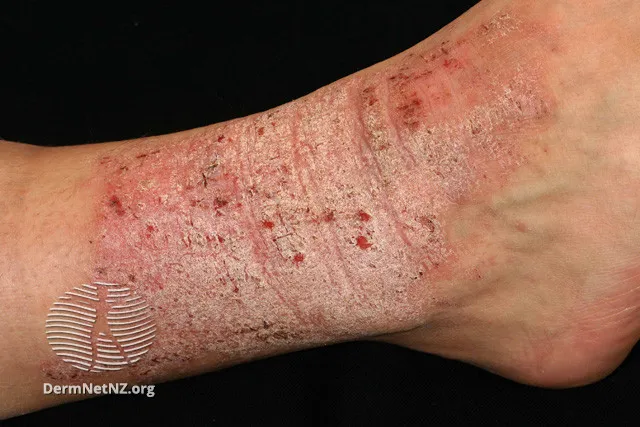
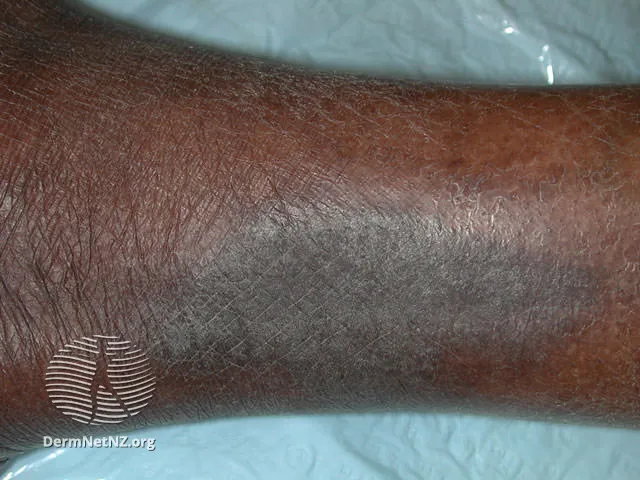
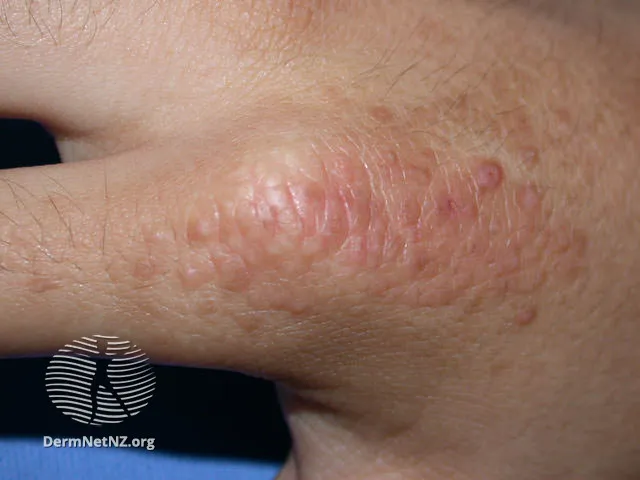
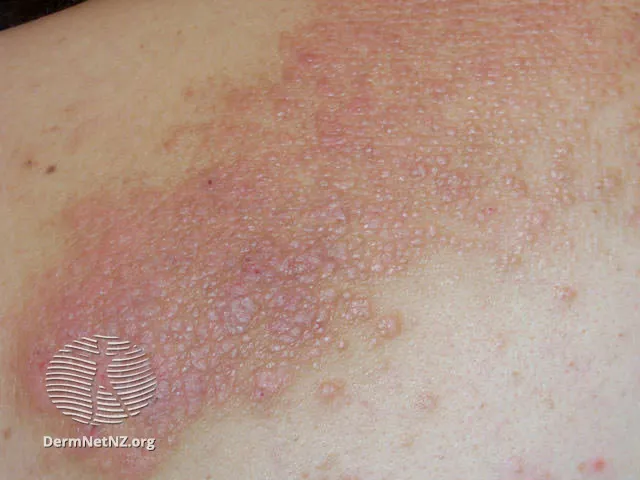
Management: potent topical steroids are needed to penetrate the skin and break the itch-scratch cycle. Options include betamethasone dipropionate 0.05%, betamethasone valerate 0.1%, or mometasone furoate 0.1% ointment, once or twice daily for up to 4 weeks. If no response, trial occlusion therapy or an optimised-vehicle steroid formulation (once–twice daily for up to 2 weeks) with or without occlusion.
See also Nodular Prurigo for the related end-stage itch-scratch-cycle condition.
Venous dermatitis
Affects those with venous insufficiency; common in elderly patients (~20% of those over 70).
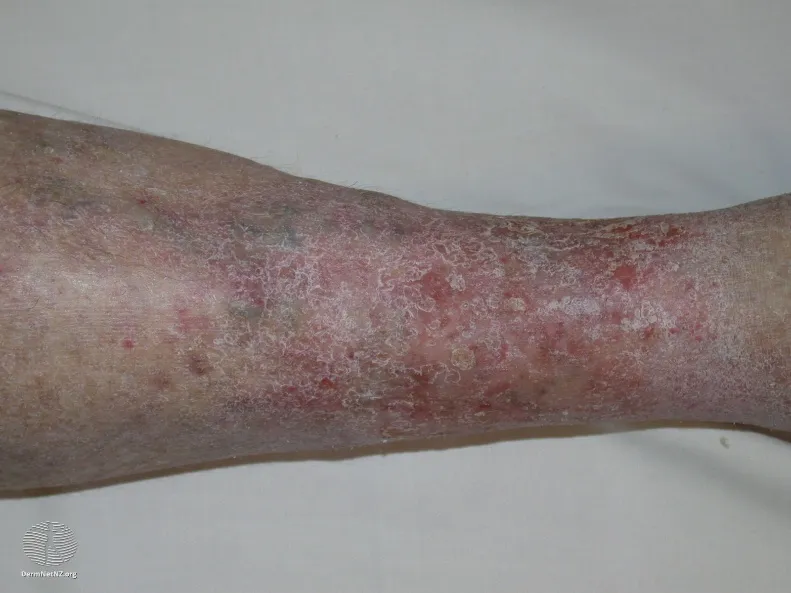
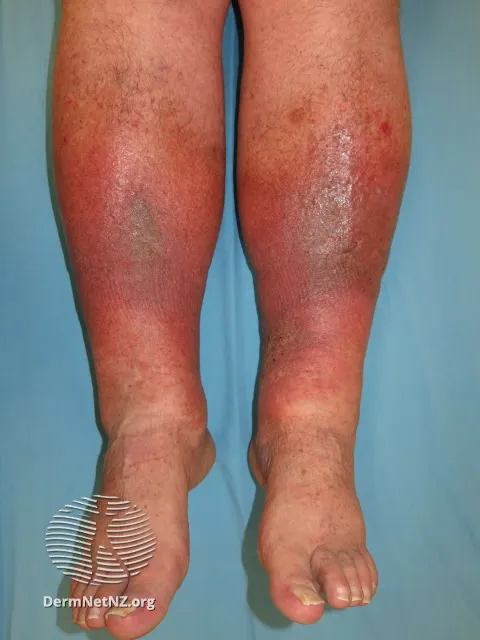
Management: treat the underlying venous insufficiency: compression stockings, leg elevation. Topical steroids for the dermatitis itself (e.g. betamethasone 0.05%), plus regular emollients and avoidance of soaps.
Pityriasis alba
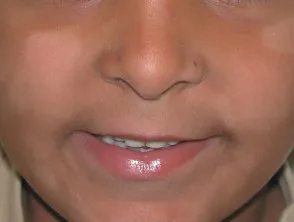
A benign condition with fine scale and hypopigmentation and no complications. Affects children aged 3–16, more prominent on darker-skinned children.
History and examination: progresses through stages: a scaly pink plaque, then a hypopigmented plaque with scale, then a post-inflammatory stage without scale, then resolution. Typically on the face, but can also arise on the neck, shoulders, and upper arms; itch is minimal.
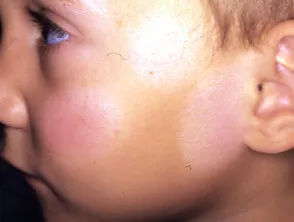
Investigations: Wood’s lamp does not enhance the lesions; fungal scrapings are negative (helps exclude tinea versicolor).
Management: emollients; mild steroid (hydrocortisone 1% twice daily for 1 week) if needed.