Hair Loss & Alopecia
Written 29th February 2020 - Last Update 27th August 2026
Hair Loss & Alopecia
Androgenetic alopecia
The most common form of hair loss; age-related, genetically determined, and androgen-dependent. In women it is generally not driven by raised androgen levels, but by end-organ hypersensitivity — more common in conditions associated with androgen excess (PCOS, androgen-secreting tumours).
Prevalence: 30% of men by age 30, 50% by age 50, 80% by age 70; 60% of women by age 70.
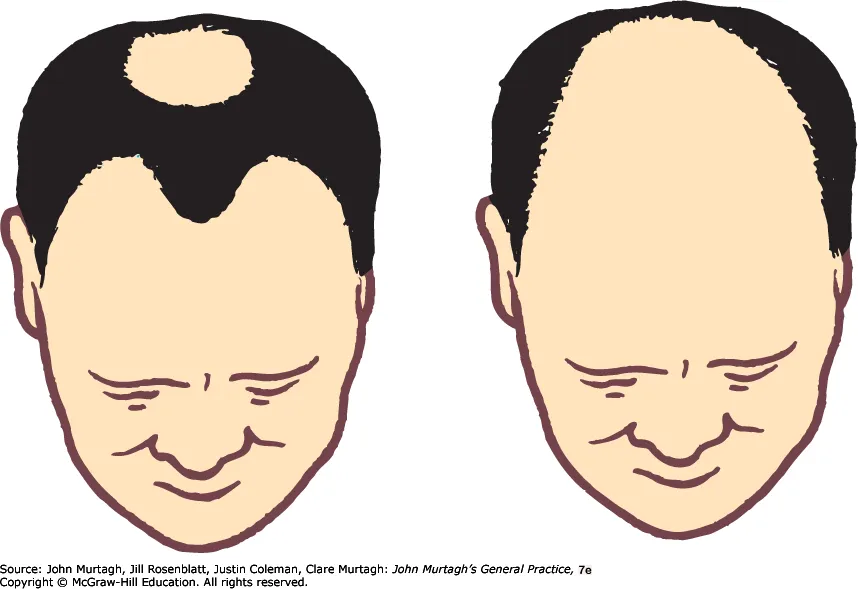
History: in men, the typical pattern is loss from the fronto-temporal regions and the crown; in women, typically diffuse thinning with loss over the crown.
Management: most treatments take 2–6 months to show effect, and need to be continued for years (or indefinitely) to sustain benefit.
- Men — topical minoxidil 5%, 1mL applied daily for at least 6–12 months (to assess efficacy); apply to areas of hair loss, taking care on the forehead/temples (hypertrichosis risk); expect a small amount of early hair shedding at 4–6 weeks. Oral finasteride 1mg daily for a minimum of 2 years — carries a risk of sexual dysfunction (erectile dysfunction, decreased libido, rare gynaecomastia); psychological adverse effects and suicidality have also been reported — warn patients and monitor mood. Finasteride roughly halves serum PSA — account for this when interpreting PSA results in men on treatment (see Prostate Cancer & PSA Screening) — and should be avoided in men trying to conceive given a signal for reduced fertility. Visible effect isn’t immediate — minoxidil takes 3–6 months, oral finasteride/spironolactone 6–12 months, so counsel on adherence before response is judged. Finasteride is suitable as monotherapy for mild-moderate disease, or combined with topical minoxidil (the recommended combination for severe disease). Dutasteride and oral minoxidil are dermatologist-prescribed second-line options. The psychological burden of androgenic alopecia is often underestimated — ask about mood/self-esteem impact alongside treatment discussions.
- Women — topical minoxidil as above. Spironolactone 50–100mg orally, increasing up to 200mg daily if no benefit after 6 months — do not use in pregnancy (risk to a male foetus); adverse effects include irregular menstrual bleeding, breast lumpiness/tenderness, and hyperkalaemia. Combined therapy can be used.
Alopecia areata
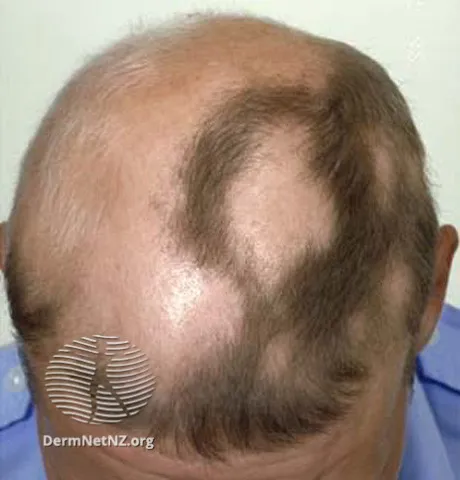
An autoimmune disorder presenting in the first two decades of life with patchy hair loss. Prognosis is worse with young age of onset (<5 years) and widespread hair loss. Alopecia totalis (total scalp hair loss) affects 5% of alopecia areata cases; alopecia universalis (total body hair loss) affects 1%.
Demographics: onset in the first two decades of life (starts in childhood in 50%, before age 40 in 80%); family history in 20%; lifetime risk 1–2%.
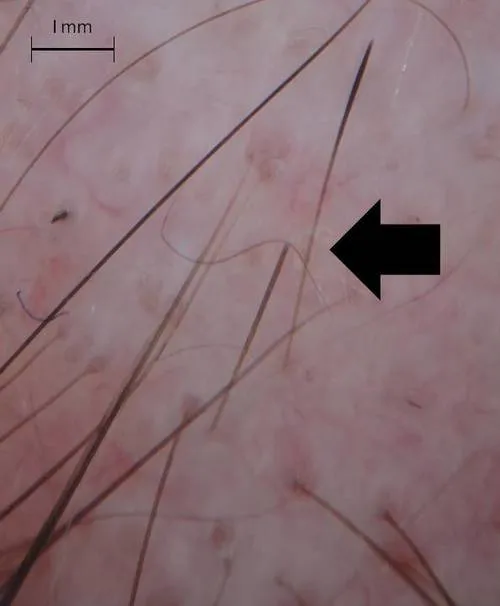
Classic triad: complete hair loss + clean scalp + exclamation-mark hairs.
History: complete hair loss, which may be patchy or diffuse; pigmented hairs are lost first; the course of hair loss and regrowth is unpredictable, but may relapse and remit.
Examination: exclamation-mark hairs — thicker at the top, tapering thinner and paler toward the base. Bald patches are smooth, normal skin devoid of hair.
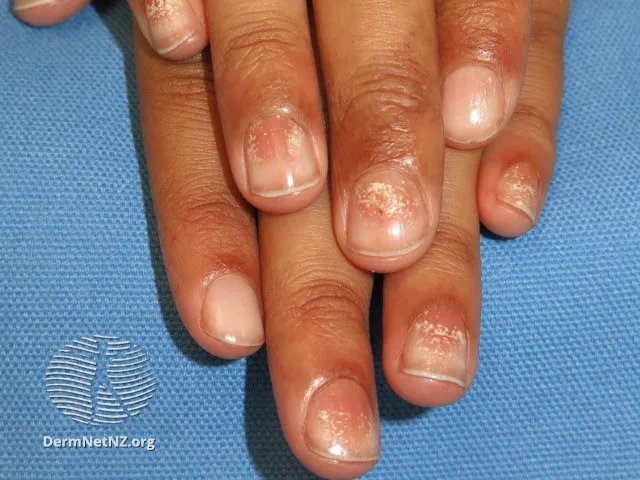
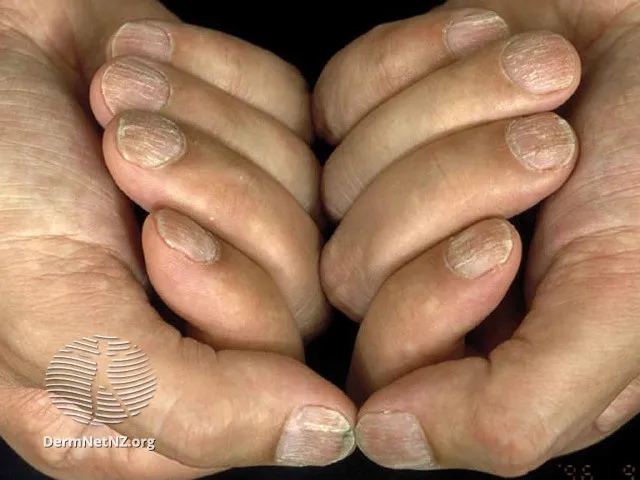
Nail changes: occur in 10–50% of people with alopecia areata; pitting and ridging are the most common findings, though many other nail changes can occur.
Investigations: skin biopsy can be used but is rarely needed.
Prognosis: may be temporary or persistent. Worse the more hair affected and the younger the age of onset; other poor prognostic indicators include extensive disease at presentation, an ophiasis pattern (band-like loss at the posterior scalp margin), family history, atopy, and nail changes. Chance of spontaneous regrowth within 12 months is up to 80% for a single patch of recent onset, but many patients relapse. Treatment is not indicated if the patch is inactive and regrowth is already visible. Ask about mood/psychosocial impact throughout — hair loss is often under-recognised as distressing; the Australian Alopecia Areata Foundation (AAAF) provides patient support and wig subsidies.
Management — limited hair loss of recent onset: potent/very potent topical steroid for 3–4 months (betamethasone dipropionate 0.05% or mometasone furoate 0.1% lotion, once or twice daily). If not responding after 3–4 months, consider intralesional steroid injections (e.g. triamcinolone 5mg/mL every 6–8 weeks — can cause headache/skin atrophy), or refer to dermatology for diphencyprone (DCP) immunotherapy, oral minoxidil, or immunosuppression.
Management — extensive hair loss: refer promptly to dermatology (particularly if rapid-onset) for DCP immunotherapy, oral corticosteroids, immunosuppression, or — for moderate-to-severe/refractory disease — a JAK inhibitor (see the guideline-update note below: baricitinib TGA-approved 2023, ritlecitinib TGA-approved 2024, neither yet PBS-listed).
Acute telogen effluvium
Occurs about 3 months after a stressful triggering event, as hairs enter telogen rest en masse, then fall out a few months later. Patients often describe hair falling out in clumps. Triggers include childbirth, major surgery, acute severe illness, crash dieting, sudden weight loss, starting a new drug, and starting/stopping the OCP. If the trigger is identified, no treatment is needed — hair regrows and should resolve within 6–9 months.
Chronic telogen effluvium
Excessive hair shedding lasting more than 9 months (corrected from 6 — see guideline update below). Scalp sensitivity, burning, and itching can occur, as in the acute form. Hair density over the vertex isn’t reduced (no widening part line, unlike androgenetic alopecia, though the two commonly overlap). Lasts a few years before resolving spontaneously; typically affects a woman aged 30–50 with long hair.
Causes: idiopathic (most cases); malnutrition (iron deficiency, hypoproteinaemia, severe zinc deficiency); severe infections; connective tissue disorders; malignancy.
Hair loss is rarely the only presenting feature of the causes above, so investigate as clinically indicated rather than routinely — possible tests include FBC, UEC, TSH, LFTs, ANA; zinc/iron/B12/folate/vitamin D are not evidence-based (nutritional deficiencies rarely cause hair loss), though iron studies are a reasonable exception to check.
Management: first-line is reassurance and correcting any identified trigger while awaiting spontaneous resolution — drug therapy isn’t usually needed. If motivated, topical minoxidil can hasten regrowth. Iron supplementation reduces shedding in iron-deficient patients — there’s specific evidence for this; nutritional/collagen supplements are not recommended in the absence of a documented deficiency, and routine trace-element testing (zinc, folate, B12, vitamin D) is not evidence-based.
Trichotillomania
Psychogenic hair pulling. Common in pre-school-age children and early adolescents — in children it usually settles with time and parental reassurance/help to curb the habit. In adults there is usually an underlying psychopathology (e.g. OCD) requiring psychiatric treatment. Hair can be pulled from any region, but commonly the side of the scalp.
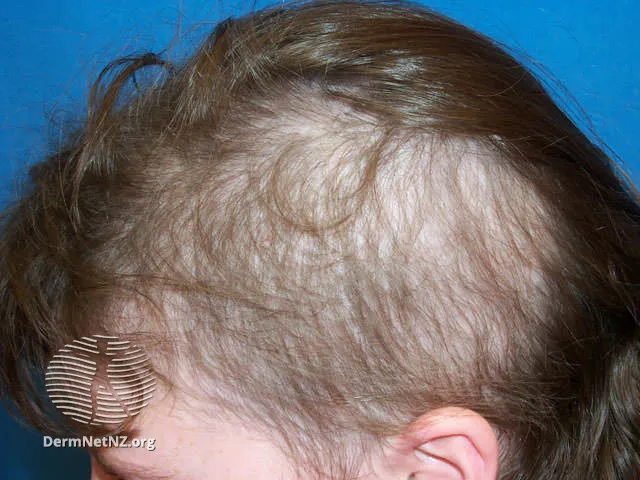
Scarring alopecia
Many conditions (e.g. chronic discoid lupus, lichen planopilaris, frontal fibrosing alopecia) cause scarring alopecia, due to inflammation in the dermis and subcutaneous tissues. Difficult to treat, and generally unresponsive once scarring has occurred. Scalp biopsy isn’t always required for diagnosis; if needed, it should be done by a dermatologist given the technical difficulty of scalp sampling and complex clinicopathological correlation.
Refer early for expert opinion and treatment; in the interim, prescribe potent topical steroids as for limited recent-onset alopecia areata. Specialist treatment includes intralesional corticosteroids, hydroxychloroquine, retinoids, and immunosuppression.
Other causes of alopecia
- Injury.
- Localised infection — bacterial, kerion, shingles.
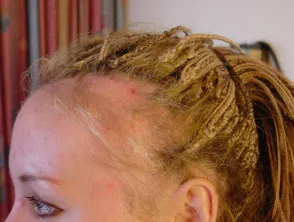
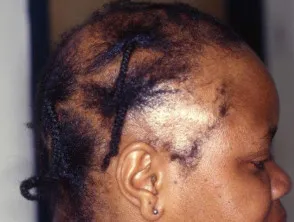
- Traction alopecia — tight curls or drawing hair back into a bun, usually frontal; can result from cornrows.