Psychosis
Written 21st May 2020 - Last Update 28th August 2026
Psychosis — an Approach
Red flags: on first presentation, exclude an organic cause and identify any underlying medical condition needing immediate management (see Organic Psychosis). Patients presenting a risk to themselves, others, or their reputation need immediate specialist intervention, including consideration of an involuntary (scheduled) assessment.
Background
Psychosis is a severe disturbance of thinking and perception in which a person “loses touch with reality.” Features can include:
- Disordered thought — strange or irrelevant thinking, thought insertion, thought broadcasting, thought withdrawal, delusions of control.
- Hallucinations — a sensory perception (seeing, hearing, feeling, or smelling) without an appropriate stimulus.
- Delusions — a false, fixed, irrational belief, firmly held and not shared by others of the same cultural background — persecutory, grandiose, or somatic themes are common.
- Difficulty interacting with others.
Psychosis may be a one-off episode, or part of an ongoing illness such as schizophrenia, bipolar disorder, or depression.
Assessment
History: onset and nature of the problem; current presentation; precipitating and perpetuating factors; impact on work, relationships, and physical function (appetite, sleep, sexual drive); previous episodes (dates, treatments, outcomes).
Risk assessment:
- Risk to self — a suicide plan, intent, and means; previous attempts; command hallucinations; depression; living alone/level of support; uncontrolled substance use; family/friend suicide; impulsivity.
- Risk to others — aggression/violence secondary to delusions or hallucinations (specifically ask about command hallucinations); a history of aggression/violence; risk of direct or indirect harm (e.g. neglect) to children/dependents.
- Risk to reputation — behaviour detrimental to the person’s wellbeing or markedly out of character.
Psychotic symptoms:
- Cognitive — impaired planning, reduced mental flexibility, impaired memory, impaired insight.
- Negative — lack of energy/motivation, social withdrawal, poor self-care, blunted affect, reduced speech output.
- Positive — thought disorder, hallucinations, delusions.
Also take a social history (recent major life events/stressors, substance misuse) and medication history, and consider an underlying mood disorder (depression, bipolar disorder, hypomania). Examine for underlying physical illness, perform a cognitive assessment, and seek a collateral/collaborative history where possible.
Management
Assess whether the patient is acutely unwell and needs inpatient referral/assessment — negotiate voluntary presentation with the patient and family/friends where possible, and consider the need for an involuntary (scheduled) assessment if the person is significantly mentally unwell and there are reasonable grounds to believe care/treatment/control is necessary for their own or others’ protection from serious harm.
Before starting an antipsychotic, obtain baseline investigations: urine drug screen and microscopy; bloods (FBC, ESR, fasting glucose, UEC, calcium/magnesium/ phosphate, LFTs, TSH, lipids); BMI; and further investigations as indicated by history (CT brain, EEG, MRI, anti-NMDAR/anti-GAD/anti-VGKC antibodies).
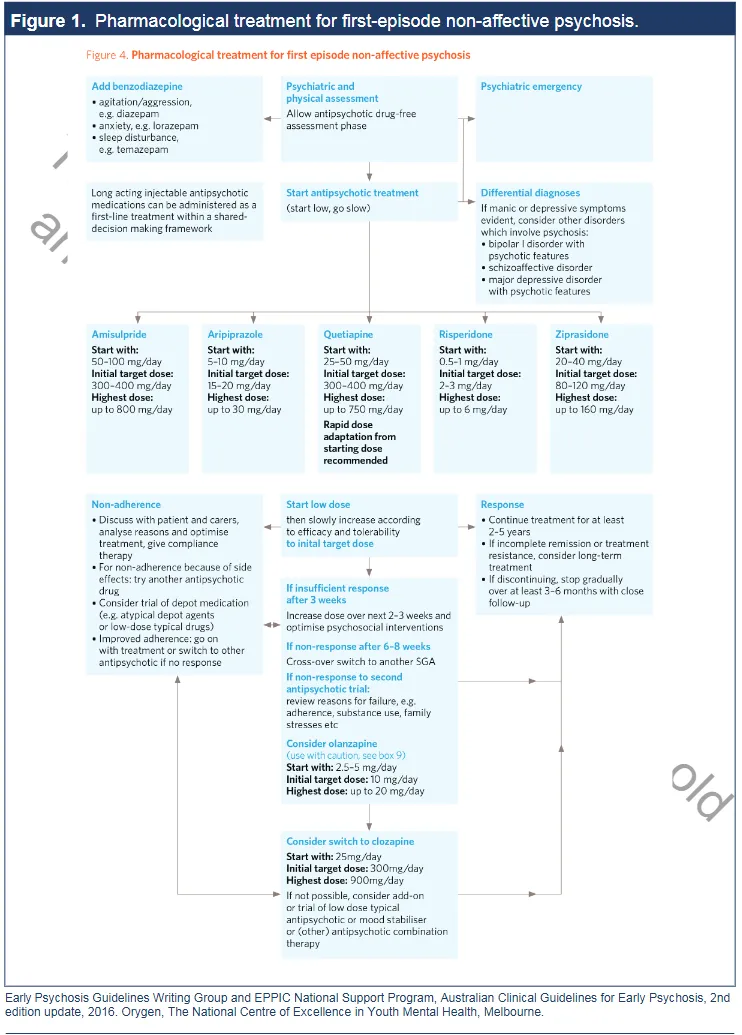
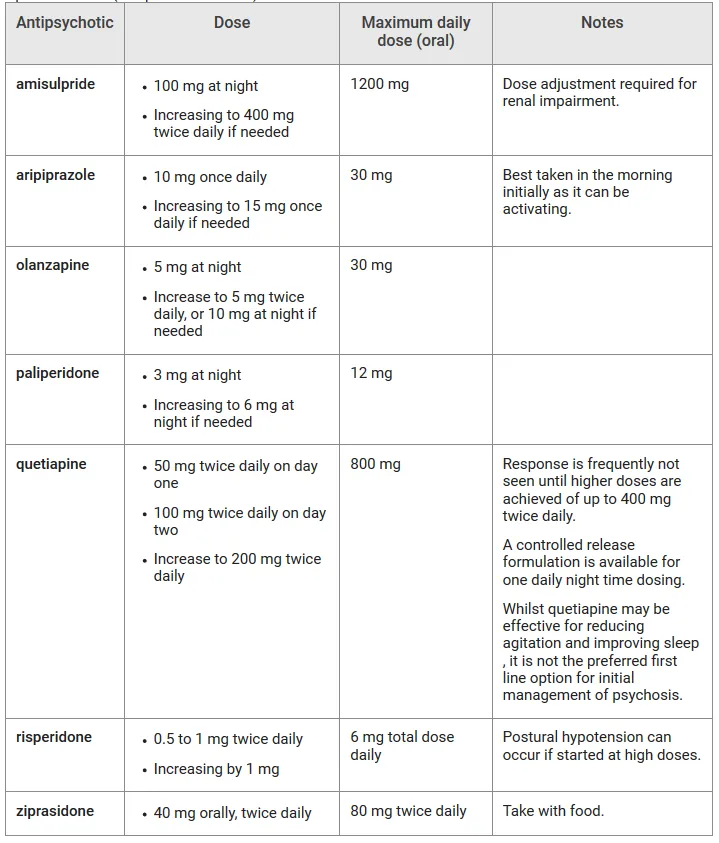
Start a low-dose oral atypical (second-generation) antipsychotic for first-episode
psychosis. Review at 1–2 weeks: if there’s a partial/incomplete response, increase
the dose; if no response, reassess the diagnosis and consider contributing factors
(substance use, non-adherence) before switching to a different atypical
antipsychotic. Dose increases are usually made in 2–3 steps, holding each new dose
for 1–3 weeks, tailored to tolerability. Positive symptoms may take several weeks to
respond fully.
Follow-up: reassess suicide/self-harm/harm-to-others/reputation risk at every contact. Monitor for comorbid depression, metabolic syndrome, movement disorders, and medication adherence.
Long-term management: watch for early warning signs of relapse, and encourage the patient to develop and follow a wellness plan. Refer to a community psychiatrist and/or psychologist as needed.
related disorders (2016, formally retired but still citable) (registry: ranzcp-schizophrenia-2016; verified 2026-07-11)