Familial Hypercholesterolaemia
Written 29th February 2020 - Last Update 18th April 2020
Familial Hypercholesterolaemia
Autosomal dominant — the most common and most serious genetic disorder of lipid metabolism, causing severely elevated blood cholesterol and accelerated, premature atherosclerotic cardiovascular disease.
Demographics
- eTG: >1 in 250 people; heterozygous FH (HeFH) 1 in 300–500; homozygous FH ~1 in 1 million.
- ~50% of first-degree relatives of an affected person are also affected.
- Higher prevalence in Afrikaner, Christian Lebanese, South African Ashkenazi Jewish, Tunisian, and French Canadian populations.
History and examination
Family history of premature heart disease, high cholesterol, or stroke in first-degree relatives; personal history of the same; angina or claudication symptoms.
Examine for xanthoma — Achilles tendon, extensor tendons of the hands, eyelids (palpebral xanthelasma), and corneal arcus.
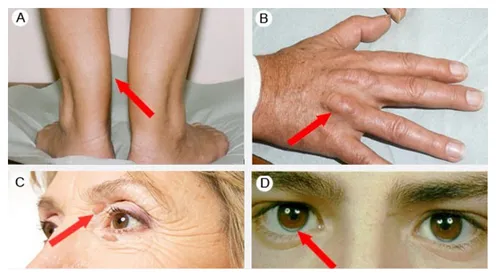
Cardiovascular exam (BP, pulse, JVP, carotid bruits, murmurs) and a renal artery bruit check; bedside random BSL and urine dipstick for protein.
Investigations
Fasting lipid profile — suspect FH when LDL-C >5 mmol/L. Homozygous and severe heterozygous FH typically show LDL-C >13 mmol/L untreated (>8 mmol/L treated).
Dutch Lipid Clinic Network Score (DLCNS) — the Australian standard for a clinical diagnosis, based on family history, personal history/examination findings (xanthoma, corneal arcus), and LDL-C level:
| Stratification | Total score |
|---|---|
| Definite FH | >8 |
| Probable FH | 6–8 |
| Possible FH | 3–5 |
| Unlikely FH | <3 |
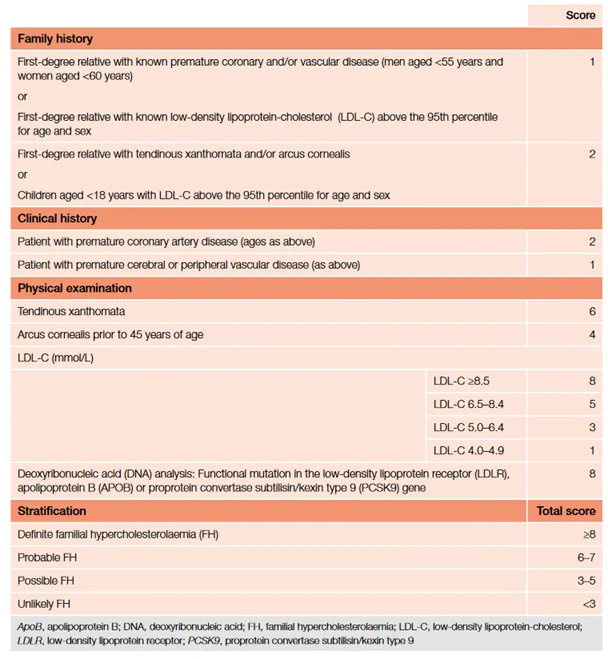
A confirmed functional mutation in LDLR, APOB, or PCSK9 on genetic testing scores 8 points on its own (equivalent to “definite” FH by phenotype alone). Genetic testing isn’t essential for diagnosis or management in general practice — it’s typically arranged by a specialist, and adds value mainly for cascade testing of relatives once a proband is identified.
Other investigations: ECG (ischaemic change, old infarct/Q waves); TSH, UEC, urine albumin/creatinine ratio, fasting glucose, and HbA1c to exclude secondary causes of hypercholesterolaemia (hypothyroidism, diabetes, nephrotic syndrome, corticosteroid use).
Management
Lifestyle: low-cholesterol diet, smoking cessation, regular physical activity and weight management, limited alcohol.
Lipid-lowering therapy — statin ± ezetimibe, targeting:
- LDL-C <2.5 mmol/L if no established CVD, aiming for at least a 50% reduction from baseline.
- LDL-C <1.4 mmol/L, with ≥50% reduction from baseline, if there’s established CVD — this matches the tightened general post-ACS target (2025 NHFA/CSANZ ACS guideline), a significant reduction from the older <1.8 mmol/L target.
- If targets aren’t met on maximally tolerated statin + ezetimibe, add a PCSK9 inhibitor (evolocumab or alirocumab; inclisiran is a third, TGA-approved option) — PBS-subsidised since December 2022 for LDL-C >1.8 mmol/L on maximal tolerated therapy, a much lower access threshold than previously.
Follow-up: recheck lipids ~6 weeks after starting/changing therapy to confirm response, then regularly (e.g. annually) once stable. Refer for specialist care (cardiologist, clinical geneticist, or lipid specialist) — particularly for homozygous FH, treatment-resistant cases, or where genetic testing/specialist-level cascade screening coordination is needed.
Cascade screening is the most effective way to detect FH before cardiovascular symptoms develop. Once a case is confirmed, systematically contact all available first-degree relatives, notify them of their risk, and offer screening (clinical history, lipid profile, and/or DNA testing where a familial mutation is known) — around half of first-degree relatives will also be affected. Early treatment improves outcomes, so children and adolescents should also be screened. Dedicated cascade-screening/FH clinical services exist in Australia for referral.